Description
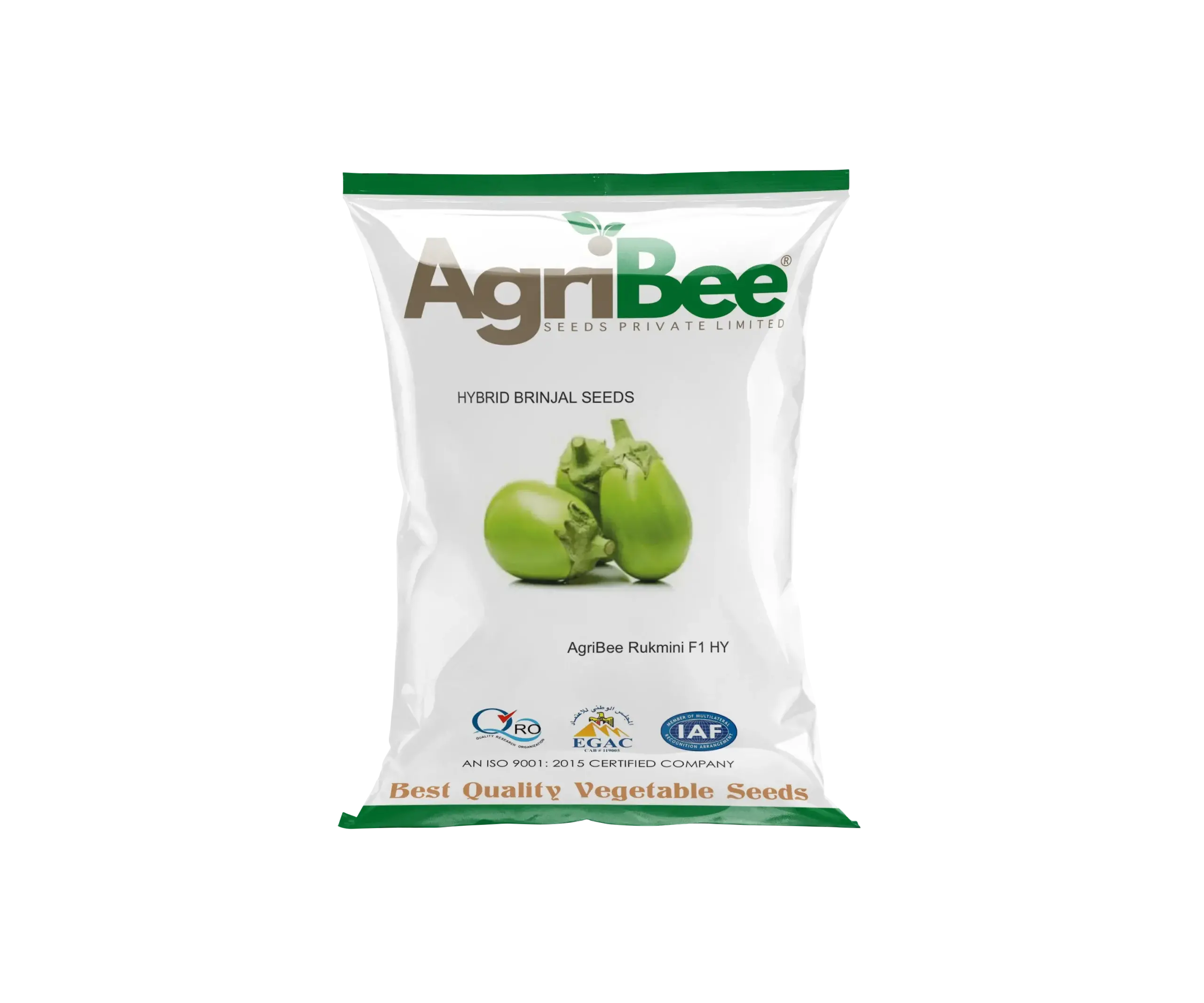
Farming & Cultivation Guide — Brinjal Seeds AgriBee Rukmini F1 HY
Complete step-by-step agronomic guide for optimal crop management, disease resistance, and premium produce quality.
🌾 Soil Preparation & Field Prep
Proper land preparation ensures uniform seedling emergence and robust root anchorage.
🌱 Ideal Soil Type & pH
Well-drained loamy or sandy-loam soils with a pH range of 5.5–7.0. Brinjal thrives best in deep, fertile soils rich in organic matter with good moisture retention capacity.
✨ Core Advantage
Loamy soil structure ensures rapid seedling establishment, strong root penetration, and optimal nutrient availability throughout the vegetative and reproductive phases.
- 1
Deep summer ploughing to a depth of 25–30 cm followed by 2–3 cross-harrowings for fine tilth and weed control.
- 2
Field leveling and creation of proper drainage channels to prevent waterlogging during monsoon periods.
- 3
Incorporation of 8–10 tonnes per acre of well-decomposed FYM or compost during the final harrowing for soil conditioning.
- 4
Soil testing and pH correction using gypsum (for alkaline soils) or sulfur (for acidic soils) to maintain the ideal 5.5–7.0 range.
🌱 Sowing Time & Method
Precise seed rate and spacing maximize light interception and canopy development.
| Parameter | Recommendation | Agronomic Importance |
|---|---|---|
| Sowing Window | June–July for Kharif; Oct–Nov for Rabi; Feb–Mar for Summer (protected cultivation) | Aligns sowing with favorable temperature and moisture conditions for optimal germination and seedling vigor. |
| Seed Rate | 250–300 g per Acre (Transplanted method) | Ensures adequate plant population while minimizing seed cost through efficient nursery utilization. |
| Spacing | 60 cm × 60 cm (Row-to-row × Plant-to-plant) | Provides balanced canopy spread, improves airflow, reduces humidity-related diseases, and facilitates field operations. |
| Sowing / Transplanting Depth | 0.5–1.0 cm for direct sowing; 2–3 weeks old seedlings for transplanting | Optimal depth ensures uniform emergence without burying the cotyledons too deeply, promoting healthy seedling development. |
💧 Irrigation & Water Management
Adequate moisture regulation supports strong vegetative and reproductive growth.
☀️ Water Requirement Profile
Brinjal requires moderate and regular irrigation throughout its growth cycle. The crop is moderately drought-sensitive, particularly during flowering and fruit development stages. Drip irrigation is highly recommended as it conserves water, delivers precise moisture, and reduces foliar disease incidence by keeping foliage dry.
🌦️ Soil Moisture Management
Under rainfed conditions, ensure initial soil moisture is adequate at transplanting. Mulching with straw or polythene helps retain soil moisture and suppress weeds. Avoid waterlogging at any stage, as brinjal roots are highly susceptible to root rot in stagnant conditions.
- ✓
First Irrigation: Apply immediately after transplanting (day 0) to settle the soil around roots and reduce transpiration stress. This establishes uniform stand.
- ✓
Vegetative Phase: Light and frequent irrigation every 3–4 days during active leaf and stem growth (2–6 weeks after transplanting). Maintain consistent soil moisture for vigorous canopy development.
- ✓
Critical Growth Stage: Increase irrigation frequency during flowering and early fruit set (4–8 weeks after transplanting). Water stress at this stage causes flower drop and poor fruit development.
- ✓
Pre-Harvest: Reduce irrigation slightly 5–7 days before peak harvesting to improve fruit firmness and extend post-harvest shelf life.
🧪 Fertilizer & Nutrition Management
Balanced crop nutrition supports robust plant structure and premium produce quality.
| Nutrient | Recommended Dose (per Acre) | Application Method & Timing |
|---|---|---|
| Nitrogen (N) | 80–100 kg/acre | 50% basal at transplanting; remaining 50% split into two equal top-dressings at 30 DAT and 60 DAT for sustained vegetative and reproductive growth. |
| Phosphorus (P2O5) | 50–60 kg/acre | 100% basal application mixed with FYM and incorporated during final land preparation. Promotes root development and flowering. |
| Potash (K2O) | 40–50 kg/acre | 50% at basal; 50% at first top-dressing. Enhances fruit quality, firmness, color development, and overall plant vigor. |
🌿 Interculture & Weed Management
Timely weed control ensures optimal nutrient and moisture availability for crop seedlings.
-
1
First Weeding & Hoeing: Carried out 15–20 days after transplanting (DAT) to eliminate early weed competition. Shallow hoeing avoids root damage. A weed-free crop during the first month is critical for strong initial growth and uniform stand establishment.
-
2
Second Weeding & Earthing-Up: Performed at 30–35 DAT to control second flush of weeds and build up soil around the plant base. Earthing-up provides stability to branches bearing developing fruits and improves root zone aeration.
-
3
Special Interculture Operation: Apply organic mulch (straw/paddy husk) at 3–4 tonnes/acre after second weeding to conserve moisture, suppress weeds, and moderate soil temperature. Practice de-suckering by removing side shoots from axils below the first fruit-bearing node to direct energy toward main stem and fruit development. Staking with bamboo or support nets is recommended for plants with heavy fruit loads.
🛡️ Pest & Disease Management
Proactive crop monitoring and integrated management ensure healthy crop development.
🐛 Insect Pest Management
- Fruit and Shoot Borer (FSB) — Leucinodes orbonalis: larvae bore into fruits and tender shoots causing wilting, borer holes with frass exudation, and fruit rot. Control: Install pheromone traps at 10/acre. Spray chlorantraniliprole 0.3 ml/L or spinosad 0.05 ml/L at 7-day intervals during peak flight (monitor with pheromone trap). Remove and destroy infested fruits/shoots manually.
- Brinjal Shot Hole Borer — Conotrachelus nasutus: adult beetles cause shot-hole damage on leaves; larvae bore into stems and fruits. Control: Hand-pick and destroy adult beetles in the morning. Spray neem-based biopesticide (neem oil 3 ml/L) or cartap hydrochloride 0.1% at 10-day intervals. Practice crop rotation with non-Solanaceous crops.
- Whitefly — Bemisia tabaci: causes yellowing, curling, and sooty mold on leaves; vectors leaf curl virus. Control: Install yellow sticky traps at 15/acre. Spray imidacloprid 0.3 ml/L or thiamethoxam 0.1 g/L. Intercrop with marigold or cowpea as repellent border plants. Maintain field hygiene by removing infected plants promptly.
🔬 Disease Control
- Bacterial Wilt — Ralstonia solanacearum: sudden wilting of one side of the plant, vascular browning on stem cross-section, bacterial ooze from cut stems. Prevention: Use resistant/rootstock management. Soil solarization before sowing. drench plot with streptocycline 0.2 g/10L water + copper oxychloride 0.3% at planting. Remove and burn infected plants. Rotate with non-host crops for 2–3 seasons.
- Phytophthora Blight — Phytophthora capsici: water-soaked lesions on stems and fruits, white sporangia on undersides of leaves, wilting and dieback in humid conditions. Control: Spray metalaxyl + mancozeb (3 g/L) or copper hydroxide (2 g/L) at 7-day intervals starting at fruit initiation. Ensure proper drainage and avoid overhead irrigation. Remove and destroy severely infected plant parts.
- Antrachnose /fruit spot — Colletotrichum acutatum: circular dark brown spots on fruits with concentric rings, leaf spots, and fruit rot under humid weather. Control: spray mancozeb 0.2% or carbendazim 0.1% at 10-day intervals. Practice adequate spacing for air circulation. Avoid wetting foliage during irrigation. Apply copper-based fungicide as protective preventive measure during monsoon.
✂️ Harvesting & Produce Quality Guide
Harvesting at peak maturity ensures maximum commercial grade and long keeping quality.
⏱️ Harvesting Schedule & Timing
First picking begins 60–65 days after transplanting. Subsequent pickings are taken at 5–7 day intervals depending on fruit growth rate and market demand. Continuous harvesting encourages further flowering and fruit setting, maintaining plant productivity over an extended harvest window.
⭐ Produce Quality Characteristics
Fruits exhibit attractive purple/black/green gloss, firm and smooth skin texture with no spines on calyx. Interior flesh is dense with minimal seeding, offering a rich, mildly sweet flavor preferred in Indian culinary preparations. The non-spiny green calyx adds to visual appeal.
| Quality Parameter | Agronomic Standard | Farmer & Market Benefit |
|---|---|---|
| First Harvest Stage | 60–65 Days after Transplanting | Ensures early market entry when prices are typically favorable due to limited supply in the market. |
| Harvest Maturity Signs | Skin glossy and firm; fruit reaches marketable size (100–250 gm); seeds not yet hardened; calyx bright green and turgid | Prevents over-maturity which leads to bitter taste, hard seeds, and market rejection. |
| Shelf Life & Keeping Quality | 7–10 days under ambient conditions; up to 14–18 days under cool storage at 10–12°C with 85–90% relative humidity | Excellent post-harvest keeping quality enables transportation to distant markets and reduces post-harvest losses significantly. |
| Market Suitability | Fresh table market, wholesale mandis, and premium retail outlets. Suitable for local and regional trade across India. | Attractive appearance, uniform fruit size, and spiny-free calyx make this variety highly preferred by traders and consumers alike, fetching competitive market rates. |
⭐ Varietal Features — Brinjal Seeds AgriBee Rukmini F1 HY
Distinguishing characteristics that make this variety a top choice for Indian growers.
🌿 Core Variety Highlight
AgriBee Rukmini F1 HY is a high-performing hybrid developed for Indian growing conditions, combining robust field vigor with consistent fruit production across diverse agro-climatic zones.
🌿 Produce Quality & Appearance
Produces oval to oblong to round fruits with a striking glossy purple/black to green skin. Non-spiny green calyx enhances shelf appeal. Firm flesh with minimal seeds and excellent flavor profile meet premium market standards.
🌿 Stress & Disease Tolerance
Demonstrates strong tolerance to major brinjal diseases including bacterial wilt and phytophthora blight, along with reasonable resilience to whitefly and shoot borer pressures under integrated management.
🌿 Growth Habit & Vigor
Compact to semi-compact plant architecture with vigorous branching habit. Uniform plant type ensures ease of field management, efficient spacing utilization, and consistent fruit exposure for even development.
🌿 Crop Duration & Earliness
Early maturity with first harvest commencing 60–65 days after transplanting, enabling faster crop turnover, multiple cropping opportunities, and earlier realization of returns for farmers.
🌿 Market & Farmer Preference
Uniform fruit size (100–250 gm), attractive coloration, non-spiny calyx, and reliable field performance make AgriBee Rukmini F1 HY a trusted choice among progressive farmers, commission agents, and wholesale traders across India.