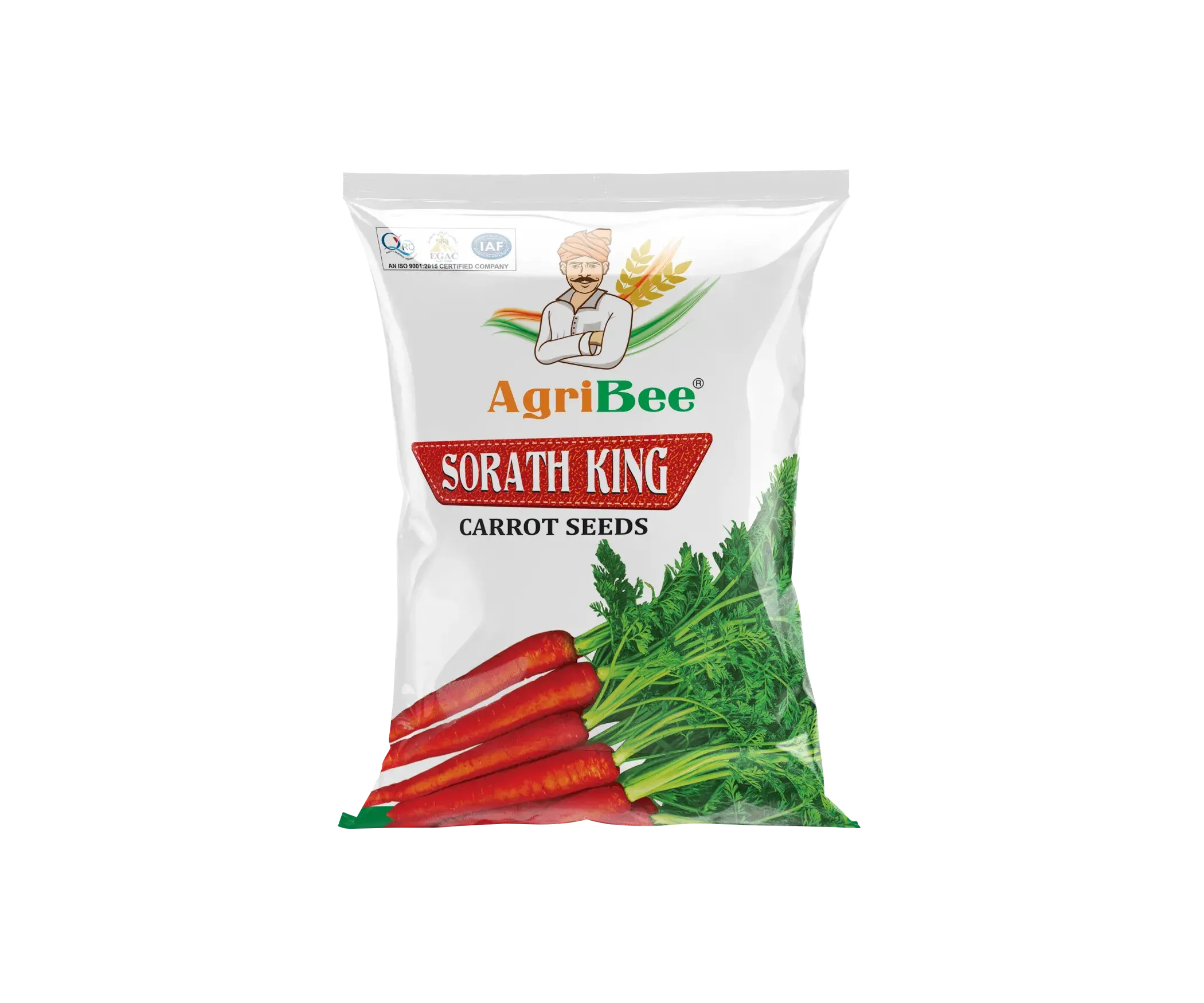
Description
Farming & Cultivation Guide — Carrot SorathKing
Complete step-by-step agronomic guide for optimal crop management, disease resistance, and premium produce quality.
🌾 Soil Preparation & Field Prep
Proper land preparation ensures uniform seedling emergence and robust root anchorage.
🌱 Ideal Soil Type & pH
Deep, well-drained sandy loam or loamy soils with pH range of 6.0–7.5. Free from waterlogging and compacted layers that restrict root penetration.
✨ Core Advantage
Loose, stone-free seedbed ensures straight, unbranched taproot development and uniform elongation of the 20–25 cm cylindrical root.
- 1
Deep summer ploughing to 25–30 cm followed by 3–4 cross-harrowings for fine, crumbly tilth free of clods.
- 2
Field leveling using laser leveling equipment for uniform water distribution and consistent root growth.
- 3
Incorporation of 15–20 tons/ha well-decomposed FYM or vermicompost during final harrowing to improve soil structure and root development.
- 4
Soil health conditioning: apply gypsum at 250 kg/ha in saline-affected areas and maintain pH near neutral for optimum nutrient availability.
🌱 Sowing Time & Method
Precise seed rate and spacing maximize light interception and canopy development.
| Parameter | Recommendation | Agronomic Importance |
|---|---|---|
| Sowing Window | October – November (Rabi) and February – March (Summer) across Gujarat, Maharashtra, Rajasthan, and MP | Cool to warm temperatures during root development ensure deep orange coloration, sweetness, and cylindrical shape without branching or splitting. |
| Seed Rate | 6–8 kg per hectare (2.5–3 kg per acre) for line sowing on raised beds | Optimal plant population prevents overcrowding and allows unrestricted taproot elongation to 20–25 cm. |
| Spacing | 30–35 cm row-to-row × 8–10 cm plant-to-plant | Adequate spacing supports foliage spread, improves air circulation, and minimizes root contact for uniform carrot development. |
| Sowing Depth | 1.0–1.5 cm depth only; seeds must not be buried beyond 2 cm | Carrot seeds are tiny and photoblastic; shallow sowing ensures rapid and uniform germination within 10–14 days. |
💧 Irrigation & Water Management
Adequate moisture regulation supports strong vegetative and reproductive growth.
☀️ Water Requirement Profile
Carrot SorathKing requires consistent soil moisture throughout its growth cycle but exhibits moderate drought resilience once established. Drip irrigation is highly recommended for water efficiency and uniform root development. The crop demands approximately 450–550 mm of total water over the 80–90 day period.
🌦️ Soil Moisture Management
In rainfed conditions, adopt mulching with dry straw to conserve moisture and prevent soil crusting. Avoid waterlogging at any stage as it causes root rot and forked or split carrots. Apply light irrigations at 8–10 day intervals during dry spells.
- ✓
First irrigation immediately after sowing to activate germination; keep seedzone consistently moist for 10–14 days until emergence.
- ✓
Vegetative phase (30–60 DAS): irrigate at 8–10 day intervals depending on soil type; sandy soils require more frequent light watering.
- ✓
Critical root expansion stage (50–80 DAS): maintain even soil moisture to prevent root cracking and ensure deep orange color development.
- ✓
Withhold irrigation 7–10 days before harvest to improve skin set, reduce field losses, and enhance shelf life during transport.
🧪 Fertilizer & Nutrition Management
Balanced crop nutrition supports robust plant structure and premium produce quality.
| Nutrient | Recommended Dose (per Acre) | Application Method & Timing |
|---|---|---|
| Nitrogen (N) | 60–80 kg/ha (24–32 kg/acre) as Urea | 50% basal at sowing; remaining 50% as top-dressing at 30 DAS for foliage vigor and photosynthetic support. |
| Phosphorus (P2O5) | 40–50 kg/ha (16–20 kg/acre) as DAP or SSP | 100% basal application at sowing mixed thoroughly in the seedzone for root development and energy transfer. |
| Potash (K2O) | 40–50 kg/ha (16–20 kg/acre) as MOP | 100% basal application; potassium enhances root color intensity, firmness, sweetness, and disease resistance. |
🌿 Interculture & Weed Management
Timely weed control ensures optimal nutrient and moisture availability for crop seedlings.
-
1
Thinning and First Weeding: Perform thinning at 15–20 DAS to maintain 8–10 cm plant spacing. Conduct first shallow hoeing simultaneously to remove weed competition during the most vulnerable early growth phase.
-
2
Second Weeding and Earthing-Up: At 35–40 DAS, conduct second weeding and gently earth up soil around exposed root shoulders to prevent greening and promote straight root growth.
-
3
Mulching and Inter-row Cultivation: Apply straw or black polyethylene mulch at 25 DAS to conserve moisture, suppress weeds, and maintain soil temperature. Light inter-row hoeing at 45 DAS improves aeration around the root zone.
🛡️ Pest & Disease Management
Proactive crop monitoring and integrated management ensure healthy crop development.
🐛 Insect Pest Management
- Carrot Cane Fly (Psila rosae): Symptoms include yellowing and wilting of leaflets with tunneling visible in roots. Control: Apply imidacloprid 17.8% SL @ 0.3 ml/L or thiamethoxam 25% WG @ 0.2 g/L as seed treatment before sowing. For adult fly suppression, spray chlorpyriphos 20% EC @ 2.5 ml/L at 30 DAS as a soil drench around the crop base.
- Carrot Leaf Miner (Napomyza gymnostoma): Characters include whitish serpentine mines on leaves and reduced photosynthetic capacity. Control: Install yellow sticky traps @ 10/acre for monitoring. Spray spinosad 45% SC @ 0.5 ml/L or carbaryl 50% WP @ 1.0 g/L at first sign of infestation. Remove and destroy infested leaves promptly.
- Aphids (Megoura carotae): Colonies on undersurface of leaves cause curling, stunting, and sooty mold development. Control: Treat seeds with clothianidin 48% FS @ 10 ml/kg seed. Spray imidacloprid 70% WS @ 0.3 g/L or thiacloprid 21.7% SC @ 0.5 ml/L when aphid density exceeds 10 per leaf.
🔬 Disease Control
- Cercospora Leaf Spot (Cercospora carotae): Small circular purple-brown spots with gray centers on older leaves; severe infection defoliates the crop. Control: Apply mancozeb 75% WP @ 2.0 g/L or chlorothalonil 50% WP @ 2.0 g/L at 45 DAS and repeat at 15-day intervals. Ensure good field drainage and avoid overhead irrigation to reduce leaf wetness.
- Powdery Mildew (Erysiphe heraclei): White powdery growth on leaves and petioles reduces photosynthetic efficiency and root quality. Control: Spray sulfur 80% WP @ 3.0 g/L or myclobutanil 10% SE @ 0.5 ml/L at first appearance. Rotate with non-host crops and maintain adequate spacing for canopy ventilation.
- Soft Rot (Erwinia carotovora): Water-soaked, foul-smelling soft decay of roots starting from tips; commonly follows insect damage or mechanical injury. Control: Practice crop rotation with non-brassicaceous crops for 2–3 seasons. Seed treat with streptocycline 50% WP @ 0.5 g/L. Avoid overhead irrigation and ensure excellent field drainage to prevent wound-mediated infection.
✂️ Harvesting & Produce Quality Guide
Harvesting at peak maturity ensures maximum commercial grade and long keeping quality.
⏱️ Harvesting Schedule & Timing
harvest begins at 80–90 days after sowing when roots reach full length (20–25 cm) and deep orange-red coloration. Gently pull or dig roots avoiding mechanical damage. Harvest fully during early morning hours for optimal firmness and turgor.
⭐ Produce Quality Characteristics
Roots exhibit deep orange-red pigmentation, very sweet flavor with crunchy texture, smooth skin, and minimal core size. Cylindrical shape with tapered tip ensures premium market grading and consumer appeal.
| Quality Parameter | Agronomic Standard | Farmer & Market Benefit |
|---|---|---|
| Harvest Stage | 80–90 Days after Sowing | Ensures peak sweetness, firmness, and deep color development for early market advantage and premium pricing. |
| Harvest Maturity Signs | Root shoulders visible above soil, deep orange-red color, 20–25 cm length, firm texture on gentle squeeze | Prevents over-maturity which leads to woody cores, root splitting, and reduced shelf life. |
| Shelf Life & Keeping Quality | 7–10 days under ambient conditions (15–20°C); up to 21 days under refrigerated storage (0–2°C, 90–95% RH) | Excellent post-harvest durability enables long-distance market supply and extended sales window without quality degradation. |
| Market Suitability | Fresh table market, wholesale mandis, retail supermarkets, and export-grade packing | Superior color, straight cylindrical shape, and very sweet crunchy taste command premium rates from traders and processors across India. |
⭐ Varietal Features — Carrot SorathKing
Distinguishing characteristics that make this variety a top choice for Indian growers.
🌿 Core Variety Highlight
Carrot SorathKing is an AgriBee-developed hybrid tailored for Indian growing conditions, delivering exceptional root color, sweetness, and vigorous foliage with strong field performance across Rabi and Summer seasons.
🌿 Produce Quality & Appearance
Deep orange-red roots measuring 20–25 cm in length with perfectly cylindrical shape, smooth skin, very sweet flavor, and crunchy texture that meets premium retail and export standards.
🌿 Stress & Disease Tolerance
Demonstrates strong field tolerance to Cercospora leaf spot and moderate resistance to soft rot and powdery mildew under recommended agronomic practices, ensuring consistent foliage health throughout the crop cycle.
🌿 Growth Habit & Vigor
Upright, bushy foliage with high photosynthetic efficiency provides robust canopy cover, suppresses weed growth naturally, and channels maximum assimilates toward root enlargement and pigmentation.
🌿 Crop Duration & Earliness
Matures in 80–90 days after sowing, enabling flexible crop rotation planning, early market entry, and multiple cropping opportunities within a single agricultural year.
🌿 Market & Farmer Preference
Trusted by progressive farmers across Gujarat, Maharashtra, Rajasthan, and Madhya Pradesh for reliable germination, uniform root grading, outstanding shelf life, and consistent consumer demand commanding premium mandi prices.