Description
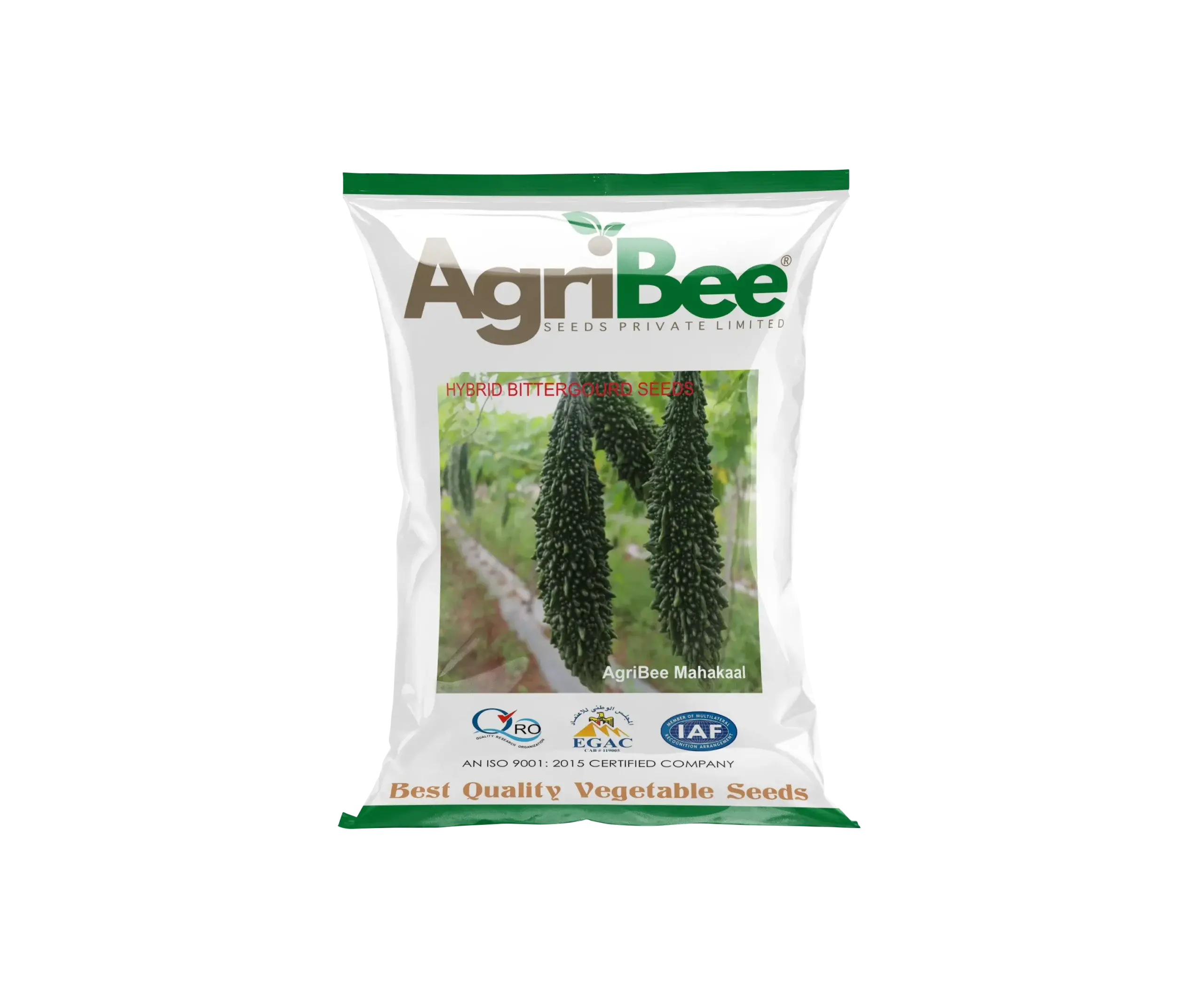
Farming & Cultivation Guide — Bitter Gourd Seeds AgriBee Mahakaal
Complete step-by-step agronomic guide for optimal crop management, disease resistance, and premium produce quality.
🌾 Soil Preparation & Field Prep
Proper land preparation ensures uniform seedling emergence and robust root anchorage.
🌱 Ideal Soil Type & pH
Well-drained sandy loam to loamy soils with good organic matter. pH range: 6.0 to 7.5.
✨ Core Advantage
Firm yet loose tilth ensures rapid seed germination, robust root establishment, and strong anchor for vining growth.
- 1
Deep summer ploughing to 25–30 cm followed by 2–3 cross-harrowings for fine, clod-free tilth.
- 2
Field leveling and preparation of raised beds or ridges to ensure excellent drainage.
- 3
Incorporate 15–20 tons/acre of well-decomposed FYM or compost during final harrowing.
- 4
Apply sulfur (if needed) to adjust high pH soils, targeting a stable neutral range.
🌱 Sowing Time & Method
Precise seed rate and spacing maximize light interception and canopy development.
| Parameter | Recommendation | Agronomic Importance |
|---|---|---|
| Sowing Window | Kharif onset, Summer post-last frost, Rabi late Oct–Nov | Ensures warm soil temperatures for optimal germination and avoids waterlogging. |
| Seed Rate | 300–400 g/acre (transplanted) | 600–800 g/acre (direct) | Maintains correct population density for vigorous vine coverage. |
| Spacing | Row-to-row: 90–120 cm | Plant-to-plant: 45–60 cm | Provides sufficient canopy space, aeration, and light penetration for fruit development. |
| Sowing Depth | 2–3 cm (2 seeds/hole) | Promotes uniform germination and prevents damping-off. |
💧 Irrigation & Water Management
Adequate moisture regulation supports strong vegetative and reproductive growth.
☀️ Water Requirement Profile
Moderate water requirement. Drought tolerance is limited during flowering and fruit-setting stages. Drip irrigation is highly suitable and recommended to maintain consistent soil moisture and reduce foliar diseases.
🌦️ Soil Moisture Management
Ensure adequate soil moisture at sowing and during active fruit growth. Use mulching to conserve moisture in rainfed and summer conditions.
- ✓
First irrigation immediately after sowing/transplanting to ensure good stand establishment.
- ✓
Light and frequent irrigation during vegetative phase to promote vigorous vine growth.
- ✓
Critical: Maintain even moisture during flowering, fruit set, and fruit development; water stress causes flower drop and malformed fruits.
- ✓
Reduce irrigation frequency 5–7 days before final harvest to improve fruit firmness and shelf life.
🧪 Fertilizer & Nutrition Management
Balanced crop nutrition supports robust plant structure and premium produce quality.
| Nutrient | Recommended Dose (per Acre) | Application Method & Timing |
|---|---|---|
| Nitrogen (N) | 40–50 kg/acre | 50% basal + 2 split top-dressings at 20 DAS and 40 DAS |
| Phosphorus (P2O5) | 30 kg/acre | 100% basal application with FYM during last harrowing |
| Potash (K2O) | 20 kg/acre | 50% basal + 50% at 30 DAS for fruit quality and stalk strength |
🌿 Interculture & Weed Management
Timely weed control ensures optimal nutrient and moisture availability for crop seedlings.
-
1
First Weeding & Hoeing: At 15 DAS: Shallow inter-row weeding and hoeing to control early weeds and aerate soil.
-
2
Second Weeding & Earthing-Up: At 30 DAS: Second weeding and gentle earthing-up around base to support vines and improve root zone aeration.
-
3
Special Interculture Operation: Apply straw mulch between rows to conserve moisture, suppress weeds, and keep fruits clean. Train main vines on trellis and pinch secondary laterals after 6–8 leaves for better fruit exposure.
🛡️ Pest & Disease Management
Proactive crop monitoring and integrated management ensure healthy crop development.
🐛 Insect Pest Management
- Aphids: Suck sap from tender shoots and buds, causing curling and sooty mold. Spray Neem oil 3 ml/L or Imidacloprid 0.3 ml/L at first sighting. Repeat after 7 days if needed.
- Fruit Fly: Adults lay eggs in young fruits, causing larval damage and rotting. Use yellow sticky traps at 15/day/acre and spray with spinosad 0.2 ml/L or bait sprays. Remove and destroy infested fruits.
- Whitefly: Causes honeydew deposition and viral transmission. Use silver mulch film at sowing, introduce predatory beetles, and spray Acetamiprid 0.1 g/L or Neem-based formulations weekly during outbreaks.
🔬 Disease Control
- Powdery Mildew: White powdery growth on leaves leading to drying. Preventive spray of Sulphur 2 g/L or Wettable Sulphur 3 g/L every 10–12 days; avoid overhead irrigation.
- Downy Mildew: Yellow angular leaf spots with fuzzy grey sporulation underneath. Spray Mancozeb 2.5 g/L or Metalaxyl 0.5 g/L at first appearance; ensure good air circulation.
- Bacterial Wilt: Sudden wilting of vines while roots remain healthy. Manage via crop rotation, use of disease-free seeds, and soil drenching with Streptocycline 0.2 g/L or Copper oxychloride 3 g/L at transplanting.
✂️ Harvesting & Produce Quality Guide
Harvesting at peak maturity ensures maximum commercial grade and long keeping quality.
⏱️ Harvesting Schedule & Timing
First picking begins 50–55 days after sowing. Subsequent pickings at 3–4 day intervals depending on fruit growth and market demand.
⭐ Produce Quality Characteristics
Premium spindle-shaped, toothed, dark green fruits with firm texture, balanced bitterness, and excellent aroma. No hollowing or over-maturity issues.
| Quality Parameter | Agronomic Standard | Farmer & Market Benefit |
|---|---|---|
| First Harvest Stage | 50–55 Days after Sowing | Ensures peak quality and early market arrival, capturing better prices. |
| Harvest Maturity Signs | Dark green color, firm skin, 15–20 cm length, 80–120 g weight | Prevents over-maturity, seed hardening, and fruit deterioration. |
| Shelf Life & Keeping Quality | 3–5 days under cool, humid conditions; up to 7 days under controlled refrigeration | Facilitates long-distance transport and extended sales window. |
| Market Suitability | Fresh market, premium mandis, export, and processing units | Attracts premium rates due to uniform shape, vibrant color, and disease-resistant performance. |
⭐ Varietal Features — Bitter Gourd Seeds AgriBee Mahakaal
Distinguishing characteristics that make this variety a top choice for Indian growers.
🌿 Core Variety Highlight
Highly vigorous vine with strong field persistence and consistent fruit setting under diverse Indian growing conditions.
🌿 Produce Quality & Appearance
Distinctive spindle-shaped, toothed fruits with rich dark green color and firm, dense flesh—ideal for fresh and processed markets.
🌿 Stress & Disease Tolerance
Good tolerance to common foliar diseases and moderate drought stress when managed with proper irrigation and nutrition.
🌿 Growth Habit & Vigor
Compact branching habit with strong primary and secondary vine growth, enabling efficient trellis coverage and fruit exposure.
🌿 Crop Duration & Earliness
Early maturing (50–55 days) allowing multiple cropping cycles and flexible rotation planning.
🌿 Market & Farmer Preference
Farmers favor AgriBee Mahakaal for its reliable germination, uniform fruit traits, strong shelf life, and consistent market demand across regions.