Description
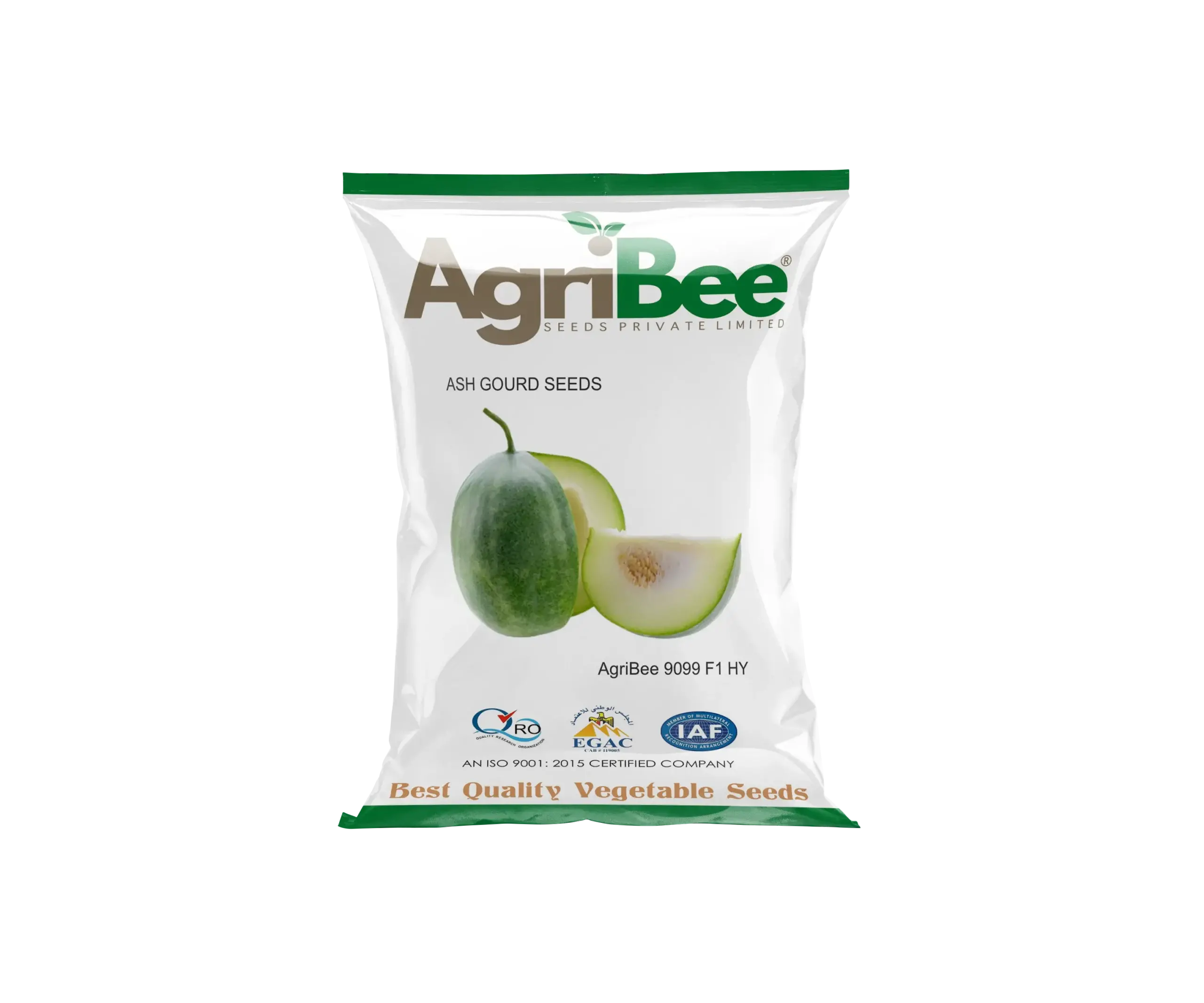
Farming & Cultivation Guide — Ash Gourd Seeds AgriBee 9099 F1 HY
Complete step-by-step agronomic guide for optimal crop management, disease resistance, and premium produce quality.
🌾 Soil Preparation & Field Prep
Proper land preparation ensures uniform seedling emergence and robust root anchorage.
🌱 Ideal Soil Type & pH
Well-drained sandy loam to loam soils with pH 6.0 – 7.5. Deep, fertile soils with good organic matter content support vigorous vine growth and large fruit development.
✨ Core Advantage
Deep, loose soil structure encourages extensive taproot penetration and promotes uniform waxy bloom development on maturing fruits.
- 1
Deep summer ploughing to 25–30 cm followed by 2–3 harrowings for fine tilth and weed seed burial.
- 2
Formation of raised beds (1.5 m wide) or broad furrows for superior drainage during heavy rainfall.
- 3
Incorporation of 8–10 t/ha well-decomposed FYM or compost during last ploughing for soil conditioning.
- 4
Application of sulphur or gypsum in acidic soils to maintain optimal nutrient availability.
🌱 Sowing Time & Method
Precise seed rate and spacing maximize light interception and canopy development.
| Parameter | Recommendation | Agronomic Importance |
|---|---|---|
| Sowing Window | June–July (Kharif), Oct–Nov (Rabi), Feb–March (Summer) | Aligns with favorable temperature and humidity for rapid germination and vine establishment. |
| Seed Rate | 3–4 kg/acre (line sowing) / 8–10 kg/acre (hill sowing) | Optimizes plant population while minimizing intra-crop competition for light and nutrients. |
| Spacing | Row-to-row: 1.5–2.0 m; Plant-to-plant: 0.8–1.0 m | Provides adequate canopy spread for photosynthesis and improves airflow to reduce disease pressure. |
| Sowing Depth | 2–3 cm in light soils; 3–4 cm in heavy soils | Ensures proper soil contact for consistent moisture uptake and uniform emergence. |
💧 Irrigation & Water Management
Adequate moisture regulation supports strong vegetative and reproductive growth.
☀️ Water Requirement Profile
Ash gourd has moderate water demand. Drip irrigation with micro-sprinklers is highly compatible and improves fruit uniformity. Avoid overhead watering during flowering to prevent pollen wash-off.
🌦️ Soil Moisture Management
Apply black plastic mulch or organic straw mulch to conserve soil moisture and suppress weeds. Ensure early-season soil moisture is adequate for root establishment.
- ✓
First irrigation at 5–7 days after sowing to ensure uniform germination.
- ✓
Light irrigation every 5–7 days during active vine growth to prevent water stress.
- ✓
Critical irrigation at flowering and fruit set stages; maintain consistent moisture to prevent fruit cracking.
- ✓
Reduce irrigation 7–10 days before harvest to enhance waxy bloom development and improve shelf life.
🧪 Fertilizer & Nutrition Management
Balanced crop nutrition supports robust plant structure and premium produce quality.
| Nutrient | Recommended Dose (per Acre) | Application Method & Timing |
|---|---|---|
| Nitrogen (N) | 80–100 kg/acre | 40% basal; 30% at 30 DAS; 30% at 60 DAS |
| Phosphorus (P2O5) | 50 kg/acre | 100% basal as DAP or SSP along with FYM |
| Potash (K2O) | 40–50 kg/acre | 100% basal as MOP; split top-dressing at fruit initiation for improved rind quality |
🌿 Interculture & Weed Management
Timely weed control ensures optimal nutrient and moisture availability for crop seedlings.
-
1
First Weeding & Hoeing: Carry out at 15 DAS using hand hoe or cultivator to remove early weed flush without damaging shallow roots.
-
2
Second Weeding & Earthing-Up: Perform at 30 DAS; mild earthing-up around vine bases stabilizes plants and encourages adventitious root formation.
-
3
Vine Training & Mulching: Train main vine on trellis or allow spreading on mulched surface. Remove excess suckers after 60 DAS to direct energy toward fruit development.
🛡️ Pest & Disease Management
Proactive crop monitoring and integrated management ensure healthy crop development.
🐛 Insect Pest Management
- Aphids / Whiteflies: Yellow curled leaves and sticky honeydew. Spray Imidacloprid 17.8% SL at 0.3 ml/L or Acetamiprid 20% SP at 0.5 g/L at 15-day intervals.
- Fruit Borer (Helicoverpa armigera): Boring holes in young fruits with frass accumulation. Apply pheromone traps at 10/acre; spray Chlorantraniliprole 18.5% SC at 0.3 ml/L or Bacillus thuringiensis at 2 g/L.
- Spider Mites: Reddening and webbing on leaf underside. Spray Hexythiazox 5% WP at 0.5 g/L or Abamectin 1.9% EC at 0.3 ml/L with stickers.
🔬 Disease Control
- Downy Mildew (Peronospora variabilis): Angular yellow lesions on upper leaf surface, gray sporulation below. Spray Mancozeb 75% WP at 2.5 g/L or Metalaxyl 35% WS at 1.0 g/L as preventive spray.
- Powdery Mildew (Erysiphe cichoracearum): White powdery spots on leaves and stems. Spray Sulphur 80% WP at 3.0 g/L or Myclobutanil 5% EC at 1.0 ml/L at 10-day intervals.
- Fruit Rot / Anthracnose (Colletotrichum orbiculare): Water-soaked lesions on fruits with pink sporulation in humid conditions. Spray Copper oxychloride 50% WP at 3.0 g/L or Trichoderma viride paste at 10 g/kg seed as soil drench.
✂️ Harvesting & Produce Quality Guide
Harvesting at peak maturity ensures maximum commercial grade and long keeping quality.
⏱️ Harvesting Schedule & Timing
First harvest at 90–100 days after sowing. Fruits are harvested individually as they reach full size and maturity. Allow 7–10 days between successive fruit maturations on the same vine.
⭐ Produce Quality Characteristics
Fruits exhibit thick, firm flesh with sweet, mild flavor. Waxy bloom provides natural protection against moisture loss and mechanical injury. Light green skin under wax indicates premium grade.
| Quality Parameter | Agronomic Standard | Farmer & Market Benefit |
|---|---|---|
| First Harvest Stage | 90–100 Days after Sowing | Ensures optimal fruit size and waxy coating development for market readiness. |
| Harvest Maturity Signs | Rind hardens, waxy bloom fully developed, peduncle dries slightly | Prevents over-softening and maintains firm texture for transport. |
| Shelf Life & Keeping Quality | 30–45 days at ambient conditions (25–30°C) | Extended market window with minimal spoilage due to thick rind and wax layer. |
| Market Suitability | Fresh market, wholesale mandis, and processing units | Uniform oblong shape and attractive color command premium prices in urban markets. |
⭐ Varietal Features — Ash Gourd Seeds AgriBee 9099 F1 HY
Distinguishing characteristics that make this variety a top choice for Indian growers.
🌿 Core Variety Highlight
AgriBee 9099 F1 HY combines vigorous seedling establishment with strong field performance, delivering uniform plant stands and balanced canopy architecture.
🌿 Produce Quality & Appearance
Produces oblong to cylindrical fruits with consistent light green color beneath a prominent waxy bloom, appealing to consumers and traders alike.
🌿 Stress & Disease Tolerance
Demonstrates reliable field tolerance to common downy and powdery mildews, along with moderate resilience to heat fluctuations during fruit development.
🌿 Growth Habit & Vigor
Semi-spreading vine habit with robust lateral branching, enabling efficient ground cover and improved fruit shading for uniform coloring.
🌿 Crop Duration & Earliness
Earliness of 90–100 days allows flexible scheduling in crop rotation systems and earlier market entry compared to conventional open-pollinated varieties.
🌿 Market & Farmer Preference
Farmers value this hybrid for its dependable germination, attractive fruit, and extended post-harvest shelf life, reducing marketing risks.