Description
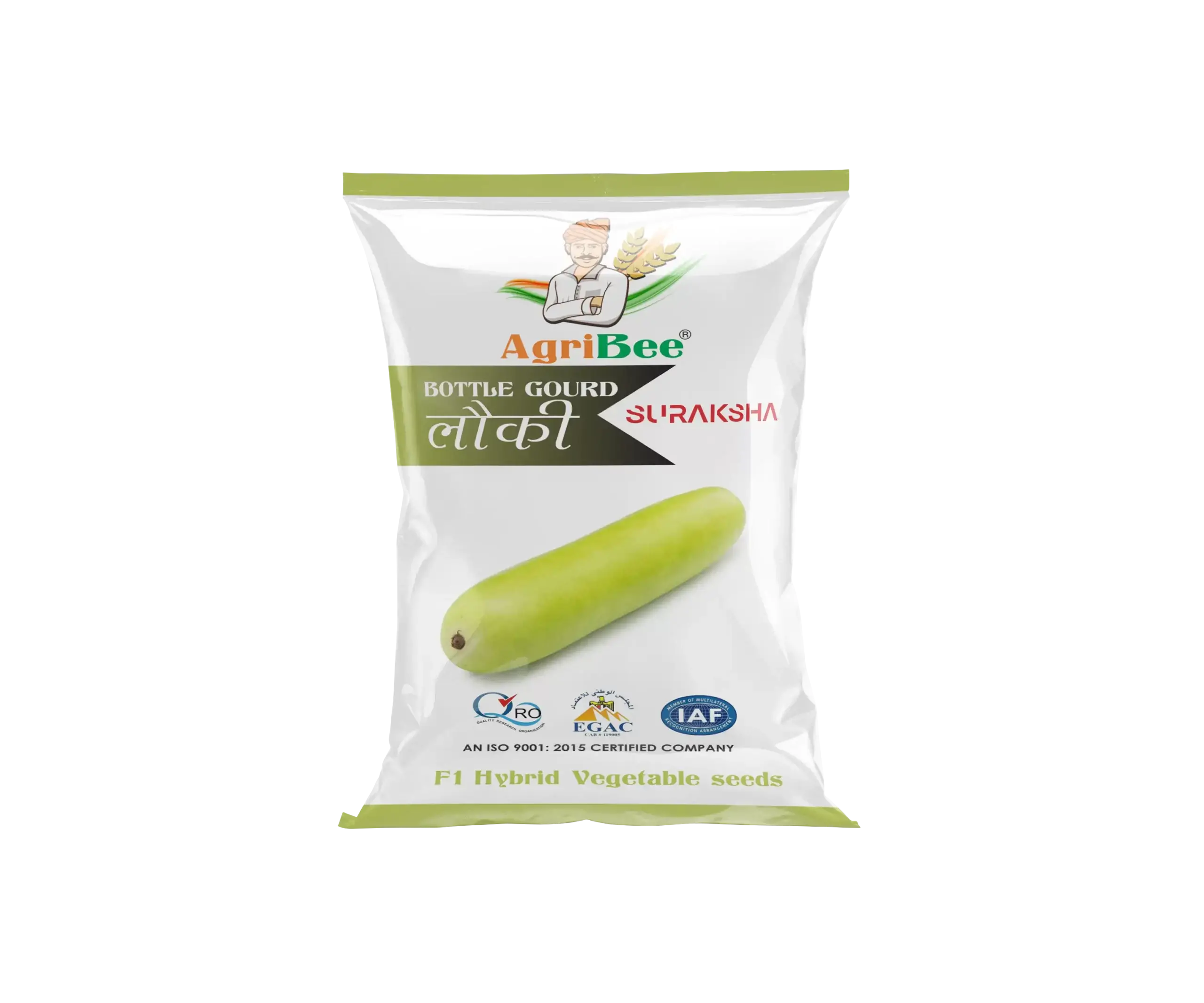
Farming & Cultivation Guide — BottleGourd Seeds – Suraksha
Complete step-by-step agronomic guide for optimal crop management, disease resistance, and premium produce quality.
🌾 Soil Preparation & Field Prep
Proper land preparation ensures uniform seedling emergence and robust root anchorage.
🌱 Ideal Soil Type & pH
Well-drained sandy loam to loamy soils with pH 6.0–7.5. Bottle gourd thrives in deep, fertile soils with good organic matter content and effective drainage to prevent waterlogging.
✨ Core Advantage
Loose, well-aerated seedbed promotes rapid germination, strong root development, and uniform seedling establishment under Indian climatic conditions.
- 1
Deep summer ploughing followed by 2–3 cross-harrowings to achieve fine tilth and kill perennial weeds.
- 2
Field leveling with laser or traditional method; prepare raised beds of 10–15 cm height in heavy soils for better drainage.
- 3
Incorporate 15–20 tonnes/ha of well-decomposed FYM or compost during last ploughing for soil structure improvement.
- 4
Conduct soil test and apply lime at 250–500 kg/ha if pH is below 5.5; maintain balanced soil nutrition for sustained crop vigor.
🌱 Sowing Time & Method
Precise seed rate and spacing maximize light interception and canopy development.
| Parameter | Recommendation | Agronomic Importance |
|---|---|---|
| Sowing Window | June–July (Kharif) and Oct–Nov (Rabi); Summer sowing in Feb–March in protected zones | Aligns with favorable temperature (25–30°C) and moisture for rapid germination and vine establishment |
| Seed Rate | 0.8–1.0 kg/acre (2.0 kg/ha); use 4–5 seeds per hill | Ensures optimal plant population and uniform canopy coverage without overcrowding |
| Spacing | 90–100 cm x 60–70 cm (Row-to-Row x Plant-to-Plant) | Provides adequate space for vine spread, leaf canopy development, and field operations |
| Sowing / Transplanting Depth | 2–3 cm depth; transplant seedlings at 2–3 true leaf stage (10–12 DAS) | Optimal depth ensures consistent emergence; shallow sowing in heavy soils prevents seed rot |
💧 Irrigation & Water Management
Adequate moisture regulation supports strong vegetative and reproductive growth.
☀️ Water Requirement Profile
Bottle gourd has moderate water demand with shallow fibrous root system. Under drip irrigation, apply 25–30 mm/week during active vegetative and fruiting phases. The crop is moderately sensitive to moisture stress, especially during flowering and young fruit development stages.
🌦️ Soil Moisture Management
In rainfed areas, sow at the onset of monsoon to capture residual soil moisture. Use mulching (straw or black polyethylene) to conserve soil moisture and suppress weeds. Avoid water stagnation around the crown to prevent root rot and collar diseases.
- ✓
First irrigation at 3–5 days after sowing/transplanting to establish root contact and promote uniform germination.
- ✓
Irrigate every 5–7 days during vigorous vine growth phase (20–40 DAS); maintain consistent soil moisture without waterlogging.
- ✓
Critical irrigation at flowering and fruit set stage (40–60 DAS); deficiency at this stage causes flower drop and poor fruit development.
- ✓
Reduce irrigation frequency 5–7 days before final harvest to improve fruit firmness and extend shelf life.
🧪 Fertilizer & Nutrition Management
Balanced crop nutrition supports robust plant structure and premium produce quality.
| Nutrient | Recommended Dose (per Acre) | Application Method & Timing |
|---|---|---|
| Nitrogen (N) | 40–50 kg/acre | 50% basal at last ploughing + 50% top-dressing at 25–30 DAS |
| Phosphorus (P2O5) | 25–30 kg/acre | 100% basal application with FYM during last ploughing |
| Potash (K2O) | 20–25 kg/acre | 50% basal + 50% split at 30 DAS for improved fruit quality and disease tolerance |
🌿 Interculture & Weed Management
Timely weed control ensures optimal nutrient and moisture availability for crop seedlings.
-
1
First Weeding & Hoeing: Carry out at 10–12 DAS using hand hoe or mechanical weeder. Early weed control is critical as bottle gourd seedlings are slow growers and highly competitive against weeds during the first 3 weeks.
-
2
Second Weeding & Earthing-Up: Perform at 25–30 DAS. Light earthing-up around the plant base supports vine anchorage and protects emerging lateral roots. Remove all volunteer weeds that harbor insect pests and fungal inoculum.
-
3
Trellising and Vine Training: Install trellis netting or bamboo frames at 45–60 cm height immediately after vine initiation (20–25 DAS). Train main vine vertically and remove side shoots (suckers) below first node to direct energy toward fruit production and improve airflow within the canopy.
🛡️ Pest & Disease Management
Proactive crop monitoring and integrated management ensure healthy crop development.
🐛 Insect Pest Management
- Aphids (Aphis gossypii): Sucking sap causing leaf curling, yellowing, and honeydew accumulation leading to sooty mould. Spray Imidacloprid 17.8% SL at 0.3 ml/L or Affimo 25% WG at 0.1 g/L. Alternatively, release ladybird beetles (Curculia spp.) at 5,000/acre as biological control.
- Fruit &Shoot Borer (Diaphania perspectalis): Larvae bore into tender shoots and fruits causing wilting and borer holes with frass excretion. Spray Chlorantraniliprole 18.4% SC at 0.2 ml/L or Bacillus thuringiensis (Bt) at 2.5 g/L. Remove and destroy infested shoots manually.
- Cucumber Beetle (Aulacophora foveicollis): Adults feed on leaves creating circular holes; larvae attack roots and stems. Spray Carbendazim 50% WP at 1.0 g/L combined with Quinalphos 25% EC at 1.0 ml/L. Install yellow sticky traps at 1 trap/10 m² for monitoring and reduction.
🔬 Disease Control
- Powdery Mildew (Erysiphe cichoracearum): White powdery growth on both leaf surfaces, leading to premature leaf drying and reduced photosynthetic area. Spray Sulphur 80% WP at 2.0 g/L or Myclobutanil 6.9% WG at 0.5 g/L at 7-day intervals. Remove heavily infected leaves to reduce inoculum spread.
- Downy Mildew (Pseudoperonospora cubensis): Angular yellow lesions on upper leaf surface with purple-grey sporulation on lower surface under humid conditions. Spray Metalaxyl 35% WS at 1.5 g/L or Mancozeb 75% WP at 2.0 g/L. Ensure proper spacing for canopy ventilation and avoid overhead irrigation.
- Fusarium Wilt (Fusarium oxysporum f. sp. lagenaria): Yellowing and wilting of one side of the plant; vascular browning on stem cross-section. Soil drench with Trichoderma viride at 10 g/plant or Pseudomonas fluorescens at 5 g/L. Practice 3-year crop rotation with non-cucurbit crops and use raised beds for drainage.
✂️ Harvesting & Produce Quality Guide
Harvesting at peak maturity ensures maximum commercial grade and long keeping quality.
⏱️ Harvesting Schedule & Timing
First picking at 55–60 days after sowing. Subsequent pickings at 5–7 day intervals over 4–6 weeks. Harvest when fruits reach marketable size of 850–1000 g with smooth, uniform light green skin.
⭐ Produce Quality Characteristics
Premium fruits exhibit cylindrical shape, smooth light green, firm texture, and mild sweet flavor. Fruits should be harvested before seed hardening to ensure tender, palatable flesh preferred in Indian culinary applications.
| Quality Parameter | Agronomic Standard | Farmer & Market Benefit |
|---|---|---|
| First Harvest Stage | 55–60 Days after Sowing | Early market arrival commands premium prices and enables quick crop turnover for successive planting |
| Harvest Maturity Signs | Light green color, firm skin, 15–20 cm length, cylindrical shape without seed indentation | Prevents over-maturity that leads to tough rind, bitter taste, and market rejection |
| Shelf Life & Keeping Quality | 5–7 days at ambient temperature (25–30°C); up to 10–12 days under cool storage (8–10°C) | Good post-harvest durability supports transportation to distant markets and retail distribution networks |
| Market Suitability | Fresh market, wholesale mandis, institutional supply, and processing units across India | Uniform size, attractive color, and disease-free appearance attract high demand from traders and modern retail chains |
⭐ Varietal Features — BottleGourd Seeds – Suraksha
Distinguishing characteristics that make this variety a top choice for Indian growers.
🌿 Core Variety Highlight
Suraksha is an early-maturing, high-vigor Bottle Gourd variety developed for Indian farmers seeking reliable field performance with consistent fruit set and strong disease tolerance profile.
🌿 Produce Quality & Appearance
Produces uniformly cylindrical, light green fruits weighing 850–1000 g with smooth skin, tender flesh, and excellent culinary texture preferred by consumers across Indian markets.
🌿 Stress & Disease Tolerance
Demonstrates good field tolerance to common cucurbit diseases including powdery mildew, downy mildew, and fusarium wilt, reducing dependency on prophylactic chemical interventions.
🌿 Growth Habit & Vigor
Vigorous vine growth with well-branched architecture; robust foliage canopy supports sustained photosynthetic activity and healthy fruit development under diverse growing conditions.
🌿 Crop Duration & Earliness
Early maturity with first picking at 55–60 days enables faster crop cycles, multiple harvest windows, and flexible integration into intensive cropping systems across Indian agro-climatic zones.
🌿 Market & Farmer Preference
Trusted by progressive farmers and seed dealers for its uniform fruiting, attractive produce quality, and dependable field performance, making it a preferred choice for both domestic and commercial cultivation.