Description
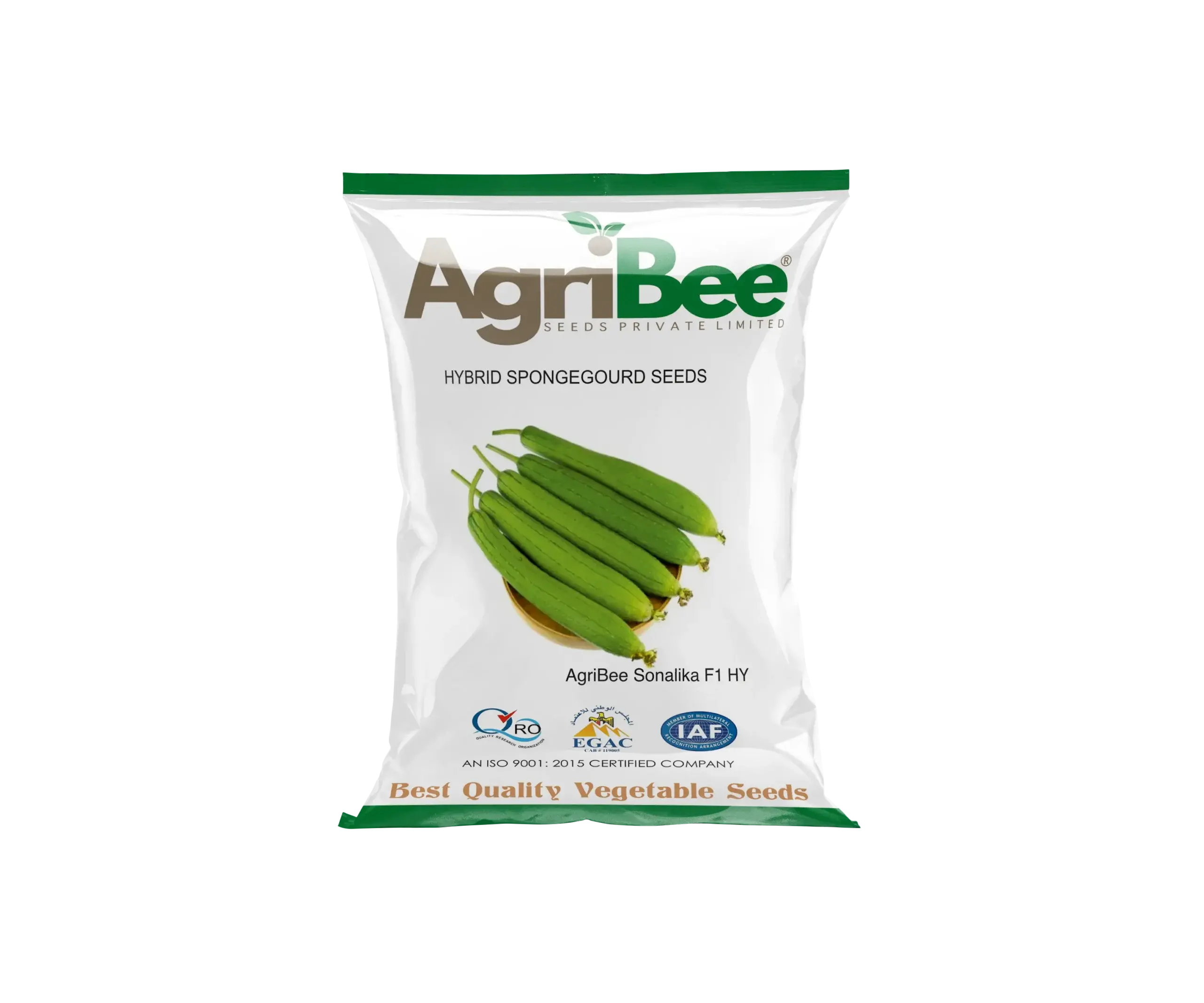
Farming & Cultivation Guide — Sponge Gourd Seeds – Sonalika
Complete step-by-step agronomic guide for optimal crop management, disease resistance, and premium produce quality.
🌾 Soil Preparation & Field Prep
Proper land preparation ensures uniform seedling emergence and robust root anchorage.
🌱 Ideal Soil Type & pH
Well-drained sandy loam to clay loam soils with pH 6.0–7.5. Heavy soils must be avoided due to poor drainage.
✨ Core Advantage
Loose, fertile soil ensures rapid seedling emergence and strong root development for vigorous vine spread.
- 1
Deep ploughing in early summer followed by 2–3 harrowings to obtain fine tilth.
- 2
Formation of raised beds or ridges (15 cm height) for superior drainage during monsoon.
- 3
Incorporation of 8–10 tonnes/acre well-decomposed FYM or compost during final ploughing.
- 4
Liming recommended if soil pH is below 5.5 to prevent soil-borne diseases.
🌱 Sowing Time & Method
Precise seed rate and spacing maximize light interception and canopy development.
| Parameter | Recommendation | Agronomic Importance |
|---|---|---|
| Sowing Window | Onset of monsoon (early June) in most regions; February–March in South India | Warm temperatures and adequate moisture ensure uniform germination and avoid frost damage |
| Seed Rate | 2–3 kg per Acre | Ensures optimal plant population while accounting for seed viability and germination variability |
| Spacing | 90–100 cm x 60 cm (Row-to-row x Plant-to-plant) | Provides adequate canopy space, aeration, and sunlight penetration for healthy foliage |
| Sowing Depth | 2–3 cm (1 inch) | Shallow depth prevents damping-off and promotes rapid seedling emergence |
💧 Irrigation & Water Management
Adequate moisture regulation supports strong vegetative and reproductive growth.
☀️ Water Requirement Profile
Moderate water demand; sponge gourd thrives in warm, humid conditions but is sensitive to waterlogging. Drip irrigation is highly recommended for consistent moisture and disease reduction.
🌦️ Soil Moisture Management
Ensure timely pre-sowing irrigation in dryland areas. Mulching with straw helps retain soil moisture and suppress weeds during early growth.
- ✓
First irrigation immediately after sowing to activate germination.
- ✓
Light and frequent irrigation during vegetative phase (every 5–7 days).
- ✓
Critical irrigation during flowering and fruit set stages; water stress leads to flower drop.
- ✓
Reduce irrigation frequency 7–10 days before harvest to improve fruit firmness and shelf life.
🧪 Fertilizer & Nutrition Management
Balanced crop nutrition supports robust plant structure and premium produce quality.
| Nutrient | Recommended Dose (per Acre) | Application Method & Timing |
|---|---|---|
| Nitrogen (N) | 40–50 kg/acre | 50% basal + 50% top-dressing at 20 DAS |
| Phosphorus (P2O5) | 25–30 kg/acre | 100% basal through DAP or SSP |
| Potash (K2O) | 20–25 kg/acre | 100% basal through MOP for fruit quality and disease resistance |
🌿 Interculture & Weed Management
Timely weed control ensures optimal nutrient and moisture availability for crop seedlings.
-
1
First Weeding & Hoeing: Perform at 15 DAS to remove early weeds and loosen soil for root aeration.
-
2
Second Weeding & Earthing-Up: Conduct at 30 DAS; earthing up supports vines and encourages adventitious root formation.
-
3
Vine Training & Staking: Install trellis or netting at 25–30 DAS to support vertical growth, improve air circulation, and reduce fruit rot.
🛡️ Pest & Disease Management
Proactive crop monitoring and integrated management ensure healthy crop development.
🐛 Insect Pest Management
- Aphids: Small green/black insects clustering on tender shoots and underside of leaves; cause curling and honeydew soot. Control: Imidacloprid 17.8% SL @ 0.3 ml/L or Neem-based biopesticide @ 5 ml/L.
- Fruit Borer: Larvae bore into young fruits causing holes and frass accumulation. Control: Chlorantraniliprole 18.5% SC @ 0.4 ml/L or Bt spray @ 2.5 g/L at first incidence.
- Whitefly: Sucking pests on lower leaf surface causing yellowing and viral transmission. Control: Cyantraniliprole 10.26% OR @ 0.6 ml/L or spinosad 45% SC @ 0.3 ml/L.
🔬 Disease Control
- Powdery Mildew: White powdery fungal growth on leaves leading to necrosis. Control: Propiconazole 25% EC @ 0.5 ml/L or sulfur dust @ 25 kg/acre.
- Downy Mildew: Yellow angular leaf spots with gray-purple sporulation underneath. Control: Mancozeb 75% WP @ 2.5 g/L or metalaxyl 35% WS @ 1.5 g/L.
- Fusarium Wilt: Wilting, yellowing, and vascular browning of stems. Control: Carbendazim 50% WP @ 1 g/L drench at base; practice crop rotation and use resistant varieties.
✂️ Harvesting & Produce Quality Guide
Harvesting at peak maturity ensures maximum commercial grade and long keeping quality.
⏱️ Harvesting Schedule & Timing
First harvest at 40–45 days after sowing; subsequent pickings every 2–3 days during peak production.
⭐ Produce Quality Characteristics
Cylindrical, smooth-skinned fruits with dark green color, firm texture, and tender flesh. Optimal market grade meets 35–40 cm length and 4–5 cm diameter.
| Quality Parameter | Agronomic Standard | Farmer & Market Benefit |
|---|---|---|
| First Harvest Stage | 40–45 Days after Sowing | Ensures peak tenderness and early market availability for premium pricing |
| Harvest Maturity Signs | Dark green glossy skin, firm yet tender feel, cylindrical shape fully formed | Prevents over-maturity that leads to fibrous, hard fruit unsuitable for fresh market |
| Shelf Life & Keeping Quality | 3–5 days under ambient conditions; up to 7–10 days in cool storage (10–12°C) | Facilitates transport to distant mandis and reduces post-harvest losses |
| Market Suitability | Fresh vegetable market, processing units, and niche export markets | Uniform appearance and high consumer appeal attract better rates from traders |
⭐ Varietal Features — Sponge Gourd Seeds – Sonalika
Distinguishing characteristics that make this variety a top choice for Indian growers.
🌿 Core Variety Highlight
Early maturing variety with uniform cylindrical fruits, ideal for Kharif and Summer seasons across India.
🌿 Produce Quality & Appearance
Smooth, dark green fruits with consistent size and shape; excellent consumer preference in fresh markets.
🌿 Stress & Disease Tolerance
Good tolerance to common viral and fungal diseases; adapts well to varying soil moisture conditions.
🌿 Growth Habit & Vigor
Vigorous vining habit with strong lateral branching; responds well to trellising and trained systems.
🌿 Crop Duration & Earliness
First harvest within 40–45 days, enabling multiple pickings and faster crop turnaround.
🌿 Market & Farmer Preference
Compact fruit size and attractive color make it a preferred choice among growers and traders seeking consistent supply.