Description
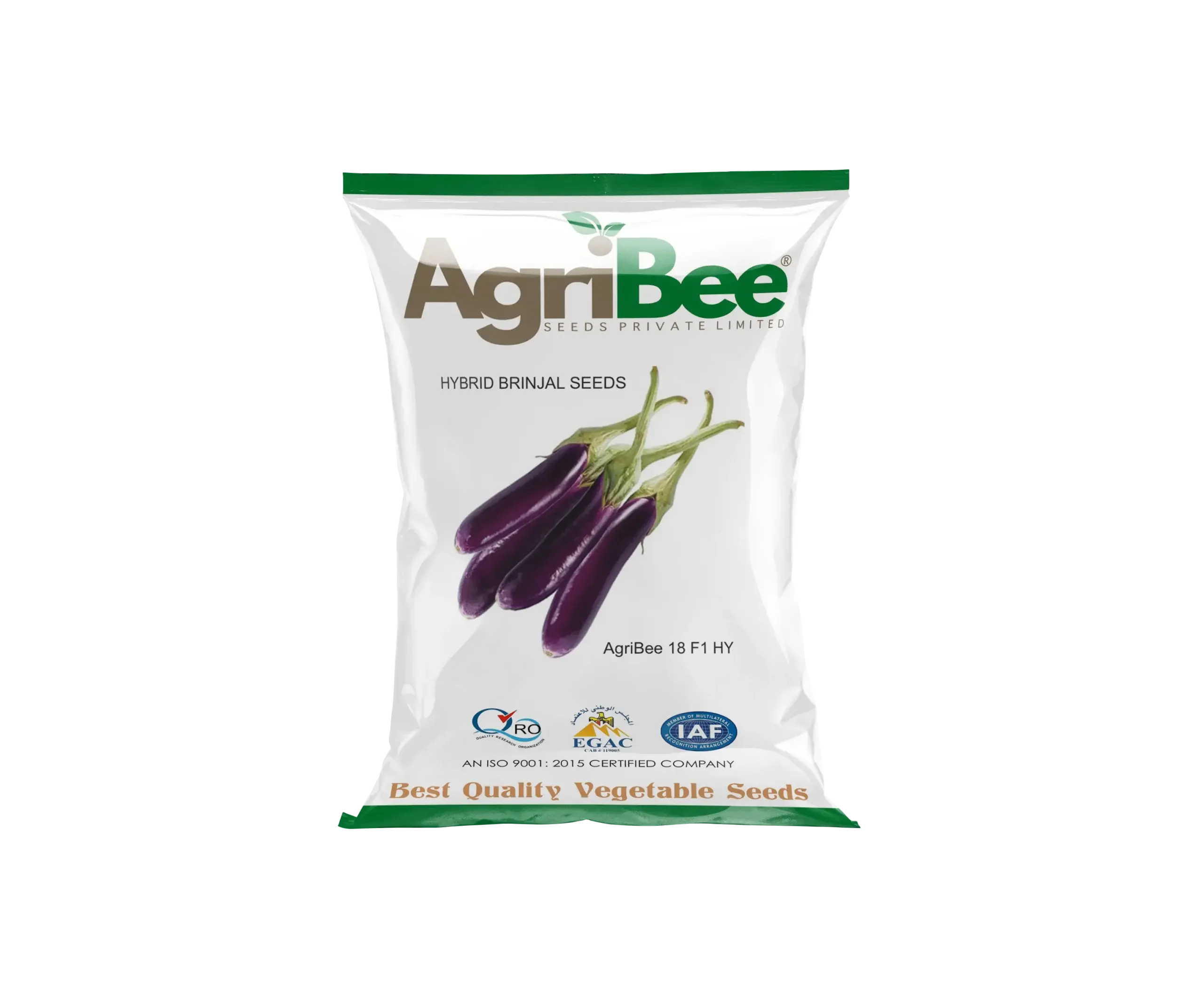
Farming & Cultivation Guide — Brinjal Seeds AgriBee 18 F1 HY
Complete step-by-step agronomic guide for optimal crop management, disease resistance, and premium produce quality.
🌾 Soil Preparation & Field Prep
Proper land preparation ensures uniform seedling emergence and robust root anchorage.
🌱 Ideal Soil Type & pH
Well-drained loamy to sandy-loam soils with pH 5.5–7.5. Deep, fertile soils rich in organic matter are preferred for sustained fruit development and canopy health.
✨ Core Advantage
Free-draining seedbed ensures rapid seed germination, prevents damping-off, and establishes a strong taproot system for nutrient uptake.
- 1
Deep summer ploughing followed by 2–3 cross-harrowings for fine tilth and weed seed destruction.
- 2
Field leveling with laser levelling where possible, and creation of drainage channels to prevent waterlogging during monsoon.
- 3
Incorporation of 8–10 t/acre well-decomposed FYM or vermicompost into the topsoil before final land preparation.
- 4
Soil health conditioning — apply gypsum at 25 kg/acre in alkaline soils; use neem cake amendment at 20 kg/acre to suppress soil-borne pathogens.
🌱 Sowing Time & Method
Precise seed rate and spacing maximize light interception and canopy development.
| Parameter | Recommendation | Agronomic Importance |
|---|---|---|
| Sowing Window | May – June for Kharif / September – October for Rabi transplanting | Ensures transplanting during favorable temperature (20–30°C) and avoids extreme heat or cold stress during critical fruit set |
| Seed Rate | 250–300 g per Acre (for transplanting to 1-acre main field) | Optimal plant population of 25,000–30,000 plants per acre ensuring uniform stand and vigorous canopy |
| Spacing | 60 cm (row-to-row) × 45 cm (plant-to-plant) | Provides adequate canopy spread, air circulation, and light penetration reducing disease pressure and improving fruit quality |
| Sowing / Transplanting Depth | 0.5–1.0 cm for direct sowing; transplant at 3–4 leaf stage with root intact | Proper depth ensures uniform emergence; accurate transplanting age minimizes shock and accelerates recovery |
💧 Irrigation & Water Management
Adequate moisture regulation supports strong vegetative and reproductive growth.
☀️ Water Requirement Profile
Brinjal is moderately drought-sensitive; consistent soil moisture is critical, especially during flowering and fruit development. Drip irrigation with fertigation is highly recommended — delivers 2–4 mm per event every 2–3 days in summer and 4–5 mm every 4–5 days in Kharif. Avoid both waterlogging and prolonged moisture deficit.
🌦️ Soil Moisture Management
In rainfed conditions, ensure pre-sowing irrigation (2–3 cm) for germination. Apply mulch (straw or black polyethylene) to conserve soil moisture. Supplemental irrigation at flowering and fruiting stages is essential even in low-rainfall years to prevent flower drop and fruit deformity.
- ✓
First irrigation immediately after transplanting (DAE/DAT) to ensure quick establishment and reduce wilt incidence.
- ✓
Vegetative phase: light irrigation every 5–7 days in summer; maintain soil moisture at 60–70% field capacity for vigorous foliage growth.
- ✓
Critical stage — flowering and fruit set: continuous moisture is vital; deficit irrigation causes flower abort, fruit malformation, and increased pest infestation. Maintain 70–80% field capacity.
- ✓
Withhold irrigation 5–7 days before first picking to improve fruit firmness and shelf life; resume light irrigation post-harvest for next flush.
🧪 Fertilizer & Nutrition Management
Balanced crop nutrition supports robust plant structure and premium produce quality.
| Nutrient | Recommended Dose (per Acre) | Application Method & Timing |
|---|---|---|
| Nitrogen (N) | 80–100 kg/acre as Urea (46% N) | 50% basal at transplanting; remaining 50% split into two top-dressings at 30 and 60 DAT |
| Phosphorus (P₂O₅) | 50–60 kg/acre as DAP (18% P₂O₅) or SSP | 100% applied basal at transplanting near root zone for optimal root development |
| Potash (K₂O) | 40–50 kg/acre as MOP (60% K₂O) | 50% basal + 50% at first fruit setting to support fruit enlargement and color development |
🌿 Interculture & Weed Management
Timely weed control ensures optimal nutrient and moisture availability for crop seedlings.
-
1
First Weeding & Hoeing: Carry out shallow hoeing at 15–20 DAT to control early weed flush and break crust. Manual weeding preferred near the plant base to avoid root damage.
-
2
Second Weeding & Earthing-Up: Perform second weeding at 30–35 DAT along with light earthing-up around the stem base for root aeration and support of developing fruit load.
-
3
Special Interculture Operation: Apply organic mulch (paddy straw @ 500 kg/acre) immediately after transplanting to conserve moisture, suppress weeds, and moderate soil temperature. Remove suckers (side shoots below first node) from main stem to direct energy toward fruit production.
🛡️ Pest & Disease Management
Proactive crop monitoring and integrated management ensure healthy crop development.
🐛 Insect Pest Management
- Shoot and Fruit Borer (Helicoverpa armigera): Larvae bore into young shoots and fruits causing wilting and fruit damage. Control: Install pheromone traps at 10/acre; spray Carbendazim 50 WP @ 1 g/L or Emamectin benzoate 5 SG @ 0.3 g/L at 15-day intervals during peak infestation. Release Trichogramma jezoensis @ 50,000/acre at weekly intervals for biological control.
- Brinjal Fruit and Shoot Borer (Leucinodes orbonalis): Small larvae feed on fruits and tender shoots, causing frass-filled entry holes. Control: Spray Spinosad 45 SC @ 0.3 ml/L or Chlorantraniliprole 18.5 SC @ 0.2 ml/L at 10–12 day intervals starting from 30 DAT. Practice early harvesting and remove infested fruits. Use light traps @ 1/acre.
- Whitefly (Bemisia tabaci): Sucks sap causing yellowing, curling, and sooty mold. Also vectors Leaf Curl Virus. Control: Spray Imidacloprid 17.8 SL @ 0.3 ml/L or Thiamethoxam 25 WG @ 0.1 g/L. Yellow sticky traps @ 10/acre for monitoring and mass trapping. Remove infected plant residues promptly.
🔬 Disease Control
- Bacterial Wilt (Ralstonia solanacearum): Sudden wilting of one side of the plant with brown vascular discoloration. Control: Seed treatment with Streptocycline 0.2 g/kg seed + Copper oxychloride 3 g/L soil drench at 30 DAT. Rotate with non-Solanaceous crops for 2–3 seasons. Use raised beds with good drainage.
- Yellow Vein Mosaic Disease (YVMD — Begomovirus): Characteristic yellow vein clearing and leaf deformation, transmitted by whiteflies. Control: Rogue out and destroy infected plants immediately. Implement strict whitefly management with neonicotinoid sprays. Grow YVMD-resistant hybrids like AgriBee 18 F1 HY which carries specific resistance genes.
- Fruit Rot / Anthracnose (Colletotrichum capsici): Water-soaked lesions on fruit turning dark and sunken with concentric fungal sporulation. Control: Spray Mancozeb 75 WP @ 2 g/L or Copper oxychloride @ 3 g/L at 10–12 day intervals during humid weather. Avoid overhead irrigation; ensure proper spacing for fruit drying.
✂️ Harvesting & Produce Quality Guide
Harvesting at peak maturity ensures maximum commercial grade and long keeping quality.
⏱️ Harvesting Schedule & Timing
First harvest begins 60–65 days after transplanting. Subsequent pickings are taken at 5–7 day intervals over 6–8 weeks, depending on fruit size target and market demand.
⭐ Produce Quality Characteristics
Fruits exhibit glossy purple/black skin with firm, creamy-white flesh. Taste is mildly sweet with characteristic brinjal aroma. Low bitterness due to controlled seed development. Skin is smooth, taut, and free of blemishes — key indicators of premium quality.
| Quality Parameter | Agronomic Standard | Farmer & Market Benefit |
|---|---|---|
| First Harvest Stage | 60–65 Days after Transplanting (early-maturing trait) | Enables early market arrival commanding better prices before oversupply sets in |
| Harvest Maturity Signs | Skin fully colored (deep purple), glossy sheen, flesh firm to touch, seed cavity just beginning to develop | Prevents over-maturity which causes seed hardening, skin roughening, and off-flavor development |
| Shelf Life & Keeping Quality | 5–7 days at ambient temperature (25–30°C); up to 10–12 days at 10–12°C with 85–90% RH | Extended post-harvest life supports long-distance transport to distant mandis and retail chains |
| Market Suitability | Fresh table market, superstores, export-grade packing; oval-oblong shape preferred by urban consumers | Uniform size and attractive appearance fetch premium rates and repeat buyer loyalty |
⭐ Varietal Features — Brinjal Seeds AgriBee 18 F1 HY
Distinguishing characteristics that make this variety a top choice for Indian growers.
🌿 Core Variety Highlight
AgriBee 18 F1 HY combines early maturity with robust field performance, offering growers a reliable hybrid suited to both Kharif and Rabi seasons across Indian agro-climatic zones.
🌿 Produce Quality & Appearance
Oval to oblong fruits with deep purple to black glossy skin, firm texture, and minimal seed cavities. Available in green-fruited selections. Average fruit weight 100–250 gm meets diverse market grade requirements.
🌿 Stress & Disease Tolerance
Demonstrates good tolerance to Yellow Vein Mosaic Disease, bacterial wilt pressure, and moderate resilience to heat and moisture stress under variable field conditions.
🌿 Growth Habit & Vigor
Compact, bushy plant architecture with strong central stem and balanced lateral branching. Non-spiny green calyx reduces handling damage. Vigorous vegetative growth ensures healthy photosynthetic canopy.
🌿 Crop Duration & Earliness
First fruit picking commences 60–65 days after transplanting, enabling multiple cropping cycles and flexible rotation planning with subsequent Kharif or Rabi crops.
🌿 Market & Farmer Preference
Preferred by progressive farmers for uniform fruit size, attractive glossy color, excellent shelf life, and consistent performance across diverse Indian growing regions — Gujarat, Maharashtra, Rajasthan, MP, and South India.