Description
Farming & Cultivation Guide — Vegetable Combo 4
Complete step-by-step agronomic guide for optimal crop management, disease resistance, and premium produce quality.
🌾 Soil Preparation & Field Prep
Proper land preparation ensures uniform seedling emergence and robust root anchorage.
🌱 Ideal Soil Type & pH
Well-drained loamy to sandy-loam soils with pH 6.0–7.5. All four crops thrive in fertile, organic-matter-rich media with excellent drainage to prevent waterlogging.
✨ Core Advantage
Loose, well-aerated seedbed ensures rapid germination, strong root development, and efficient nutrient uptake across all four vegetable species.
- 1
Deep summer ploughing followed by 2–3 cross-harrowings to achieve fine tilth and break hardpans.
- 2
Field leveling and creation of raised beds (10–15 cm height) for improved drainage, especially critical for brinjal and tomato.
- 3
Incorporate 8–10 tonnes/hectare of well-decomposed FYM or vermicompost during final land preparation for soil conditioning.
- 4
Test and adjust soil pH using lime (for acidic soils below 5.5) or gypsum (for alkaline soils above 8.0) before sowing.
🌱 Sowing Time & Method
Precise seed rate and spacing maximize light interception and canopy development.
| Parameter | Recommendation | Agronomic Importance |
|---|---|---|
| Sowing Window | Clusterbean & Okra: June–July (Kharif), March–April (Summer) | Brinjal & Tomato: June–July (Kharif), October–November (Rabi) | Aligns sowing with monsoon rains for natural moisture availability and avoids extreme temperatures that affect germination and fruit set. |
| Seed Rate | Clusterbean: 25–30 kg/acre (direct) | Okra: 8–10 kg/acre (transplanted) | Brinjal: 300–400 g/acre (nursery) | Tomato: 250–300 g/acre (nursery) | Optimizes plant population per unit area, preventing overcrowding while ensuring uniform crop coverage and healthy canopy development. |
| Spacing | Clusterbean: 45 cm x 10 cm | Okra: 60 cm x 45 cm | Brinjal: 60 cm x 45 cm | Tomato: 60 cm x 45 cm (determinate) / 75 cm x 60 cm (indeterminate) | Provides adequate inter-row and intra-row space for air circulation, sunlight penetration, and robust vegetative growth. |
| Sowing / Transplanting Depth | Clusterbean & Okra direct: 3–4 cm | Brinjal & Tomato nursery: 0.5–1.0 cm; Transplanting: same depth as nursery | Correct depth ensures consistent seed-soil contact for uniform germination without burying the embryo too deeply. |
💧 Irrigation & Water Management
Adequate moisture regulation supports strong vegetative and reproductive growth.
☀️ Water Requirement Profile
Clusterbean exhibits moderate drought tolerance due to its deep taproot system and makes it suitable for rainfed and low-input kitchen gardens. Okra requires consistent soil moisture but tolerates brief dry spells. Brinjal and tomato are more sensitive to moisture stress, especially during flowering and fruit development. Drip irrigation is highly compatible for all four crops, conserving water and delivering nutrients through fertigation.
🌦️ Soil Moisture Management
Apply mulch (straw or dry leaves) around plant bases to conserve soil moisture and suppress weeds. In rainfed conditions, ensure proper field drainage to avoid water stagnation. For kitchen gardens, regular light watering every 2–3 days during dry periods is essential to sustain continuous fruiting.
- ✓
First irrigation should be applied 2–3 days after sowing/transplanting to ensure seed germination and reduce transplant shock.
- ✓
Vegetative phase: irrigate at 5–7 day intervals depending on soil type and weather; maintain consistent moisture without waterlogging.
- ✓
Critical stages — flowering and fruit set: never allow moisture stress. Irrigate at 3–5 day intervals during peak summer; ensure adequate soil moisture for clusterbean pod development and tomato fruit setting.
- ✓
Reduce irrigation frequency 7–10 days before final harvest to improve firmness and shelf life of produce.
🧪 Fertilizer & Nutrition Management
Balanced crop nutrition supports robust plant structure and premium produce quality.
| Nutrient | Recommended Dose (per Acre) | Application Method & Timing |
|---|---|---|
| Nitrogen (N) | 60–80 kg/acre (Clusterbean & Okra) | 80–100 kg/acre (Brinjal & Tomato) | 50% basal at last ploughing; remaining 50% split into two top-dressings at 25 DAS and 50 DAS |
| Phosphorus (P2O5) | 40–50 kg/acre (all four crops) | 100% basal application as DAP or SSP during final land preparation |
| Potash (K2O) | 30–40 kg/acre (Clusterbean & Okra) | 40–50 kg/acre (Brinjal & Tomato) | 100% basal except for tomato and brinjal where 25% may be top-dressed at first fruit set for improved fruit quality |
🌿 Interculture & Weed Management
Timely weed control ensures optimal nutrient and moisture availability for crop seedlings.
-
1
First Weeding & Hoeing: Perform first weeding and shallow hoeing at 15–20 days after sowing (DAS) to eliminate early weed competition, which is critical during the vulnerable seedling stage. Shallow hoeing avoids root damage.
-
2
Second Weeding & Earthing-Up: Conduct second weeding and earthing-up at 30–35 DAS to control later-emerging weeds and provide mechanical support to okra and brinjal stems. Also improves root-zone aeration.
-
3
Special Interculture Operation: Stake indeterminate tomato varieties using bamboo sticks or mesh trellises to prevent lodging and improve air circulation. For clusterbean, remove lower branches bearing pods at 40 DAS to encourage continued flowering. Apply organic mulch (paddy straw or dried leaves) around plants to retain moisture and suppress weeds.
🛡️ Pest & Disease Management
Proactive crop monitoring and integrated management ensure healthy crop development.
🐛 Insect Pest Management
- Clusterbean Aphid (Aphis craccivora): Small black/green insects clustered on young shoots and pods, causing curling and stunting. Control: Spray imidacloprid 17.8% SL at 0.3 ml/L or neonicotinoid insecticide as per label; alternatively, apply neem-based biopesticide (Neemazal T.S. 1%) at 2 ml/L. Repeat at 7-day intervals if infestation persists.
- Okra Fruit & Shoot Borer (Helicoverpa armigera): Larvae bore into flowers, buds, and young fruits causing wilting, frass-filled holes, and fruit drop. Control: Install pheromone traps at 10/acre for monitoring. Spray chlorantraniliprole 18.5% SC at 0.3 ml/L or spinosad 45% SC at 0.3 ml/L at 7-day intervals. DestroyInfested pods manually.
- Brinjal Fruit & Stem Borer (Leucinodes orbonalis): Larvae enter fruits and stems causing wilting, rotting, and bore marks with frass exudation. Control: Spray cartap hydrochloride 50% WP at 1.0 g/L or emamectin benzoate 5% SG at 0.3 g/L. Apply neem oil spray (3 ml/L) as a preventive measure from flowering. Remove and destroyInfested fruits immediately.
- Tomato Leafminer (Tuta absoluta): Miners create serpentine tunnels in leaves and fruits with characteristic brown galleries. Control: Implement sticky yellow traps at 10/acre. Spray chlorfenapyr 26.5% SC at 0.4 ml/L or cyantraniliprole 10.26% OS at 0.3 ml/L. Practice crop rotation and remove volunteer tomato plants.
🔬 Disease Control
- Bacterial Wilt (Ralstonia solanacearum) — Affects brinjal and tomato: Sudden wilting of entire plant with green leaves, brown discoloration of vascular bundle in stem cross-section. Prevention: Seed treatment with streptocycline 200 ppm or copper oxychloride 3 g/L. Soil drench with carbendazim 50% WP at 2 g/L at 15-day intervals. Avoid waterlogging and practice 3-year crop rotation with non-host crops.
- Powdery Mildew (Erysiphe cichoracearum) — Primarily affects clusterbean and okra: White powdery fungal growth on leaves causing yellowing and premature leaf drop. Prevention: Spray wettable sulphur 80% WP at 2 g/L or myclobutanil 20% WP at 0.2 g/L at 10-day intervals. Ensure proper spacing for air circulation and avoid overhead irrigation.
- Early Blight (Alternaria solani) — Affects tomato and brinjal: Brown concentric ring spots on lower leaves progressing upward, leading to defoliation and sunscald on fruits. Prevention: Spray mancozeb 75% WP at 2.5 g/L or chlorothalonil 75% WP at 2 g/L at 10–12 day intervals. Remove and burn infected leaves. Mulch soil to prevent soil splash onto foliage.
✂️ Harvesting & Produce Quality Guide
Harvesting at peak maturity ensures maximum commercial grade and long keeping quality.
⏱️ Harvesting Schedule & Timing
Clusterbean: First picking at 45–50 DAS, subsequent picks every 3–4 days (3–4 total). Okra: First harvesting at 35–40 DAT, picking every alternate day during peak production (5–7 picks). Brinjal: First harvest at 80–90 DAT, picking every 3–4 days (4–6 picks). Tomato: First harvest at 60–70 DAT for green stage, continued picking every 2–3 days as fruits ripen (6–10 picks).
⭐ Produce Quality Characteristics
Clusterbean pods should be tender, straight, bright green, and crisp with no visible fibre. Okra pods must be bright green, glossy, firm yet tender (2–4 cm length), free from blemishes. Brinjal fruits should exhibit uniform glossy purple-black skin, firm flesh, and well-developed seeds only when left for maturity. Tomato fruits at green maturity should be firm, uniformly sized, deep green with white blush, transitioning to mature green or red depending on market preference.
| Quality Parameter | Agronomic Standard | Farmer & Market Benefit |
|---|---|---|
| First Harvest Stage | Clusterbean: 45–50 DAS | Okra: 35–40 DAT | Brinjal: 80–90 DAT | Tomato: 60–70 DAT | Ensures peak tenderness, optimal nutritional content, and early market availability for premium pricing. |
| Harvest Maturity Signs | Pods crisp and snap cleanly (clusterbean/okra) | Brinjal skin glossy and firm to touch | Tomato firm, full-sized, showing color break | Prevents over-maturity, seed hardening, and deterioration of texture and taste. |
| Shelf Life & Keeping Quality | Clusterbean & Okra: 2–3 days ambient, 5–7 days at 10°C | Brinjal: 5–7 days ambient | Tomato (green): 7–10 days at 13°C; ripe: 3–5 days ambient | Facilitates transport to local markets, nearby mandis, and retail outlets with minimal post-harvest losses. |
| Market Suitability | All four crops are in high demand in local kitchen garden supply chains, urban vegetable markets, and direct-to-consumer sales. Brinjal and tomato fetch steady prices year-round; clusterbean and okra see peak demand during summer months. | Diversified production spreads market risk and ensures continuous income from multiple harvests over the cropping season. |
⭐ Varietal Features — Vegetable Combo 4
Distinguishing characteristics that make this variety a top choice for Indian growers.
🌿 Core Variety Highlight
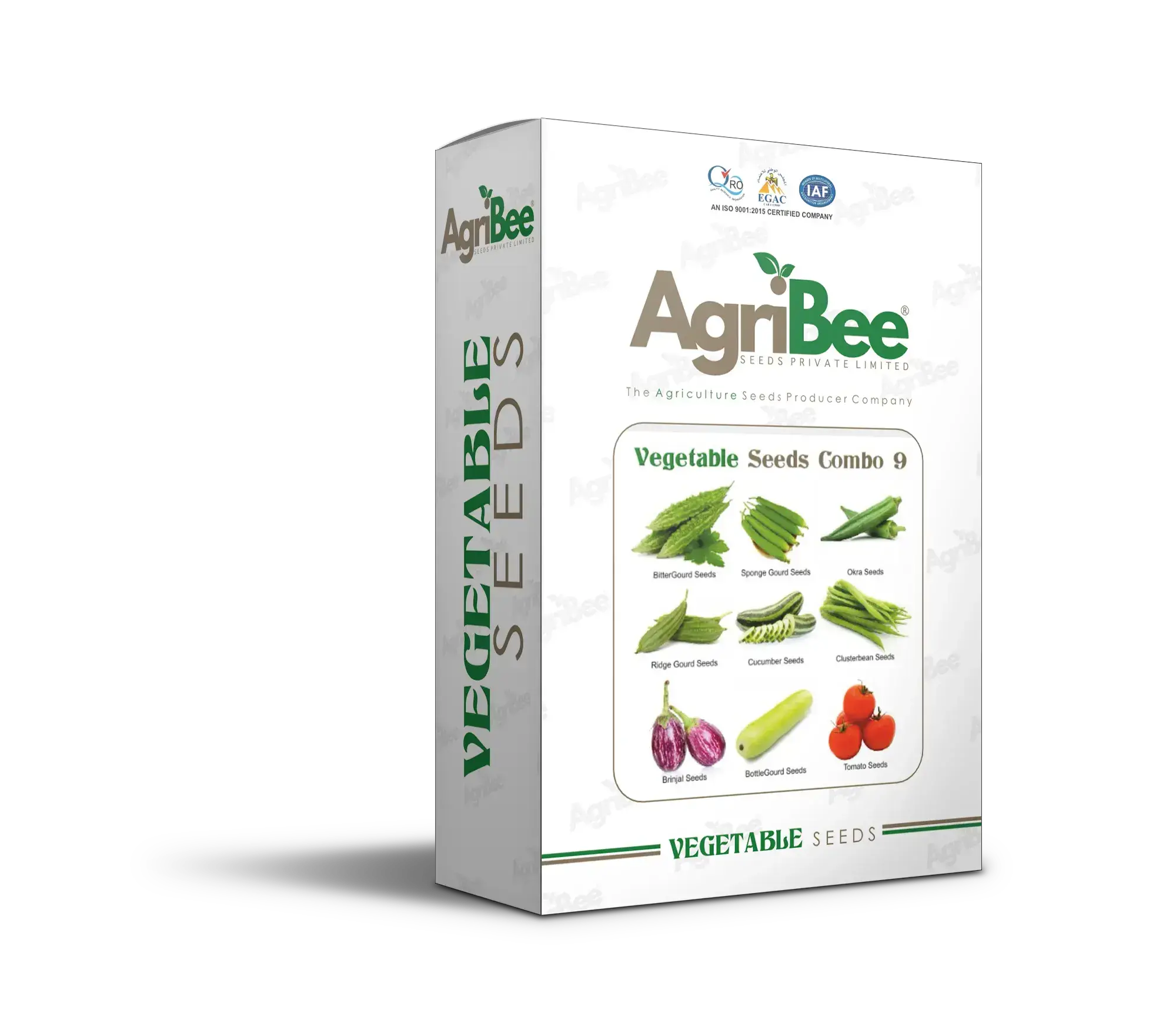
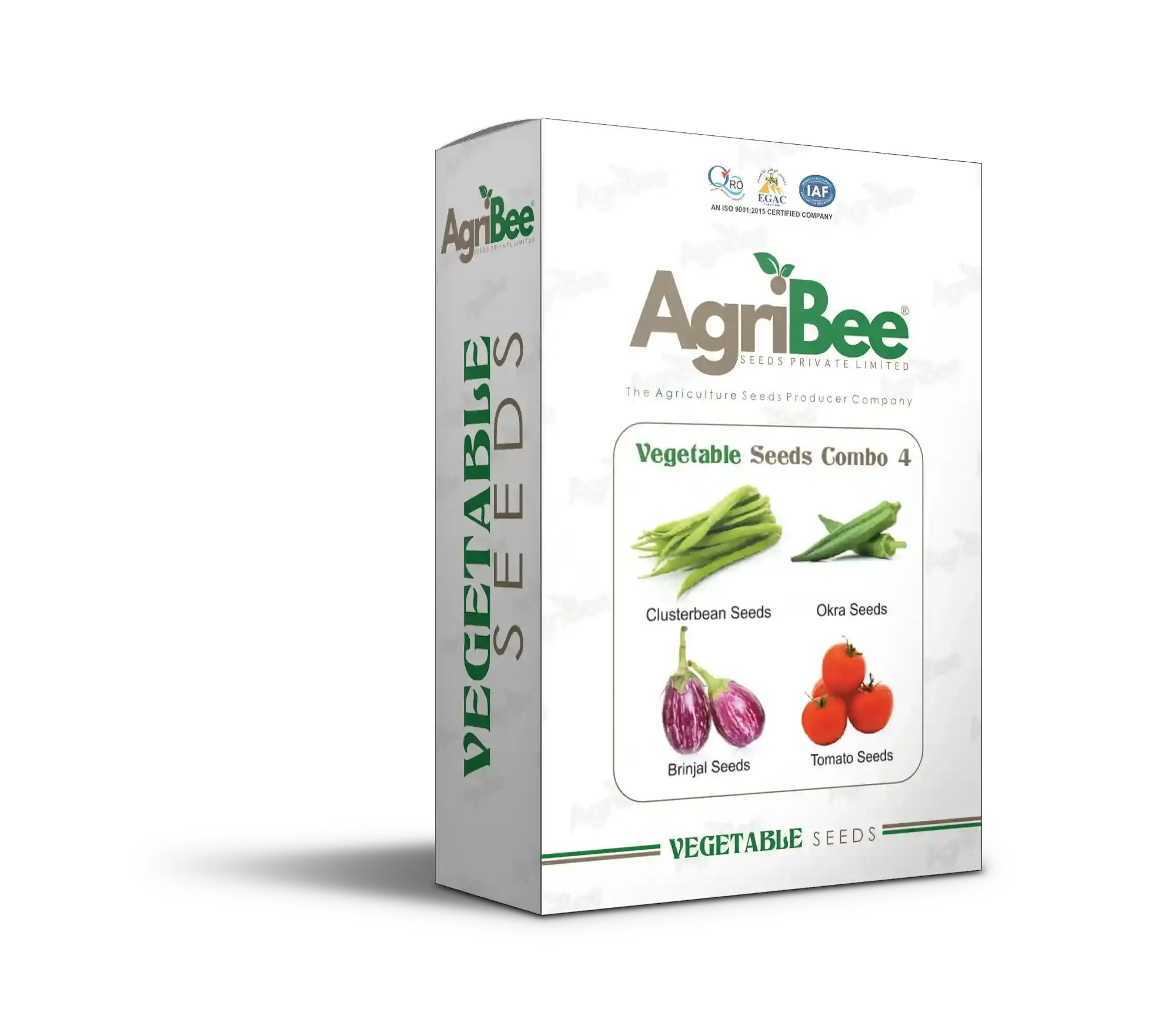
AgriBee Vegetable Combo 4 delivers a carefully curated selection of four high-demand vegetables adapted to Indian kitchen garden conditions — combining drought-resilient clusterbean, heat-tolerant okra, productive brinjal, and high-quality tomato in one convenient package.
🌿 Produce Quality & Appearance
The combo produces visually appealing, tender, and flavorful vegetables — vibrant green clusterbean pods, glossy okra, shiny brinjal fruits, and firm tomatoes — all meeting consumer preferences for fresh, home-grown organic produce.
🌿 Stress & Disease Tolerance
Clusterbean and okra exhibit strong tolerance to heat and intermittent drought stress. The selected varieties show field resistance to common viral and bacterial diseases prevalent across Indian growing regions.
🌿 Growth Habit & Vigor
Compact and vigorous growth habit suited for container gardening, raised beds, and rooftop cultivation. Plants develop strong branching, good canopy cover, and sustained flowering without excessive vegetative growth.
🌿 Crop Duration & Earliness
Relatively early-maturing varieties enable quick turnaround — okra and clusterbean begin producing within 35–50 days, while brinjal and tomato deliver harvests within 60–90 days, allowing flexible rotation and continuous kitchen garden productivity.
🌿 Market & Farmer Preference
Farmers and home gardeners favor this combo for its ease of cultivation, consistent performance across diverse Indian agro-climatic zones, and the economic advantage of growing four high-demand vegetables from a single seed purchase with minimal input requirements.