Description
Farming & Cultivation Guide — Vegetable Combo 9
Complete step-by-step agronomic guide for optimal crop management, disease resistance, and premium produce quality.
🌾 Soil Preparation & Field Prep
Proper land preparation ensures uniform seedling emergence and robust root anchorage.
🌱 Ideal Soil Type & pH
Well-drained sandy loam to loamy soils with pH 6.0–7.5. All species in this combo thrive in deep, fertile soils with good organic matter content and avoid waterlogging.
✨ Core Advantage
Loamy texture ensures rapid seed germination, strong root anchorage, and efficient nutrient uptake—critical for vigorous vine and bush growth in kitchen garden settings.
- 1
Deep summer ploughing followed by 2–3 cross-harrowings to achieve fine tilth and destroy weed seed banks.
- 2
Field leveling and drainage channel preparation to prevent stagnant water, especially critical for bottle gourd and brinjal.
- 3
Incorporation of 8–10 tonnes per acre of well-decomposed FYM or compost during last ploughing to enhance soil structure and moisture retention.
- 4
Soil health conditioning: raise pH with agricultural lime if below 5.5; avoid excessive nitrogen in acidic soils to prevent vegetative overload.
🌱 Sowing Time & Method
Precise seed rate and spacing maximize light interception and canopy development.
| Parameter | Recommendation | Agronomic Importance |
|---|---|---|
| Sowing Window | June–July (Kharif); March–April (Summer); Oct–Nov (Rabi in South India & plains) | Aligns with monsoon moisture for germination and avoids extreme heat stress during fruit set |
| Seed Rate | Bitter gourd–3 kg/acre; Sponge gourd–2.5 kg/acre; Okra–4 kg/acre; Ridge gourd–3 kg/acre; Cucumber–3 kg/acre; Brinjal–0.5 kg/acre; Bottle gourd–3 kg/acre; Tomato–0.4 kg/acre; Clusterbean–20 kg/acre | Optimizes plant population while preventing overcrowding in confined kitchen garden spaces |
| Spacing | Row-to-row: 90–120 cm; Plant-to-plant: 60–90 cm for vines; 45–60 cm for okra/brinjal/tomato/clusterbean | Ensures adequate canopy spread, light penetration, and airflow to reduce fungal incidence |
| Sowing / Transplanting Depth | Direct sow: 2–3 cm depth; Transplant (tomato/brinjal): up to first true leaf node | Proper depth ensures uniform emergence; deeper transplanting of tomato/brinjal promotes adventitious rooting |
💧 Irrigation & Water Management
Adequate moisture regulation supports strong vegetative and reproductive growth.
☀️ Water Requirement Profile
Moderate water demand; all species prefer consistent soil moisture but are sensitive to waterlogging. Drip irrigation is highly recommended for kitchen gardens—provides 20–25 mm every 3–4 days during active growth and fruit development.
🌦️ Soil Moisture Management
During rainfed conditions, mulching with straw or agro Fabric conserves soil moisture and suppresses weeds. Avoid overhead watering to minimize powdery mildew and bacterial wilt pressure.
- ✓
First irrigation within 3–5 days after sowing/transplanting to establish root systems.
- ✓
Vegetative phase: irrigate every 4–5 days to sustain leaf expansion and vine growth.
- ✓
Critical stage: flowering and fruit set require consistent moisture; stress at this stage causes flower drop and malformed fruits.
- ✓
Withhold irrigation 5–7 days before final harvest to concentrate flavors and improve shelf life.
🧪 Fertilizer & Nutrition Management
Balanced crop nutrition supports robust plant structure and premium produce quality.
| Nutrient | Recommended Dose (per Acre) | Application Method & Timing |
|---|---|---|
| Nitrogen (N) | 60–80 kg/acre (split: 50% basal, 50% at 30 DAS) | Basal incorporation + top-dressing at first flowering for sustained vegetative and fruiting vigor |
| Phosphorus (P2O5) | 40–50 kg/acre | 100% basal application with DAP or single super phosphate during seedbed preparation |
| Potash (K2O) | 30–40 kg/acre | 50% basal + 50% at flowering to enhance fruit firmness, color development, and disease tolerance |
🌿 Interculture & Weed Management
Timely weed control ensures optimal nutrient and moisture availability for crop seedlings.
-
1
First Weeding & Hoeing: Perform at 15–20 DAS to remove early weed flush and loosen soil crust without damaging shallow roots.
-
2
Second Weeding & Earthing-Up: Carry out at 30–35 DAS; light earthing-up around base of brinjal and okra supports stem and improves root aeration.
-
3
Special Interculture Operation: Install trellis/netting for bitter gourd, sponge gourd, ridge gourd, and cucumber at 10–15 DAS. Pinch terminal buds of okra at 30 DAS to encourage branching. Mulch inter-row spaces with organic matter to conserve moisture.
🛡️ Pest & Disease Management
Proactive crop monitoring and integrated management ensure healthy crop development.
🐛 Insect Pest Management
- Fruit and Shoot Borer (Helicoverpa armigera): Symptoms include bore holes and wilting shoots; control with Neem-based biopesticide (NSKE 5%) every 10 days or apply Emamectin Benzoate 5% SG at 0.4 g/litre at first incidence.
- Whitefly (Bemisia tabaci): Silvering of leaves and sooty mold; manage with yellow sticky traps at 1 trap per 10 m² and spray Imidacloprid 17.8% SL at 0.3 ml/litre or Confidor.
- Aphids (Aphis gossypii): Curling and sticky honeydew on leaves; control with Confidor 200 SC at 0.3 ml/litre or release natural enemies like ladybird beetles and ladybird larvae.
🔬 Disease Control
- Powdery Mildew (Erysiphe cichoracearum): White powdery patches on leaves; prevent with sulfur dusting at 15 kg/acre or spray Myclobutanil 68.3% WP at 0.1% concentration at first appearance.
- Bacterial Wilt (Ralstonia solanacearum): sudden wilting of branches; remove and burn infected plants, drench soil with Streptocycline 0.3 g/litre or Copper oxychloride 0.3% at onset.
- Downy Mildew (Pseudoperonospora cubensis) in cucurbits: Yellow angular lesions with purple sporulation underside; preventive spray of Mancozeb 75% WP at 2 g/litre weekly during humid weather.
✂️ Harvesting & Produce Quality Guide
Harvesting at peak maturity ensures maximum commercial grade and long keeping quality.
⏱️ Harvesting Schedule & Timing
First picking begins at 45–55 DAS for fast-maturing crops (okra, cucumber, bitter gourd). Subsequent pickings at 3–5 day intervals continue through 60–90 DAS depending on species.
⭐ Produce Quality Characteristics
Fruits should exhibit uniform size, vibrant color, firm texture, and glossy skin. Tender okra pods, crisp gourds, and plump tomatoes indicate optimal harvest maturity for fresh consumption and market appeal.
| Quality Parameter | Agronomic Standard | Farmer & Market Benefit |
|---|---|---|
| First Harvest Stage | 45–55 DAS for okra, cucumber, bitter gourd; 60–70 DAS for brinjal, tomato, bottle gourd | Ensures tender, high-quality produce and stimulates continued fruiting |
| Harvest Maturity Signs | Glossy skin, firm texture, snap when bent; color transition to mature hue | Prevents over-maturity, seed hardening, and post-harvest deterioration |
| Shelf Life & Keeping Quality | 5–7 days ambient; up to 10–12 days under cool storage (8–12°C) for tomatoes and brinjals | Extends sales window and reduces post-harvest losses in kitchen garden markets |
| Market Suitability | Fresh table market, local mandis, home consumption, and niche organic produce channels | Premium pricing for chemical-free, organically grown vegetables with superior taste and appearance |
⭐ Varietal Features — Vegetable Combo 9
Distinguishing characteristics that make this variety a top choice for Indian growers.
🌿 Core Variety Highlight
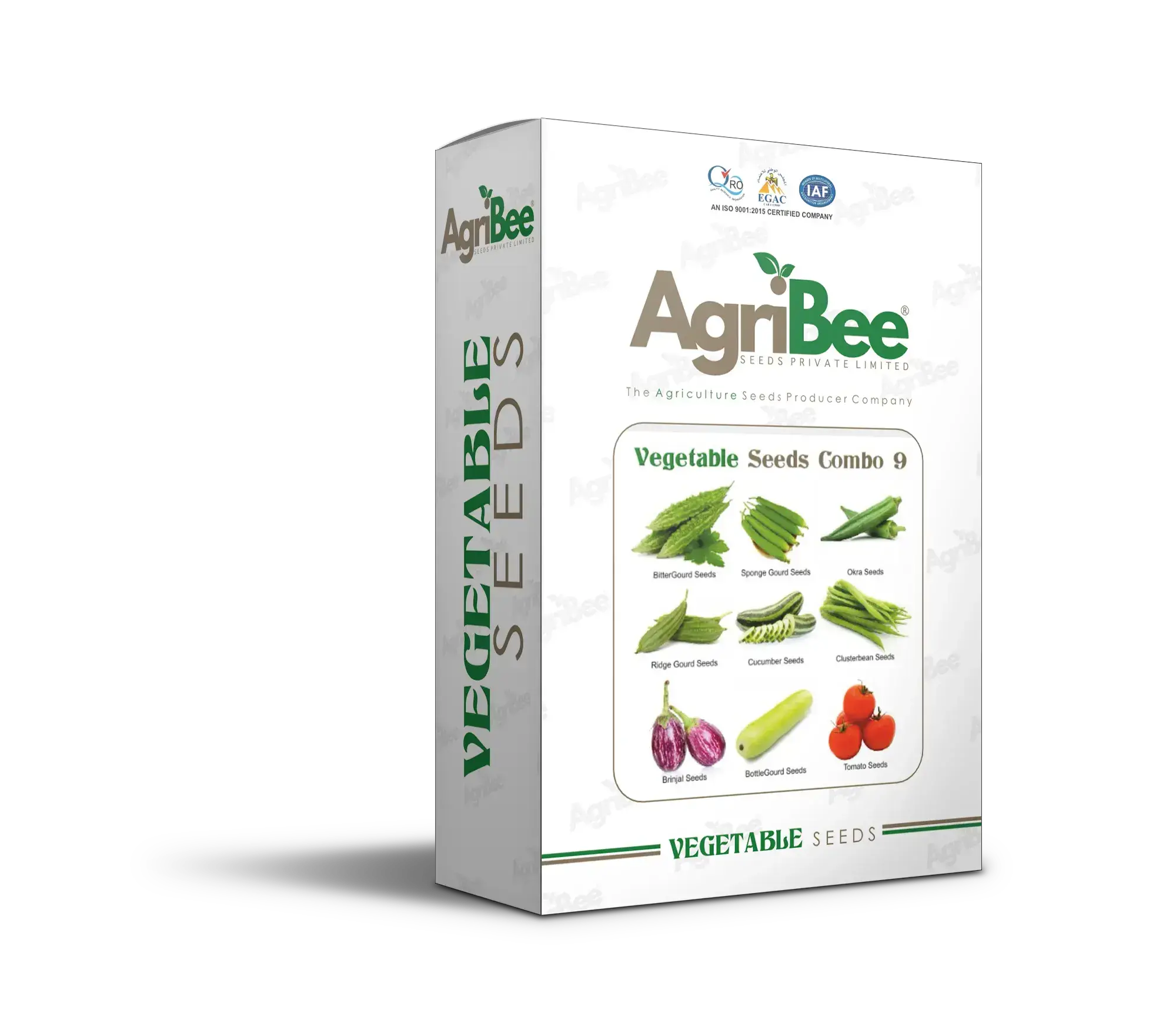
AgriBee Vegetable Combo 9 combines nine high-demand kitchen garden species selected for complementary growth habits, staggered maturity, and reliable performance under Indian climatic conditions.
🌿 Produce Quality & Appearance
Uniform fruit shape, vivid coloration, tender texture, and excellent flavor profile make these varieties visually appealing and culinarily superior for home and market use.
🌿 Stress & Disease Tolerance
Engineered for resilience against common foliar diseases, moderate drought tolerance, and adaptive vigor under variable monsoon and summer conditions prevalent across India.
🌿 Growth Habit & Vigor
Mixed architecture—bushy (okra, brinjal, clusterbean), vining (gourds, cucumber), and indeterminate (tomato)—ensures efficient space utilization in rooftop, terrace, and kitchen gardens.
🌿 Crop Duration & Earliness
Early-maturing varieties enable quick return on investment; staggered harvests from 45 to 90 days allow continuous fresh produce supply for household consumption.
🌿 Market & Farmer Preference
Farmers and home gardeners favor this combo for its simplicity, low input requirement, high germination reliability, and diverse vegetable production from a single seed package.