Description
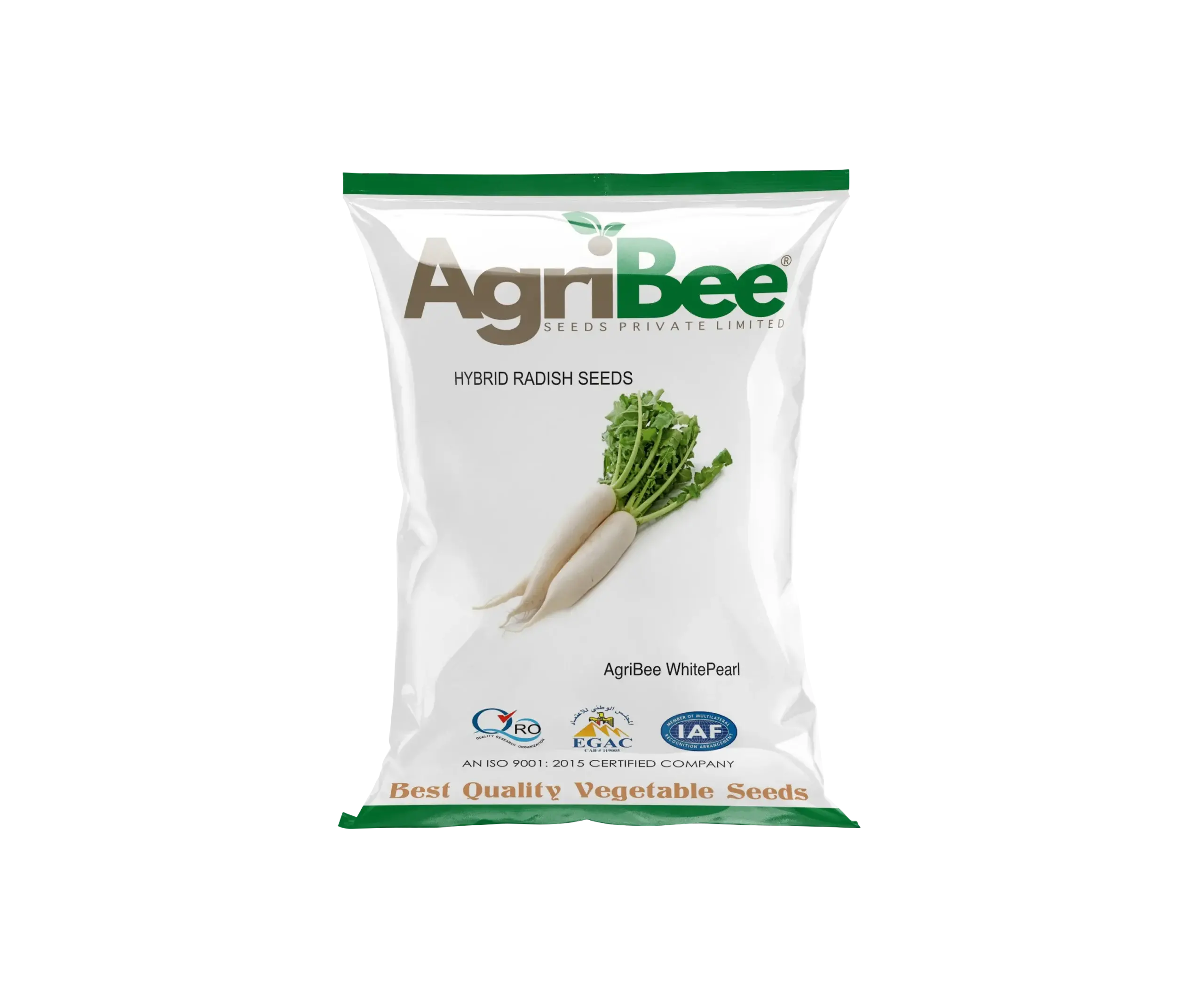
Farming & Cultivation Guide — Radish Seeds AgriBee WhitePearl
Complete step-by-step agronomic guide for optimal crop management, disease resistance, and premium produce quality.
🌾 Soil Preparation & Field Prep
Proper land preparation ensures uniform seedling emergence and robust root anchorage.
🌱 Ideal Soil Type & pH
Well-drained loamy or sandy-loam soils with pH 6.0–7.5. Deep, fertile, stone-free soils ensure straight, unbranched root development.
✨ Core Advantage
Loose, friable seedbed texture prevents forking and branching of roots, ensuring the uniform cylindrical shape characteristic of WhitePearl.
- 1
Deep summer ploughing followed by 2–3 cross-harrowings to achieve fine tilth free of clods.
- 2
Field leveling and drainage channel preparation to prevent water stagnation during light rains.
- 3
Incorporation of 8–10 tonnes per acre of well-decomposed FYM or compost during final harrowing for improved soil structure.
- 4
Soil pH testing and correction: apply 20–30 kg/acre agricultural lime if pH drops below 6.0; avoid excessive nitrogen that promotes leafy growth over root development.
🌱 Sowing Time & Method
Precise seed rate and spacing maximize light interception and canopy development.
| Parameter | Recommendation | Agronomic Importance |
|---|---|---|
| Sowing Window | Oct 15 – Dec 15 (Rabi) / Mar 1 – Apr 15 (Summer) | Cool temperatures favour crisp, mild-pungent root development without bolting |
| Seed Rate | 3–4 kg per acre (broadcast or line sowing) | Ensures adequate plant population for uniform root size and market grade produce |
| Spacing | 30 cm row-to-row x 10 cm plant-to-plant | Provides sufficient room for cylindrical root expansion and canopy aeration |
| Sowing Depth | 1–1.5 cm deep | Shallow sowing ensures rapid and uniform germination in 4–6 days |
💧 Irrigation & Water Management
Adequate moisture regulation supports strong vegetative and reproductive growth.
☀️ Water Requirement Profile
Radish is a shallow-rooted crop requiring regular but moderate moisture. WhitePearl performs best under drip irrigation with 2–3 litres per plant per session every 3–4 days. Consistent soil moisture prevents root cracking and woody texture. Drought stress during root bulging leads to pungency and fibrous roots.
🌦️ Soil Moisture Management
In rainfed environments, sow at the onset of steady post-monsoon rains. Install drainage furrows immediately after sowing. Mulching with straw at 2–3 cm thickness conserves soil moisture and maintains uniform root development during dry spells between rain events.
- ✓
First irrigation within 24–48 hours after sowing to ensure uniform germination.
- ✓
Light and frequent irrigation (every 4–5 days) during vegetative phase (15–30 DAS) for healthy foliage development.
- ✓
Critical moisture at 20–40 DAS when radial root expansion occurs; water stress here causes root splitting and poor appearance.
- ✓
Reduce irrigation frequency 5–7 days before harvest to improve skin firmness and extend post-harvest shelf life.
🧪 Fertilizer & Nutrition Management
Balanced crop nutrition supports robust plant structure and premium produce quality.
| Nutrient | Recommended Dose (per Acre) | Application Method & Timing |
|---|---|---|
| Nitrogen (N) | 40–50 kg/acre | 50% basal at sowing + 50% top-dressed at 20 DAS |
| Phosphorus (P2O5) | 25–30 kg/acre | 100% basal applied as DAP during final land preparation |
| Potash (K2O) | 20–25 kg/acre | 100% basal as MOP to enhance root firmness, colour, and storage quality |
🌿 Interculture & Weed Management
Timely weed control ensures optimal nutrient and moisture availability for crop seedlings.
-
1
First Weeding & Thin: At 10–12 DAS, perform first hand weeding and thin seedlings to 10 cm plant spacing. Remove weak, diseased, and overcrowded plants to reduce competition.
-
2
Second Weeding & Cultivation: At 20–25 DAS, conduct second weeding with a tine harrow or hand hoe. Light earthing-up is not required for radish but shallow inter-row cultivation improves soil aeration for root expansion.
-
3
Mulching Application: Apply straw or black poly mulch immediately after sowing to conserve moisture, suppress weeds, and keep developing roots clean and white by preventing soil contact.
🛡️ Pest & Disease Management
Proactive crop monitoring and integrated management ensure healthy crop development.
🐛 Insect Pest Management
- Radish Aphid (Myzus persicae): Sucks sap from leaves causing yellowing and curling. Control: Spray Imidacloprid 17.8% SL at 0.3 ml/litre water or Neem-based formulation at 3 ml/litre. Apply at first sign of infestation, repeat at 7-day intervals if needed.
- Radish Flea Beetle (Phyllotreta spp.): Small metallic beetles create shot-hole damage on cotyledons and true leaves. Control: Spray Chlorantraniliprole 18.4% WG at 0.2 ml/litre or Carbendazim-free biocontrol with Metarhizium anisopliae at 25 g/acre. Dust with neem cake at 50 kg/acre as preventive measure.
- Cabbage White Butterfly / Diamondback Moth (Plutella xylostella): Larvae mine and skeletonize leaves reducing photosynthetic capacity. Control: Spray Bacillus thuringiensis var. kurstaki at 250 g/acre or Spinosad 45% SC at 0.5 ml/litre. Use yellow sticky traps at 10/acre for monitoring and control.
🔬 Disease Control
- Downy Mildew (Peronospora parasitica): Yellow angular lesions on upper leaf surface with purplish-grey sporulation underneath in humid conditions. Prevention: Spray Mancozeb 75% WP at 2.5 g/litre or Copper oxychloride 50% WP at 3 g/litre prophylactically at 15-day intervals. Ensure proper spacing for airflow.
- Black Rot (Xanthomonas campestris pv. rapae): V-shaped yellow lesions at leaf margins progressing to blackened vascular bundles. Control: Apply Streptocycline 50% SP at 0.5 g/acre mixed in 200 litres water as drench at 20 DAS. Remove and destroy infected plants immediately. Use certified disease-free seeds.
- Fusarium Wilt (Fusarium oxysporum): Plants show wilting, yellowing, and vascular browning at stem base. Management: Soil solarization before sowing, drench with Trichoderma viride at 10 g/litre at transplanting/sowing. Maintain 2–3 year crop rotation with non-cruciferous crops.
✂️ Harvesting & Produce Quality Guide
Harvesting at peak maturity ensures maximum commercial grade and long keeping quality.
⏱️ Harvesting Schedule & Timing
First harvest begins at 40–45 days after sowing. Roots are ready when they reach 25–30 cm length and 3–4 cm diameter. Harvest is a single picking event; delay beyond 50 DAS causes pithiness and loss of crispness.
⭐ Produce Quality Characteristics
Pure white, long cylindrical roots with mild pungency and exceptional crispness. Smooth skin, no hollow centre, and uniform taper from shoulder to tip. High juice content and attractive white colour make it preferred for fresh market, salads, and garnishing.
| Quality Parameter | Agronomic Standard | Farmer & Market Benefit |
|---|---|---|
| First Harvest Stage | 40–45 Days after Sowing | Ensures peak tenderness, white colour, and market-ready uniform root size |
| Harvest Maturity Signs | Shoulder emerges above soil, pure white skin, 25–30 cm length, firm to touch | Prevents over-maturity that causes woody texture and pungency increase |
| Shelf Life & Keeping Quality | 7–10 days under cool storage (0–4°C); 3–4 days at ambient temperature | Excellent keeping quality enables transport to distant mandis and retail outlets |
| Market Suitability | Fresh table market, premium supermarkets, hotel & catering supply, processed salad packs | Uniform white cylindrical shape commands premium rates in organized and export markets |
⭐ Varietal Features — Radish Seeds AgriBee WhitePearl
Distinguishing characteristics that make this variety a top choice for Indian growers.
🌿 Core Variety Highlight
AgriBee WhitePearl delivers superior uniformity with long, cylindrical, pure white roots that stand out in competitive mandis and modern retail channels across India.
🌿 Produce Quality & Appearance
Roots measure 25–30 cm with smooth white skin, mild pungent taste, and exceptional crispness. No hollowing or branching, ensuring high percentage of marketable grade produce.
🌿 Stress & Disease Tolerance
Shows good field tolerance to downy mildew and Fusarium wilt under normal Rabi conditions. Maintains root quality under moderate heat during summer cropping with proper irrigation management.
🌿 Growth Habit & Vigor
Compact upright foliage with vigorous early growth ensures quick ground cover, weed suppression, and efficient resource use. Strong root initiation from early stages.
🌿 Crop Duration & Earliness
Earliest maturity at 40–45 days enables 3–4 successive crops per year in suitable regions, supporting intensive farming systems and rapid crop rotation cycles.
🌿 Market & Farmer Preference
Premium white colour and uniform shape attract higher prices from traders and processors. AgriBee seed quality guarantees high germination and field uniformity, reducing replanting costs and ensuring farmer confidence.