Description
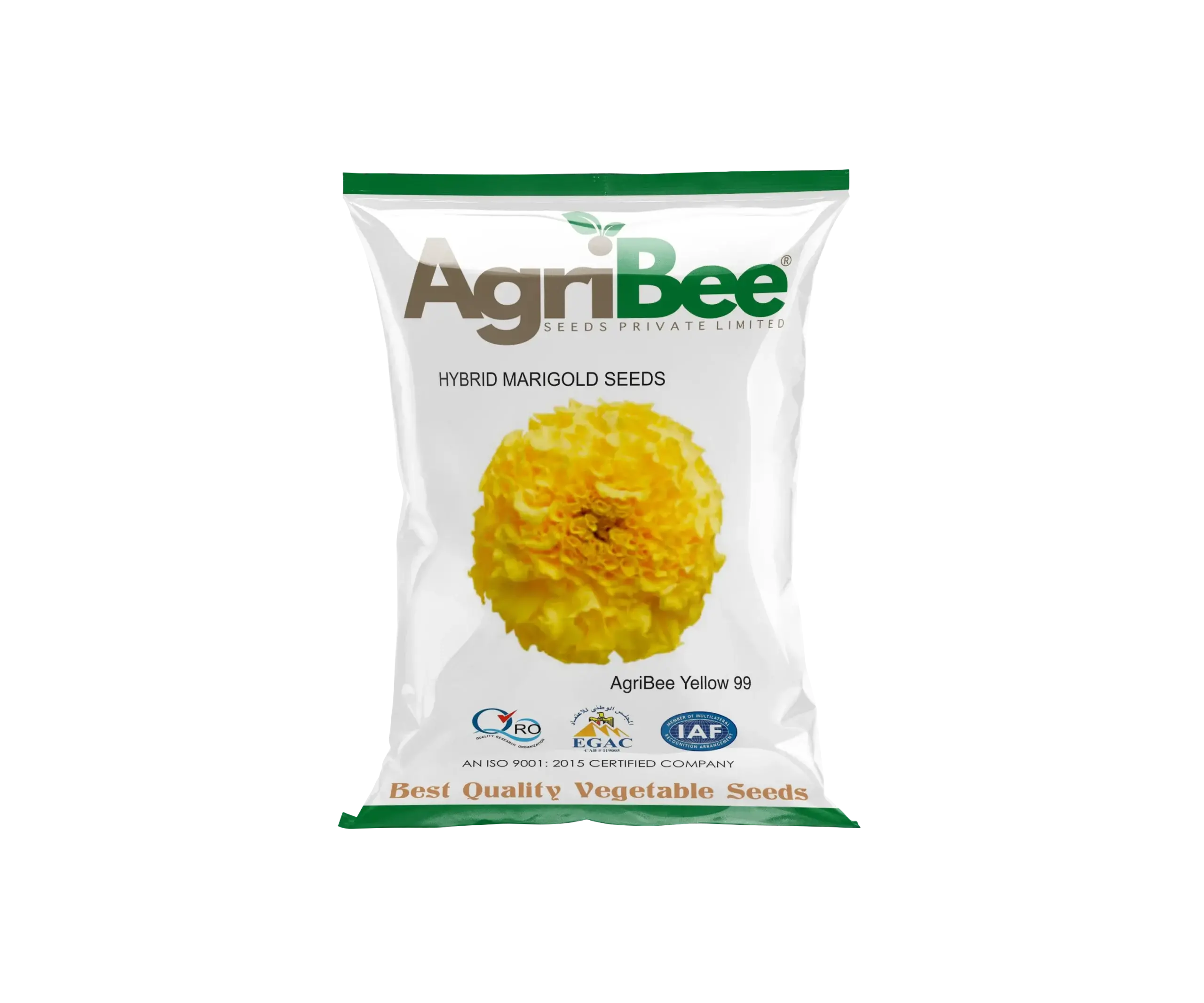
Farming & Cultivation Guide — Marigold Seeds AgriBee Yellow 99
Complete step-by-step agronomic guide for optimal crop management, disease resistance, and premium produce quality.
🌾 Soil Preparation & Field Prep
Proper land preparation ensures uniform seedling emergence and robust root anchorage.
🌱 Ideal Soil Type & pH
Well-drained loamy or sandy-loam soils with a pH range of 6.0 – 7.5. Good organic matter content ensures vigorous growth and deep golden flower colour development.
✨ Core Advantage
Free-draining soil prevents waterlogging which marigold is highly sensitive to, while supporting strong root anchorage for upright 1–1.5 ft plants.
- 1
Deep summer ploughing followed by 2–3 cross-harrowings to achieve a fine, crumbly tilth.
- 2
Field leveling with laser or board leveling and preparation of adequate drainage channels to prevent standing water.
- 3
Incorporation of 8–10 tonnes per acre of well-decomposed Farm Yard Manure (FYM) or compost during final seedbed preparation.
- 4
Soil health conditioning: if pH is below 6.0, apply agricultural lime at 200–250 kg/acre 15 days before sowing; if alkaline above 7.5, incorporate gypsum at 250 kg/acre.
🌱 Sowing Time & Method
Precise seed rate and spacing maximize light interception and canopy development.
| Parameter | Recommendation | Agronomic Importance |
|---|---|---|
| Sowing Window | January to March (Rabi season) and August to September (Kharif season) | These windows provide optimal temperature (20–30°C) for rapid germination and avoid extreme heat or waterlogging stress. |
| Seed Rate | 1 – 1.5 Kg per Acre | Ensures optimal plant population density for heavy flowering coverage without excessive competition. |
| Spacing | 30 cm × 30 cm (Row-to-row × Plant-to-plant) | Allows adequate canopy spread for 7–9 cm flower development and improves air circulation to reduce fungal incidence. |
| Sowing Depth | 0.5 – 1.0 cm (1/4 to 1/2 inch) | Marigold seeds are light-dependent for germination; shallow sowing ensures uniform emergence within 5–7 days. |
💧 Irrigation & Water Management
Adequate moisture regulation supports strong vegetative and reproductive growth.
☀️ Water Requirement Profile
Marigold is moderately drought-tolerant but requires consistent soil moisture for continuous flower production. The crop performs well under drip irrigation with 2–3 litre per plant per irrigation cycle, applied every 2–3 days during peak summer. Drip systems also help prevent foliar diseases by keeping foliage dry.
🌦️ Soil Moisture Management
During Kharif monsoon, raised beds or ridges are essential to prevent water stagnation. Mulching with straw or paddy husk conserves soil moisture and suppresses weeds. Avoid overhead sprinkler irrigation which promotes downy mildew and leaf spot outbreaks.
- ✓
First irrigation should be given within 24 hours of sowing to ensure uniform germination and seed-soil contact.
- ✓
Vegetative phase (15–35 DAS): irrigate at 5–7 day intervals depending on soil type and weather; maintain moist but not saturated conditions.
- ✓
Flowering phase (35–50 DAS): increase irrigation frequency to every 3–4 days during peak summer to support continuous bloom and prevent bud drop.
- ✓
Pre-harvest: reduce irrigation slightly 3–4 days before harvest to improve flower firmness and extend post-harvest shelf life.
🧪 Fertilizer & Nutrition Management
Balanced crop nutrition supports robust plant structure and premium produce quality.
| Nutrient | Recommended Dose (per Acre) | Application Method & Timing |
|---|---|---|
| Nitrogen (N) | 40–50 kg/acre | 50% basal at sowing + 50% top-dressing at 25 days after sowing (DAS) |
| Phosphorus (P2O5) | 25–30 kg/acre | 100% basal application as Di-ammonium Phosphate (DAP) or Single Super Phosphate (SSP) during seedbed preparation |
| Potash (K2O) | 20–25 kg/acre | 100% basal application as Muriate of Potash (MOP); split optional for prolonged flowering |
🌿 Interculture & Weed Management
Timely weed control ensures optimal nutrient and moisture availability for crop seedlings.
-
1
First Weeding & Hoeing: Carry out at 10–15 days after sowing (DAS) using a hand hoe or cultivator. Keep the operation shallow (2–3 cm depth) to avoid damaging the shallow root system. This is critical as marigold is a slow competitor during early establishment.
-
2
Second Weeding & Inter-row Hoeing: Perform at 25–30 DAS when the crop canopy begins to close. Moderate inter-row hoeing improves soil aeration and breaks capillary action to reduce evaporation. Remove any volunteer weed plants manually.
-
3
Mulching and Pinching: Apply straw or organic mulch at 20 DAS to conserve moisture, suppress weeds, and keep flowers clean during harvest. For bushier plants with more flower branches, pinch out the growing tip at 20–25 DAS (2–3 true leaves) to promote lateral branching and enhance flower count per plant.
🛡️ Pest & Disease Management
Proactive crop monitoring and integrated management ensure healthy crop development.
🐛 Insect Pest Management
- Aphids (Green Peach Aphid – Myzus persicae): Small green/black insects clustering on buds and tender shoots, causing curling and honeydew sooty mould. Control: Spray Imidacloprid 17.8% SL at 0.3 ml/Litre or Neem-based pesticide (Azadirachtin 1% EC) at 2 ml/Litre. Repeat at 7-day intervals if infestation persists.
- Leafminers (Liriomyza spp.): Sine-shaped white tunnels or trails inside leaves with transparent patches. Control: Spray Thiamethoxam 25% WG at 0.2 g/Litre or Cartap Hydrochloride 4% GD at 15 kg/acre as soil drench. Remove and destroy heavily infested leaves.
- Whiteflies (Bemisia tabaci): Silvered leaves with whitish powdery exuviae on undersides; vectors viral diseases. Control: Spray Cyantraniliprole 10.26% OR at 0.5 ml/Litre or Imidacloprid 70% WS at 0.3 g/Litre. Use yellow sticky traps at 10 traps/acre for monitoring and mass trapping.
🔬 Disease Control
- Downy Mildew (Peronospora variabilis): Yellow chlorotic patches on upper leaf surface with fuzzy grey-purple sporulation on the underside in humid conditions. Control: Apply Mannose-based fungicide or Metalaxyl + Mancozeb 8% + 64% WP at 2.5 g/Litre as preventive spray at 20 DAS and repeat at 15-day intervals. Ensure proper spacing and avoid overhead irrigation.
- Powdery Mildew (Erysiphe cichoracearum): White powdery fungal growth on leaves and petioles, especially under dry-hot conditions with high humidity. Control: Spray Sulphur powder (80% WP) at 2 g/Litre or Myclobutanil 0.5 ml/Litre. Improve air circulation through adequate spacing and avoid excess nitrogen.
- Fusarium Wilt (Fusarium oxysporum): Sudden wilting of one or more branches with yellowing and browning of leaves; vascular tissue shows brown discoloration on stem cut. Control: Soil drench with Trichoderma viride at 5 g/Litre per plant at 15 DAS as biocontrol measure. Remove and burn infected plants. Practice 2-year crop rotation with non-Asteraceae crops.
✂️ Harvesting & Produce Quality Guide
Harvesting at peak maturity ensures maximum commercial grade and long keeping quality.
⏱️ Harvesting Schedule & Timing
Begin first picking at 45–50 days after sowing when flowers are fully opened but still firm. Subsequent pickings can be taken every 2–3 days during peak flowering. Harvest in the early morning between 6–9 AM when flowers are turgid and essential oil content is highest. Cut stems at 3–4 inch length using sharp knives or scissors.
⭐ Produce Quality Characteristics
Premium quality flowers exhibit bright golden yellow colour with 7–9 cm diameter, firm petal texture, dark green healthy foliage, and long sturdy stems (8–12 inches). Flowers should be free from blemishes, insect damage, and sun scorch. Dark green leaf colour indicates good nutrition and photosynthetic vigor.
| Quality Parameter | Agronomic Standard | Farmer & Market Benefit |
|---|---|---|
| First Harvest Stage | 45–50 Days after Sowing | Ensures flowers reach optimal size and colour for religious and decorative markets at earliest |
| Harvest Maturity Signs | Fully opened florets with vibrant golden yellow colour, firm disc, petals spreading horizontally | Prevents harvesting immature buds that fail to open properly and reduces post-harvest rejection |
| Shelf Life & Keeping Quality | 5–7 days under ambient conditions; up to 10–12 days with cold storage at 10–12°C and 90% RH | Extended freshness allows transport to distant mandis and export markets with minimal quality loss |
| Market Suitability | Fresh cut flowers for garlands, religious ceremonies, weddings,Decoration, and floral arrangements | Consistent supply of bright yellow uniform flowers commands premium rates in festival demand seasons |
⭐ Varietal Features — Marigold Seeds AgriBee Yellow 99
Distinguishing characteristics that make this variety a top choice for Indian growers.
🌿 Core Variety Highlight
AgriBee Yellow 99 delivers outstanding golden yellow flower colour with heavy flowering throughout the growing season, making it a preferred choice for commercial floriculture in India.
🌿 Produce Quality & Appearance
7–9 cm diameter perfectly formed flowers with rich golden yellow pigmentation and dark green foliage. Each bloom maintains excellent symmetry and colour uniformity across the crop.
🌿 Stress & Disease Tolerance
Shows good field tolerance to common marigold diseases including downy mildew and Fusarium wilt under integrated management. Performs reliably across diverse Indian agro-climatic zones.
🌿 Growth Habit & Vigor
Compact bushy plant architecture reaching 1–1.5 feet in height with profuse branching. Dense canopy with abundant flower production throughout the growing period.
🌿 Crop Duration & Earliness
Early maturing variety ready for first harvest in just 45–50 days, enabling multiple cropping cycles and flexible scheduling around festival markets.
🌿 Market & Farmer Preference
Highly sought after for religious events, temple offerings, wedding decorations, and garland-making due to consistent size, vivid colour, and long vase life that meets trader and consumer expectations.