Description
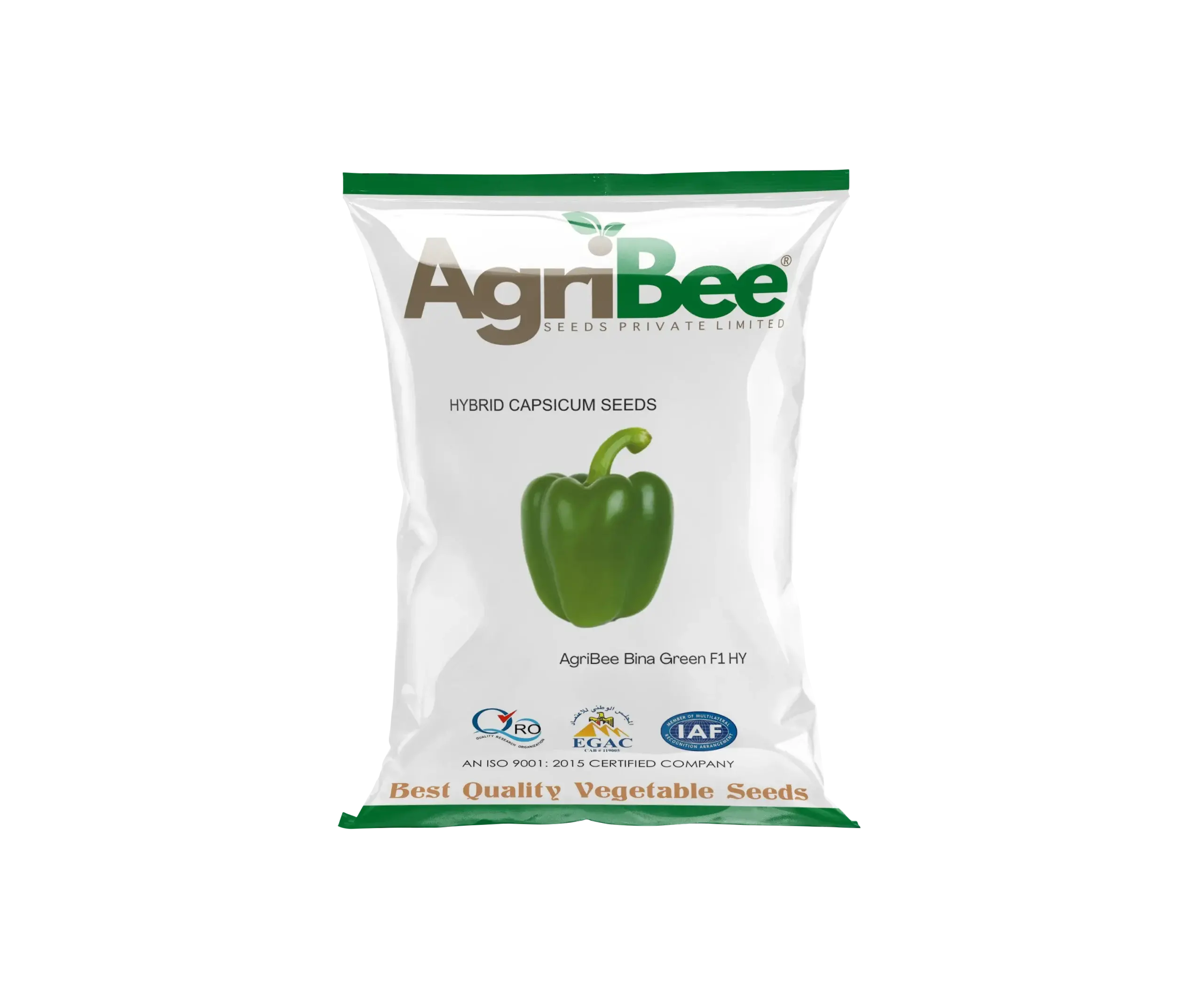
Farming & Cultivation Guide — Capsicum Seeds AgriBee Bina Green F1 HY
Complete step-by-step agronomic guide for optimal crop management, disease resistance, and premium produce quality.
🌾 Soil Preparation & Field Prep
Proper land preparation ensures uniform seedling emergence and robust root anchorage.
🌱 Ideal Soil Type & pH
Well-drained loamy to sandy-loam soils with pH 6.0–7.5. Avoid waterlogged or heavy clay soils.
✨ Core Advantage
Fine, loose seedbed ensures rapid germination and strong early root establishment under Indian conditions.
- 1
Deep summer ploughing followed by 2–3 cross-harrowings to achieve fine tilth and break crust formation.
- 2
Field leveling and creation of drainage channels to prevent standing water during monsoon rains.
- 3
Incorporation of 15–20 tonnes/acre well-decomposed FYM or compost during final harrowing.
- 4
Soil health conditioning: apply gypsum (100 kg/acre) in alkaline soils or elemental sulfur in acidic soils to maintain pH near neutral.
🌱 Sowing Time & Method
Precise seed rate and spacing maximize light interception and canopy development.
| Parameter | Recommendation | Agronomic Importance |
|---|---|---|
| Sowing Window | June–July for Kharif; October–November for Rabi seasons | Aligns vegetative growth with favorable temperatures, avoiding extreme heat or cold stress during flowering. |
| Seed Rate | 250–300 g per acre for transplanting | Ensures adequate seedling population while minimizing wastage in the nursery. |
| Spacing | 60 cm (row-to-row) × 45 cm (plant-to-plant) | Provides optimal canopy spread, sunlight penetration, and airflow to reduce disease pressure. |
| Sowing / Transplanting Depth | 0.5–1.0 cm depth in nursery trays; transplant at 25–30 days after sowing | Shallow sowing promotes uniform germination; healthy transplants establish faster in the field. |
💧 Irrigation & Water Management
Adequate moisture regulation supports strong vegetative and reproductive growth.
☀️ Water Requirement Profile
Capsicum requires consistent soil moisture but is moderately sensitive to water stress. Drip irrigation is highly recommended for efficient water use andfertigation. Avoid drought during flowering and fruit set to prevent blossom end rot and poor fruit development.
🌦️ Soil Moisture Management
Rainfed cultivation is not recommended due to erratic rainfall and high disease risk. If rainfed practices are attempted, ensure raised beds and thorough drainage to prevent root rot.
- ✓
First irrigation immediately after transplanting (within 24 hours) to settle roots and reduce transplant shock.
- ✓
During vegetative phase, irrigate at 5–7 day intervals depending on soil type and weather.
- ✓
Critical stages: maintain even moisture during flowering, fruit set, and fruit expansion; reduce irrigation frequency slightly during late fruit maturation.
- ✓
Withhold irrigation 7–10 days before the final harvest to improve fruit firmness and shelf life.
🧪 Fertilizer & Nutrition Management
Balanced crop nutrition supports robust plant structure and premium produce quality.
| Nutrient | Recommended Dose (per Acre) | Application Method & Timing |
|---|---|---|
| Nitrogen (N) | 80–100 kg/acre | 50% basal at planting; 50% top-dressed 30 days after transplanting as urea. |
| Phosphorus (P2O5) | 50 kg/acre | 100% basal application as DAP or single super phosphate at planting. |
| Potash (K2O) | 40–50 kg/acre | 100% basal; additional 20 kg/acre as muriate of potash at first fruit set for improved fruit quality. |
🌿 Interculture & Weed Management
Timely weed control ensures optimal nutrient and moisture availability for crop seedlings.
-
1
First Weeding & Hoeing: Carry out light weeding and hoeing 15 days after transplanting to eliminate early weed competition and improve soil aeration.
-
2
Second Weeding & Earthing-Up: Perform second weeding at 30 days after transplanting. Light earthing-up around the base supports root development and prevents lodging.
-
3
Special Interculture Operation: Apply straw mulch (2–3 cm layer) between rows to conserve soil moisture, suppress weeds, and keep fruits clean. Stake plants if required in high-density or windy areas.
🛡️ Pest & Disease Management
Proactive crop monitoring and integrated management ensure healthy crop development.
🐛 Insect Pest Management
- Aphids (Myzus persicae): Suck sap from undersides of leaves, causing curling and honeydew soot. Control with imidacloprid 17.8% SL at 0.3 ml/liter or neem-based biopesticide spray.
- Whiteflies (Bemisia tabaci): Cause leaf yellowing and transmit viral diseases. Use yellow sticky traps at 10/acre and spray thiamethoxam 25% WG at 0.2 g/liter or lambs-ear extract.
- Fruit borer (Helicoverpa armigera): Larvae bore into fruits, causing direct damage. Apply spinosad 45% SC at 0.5 ml/liter or pheromone traps at 10/acre for monitoring and control.
🔬 Disease Control
- Bacterial spot (Xanthomonas campestris): Small water-soaked lesions on leaves and fruits that become necrotic. Prevent with copper oxychloride 50% WP at 2.5 g/liter as preventive spray every 10–15 days.
- Phytophthora blight (Phytophthora capsici): Wilting, stem cankers, and fruit rot. Improve drainage and drench soil with metalaxyl 35% WS at 2.5 g/liter at first sign.
- Anthracnose (Colletotrichum gloeosporioides): Sunken, circular spots on ripe fruits. Spray mancozeb 75% WP at 2.0 g/liter or copper hydroxide at 2.0 g/liter at 7-day intervals during humid conditions.
✂️ Harvesting & Produce Quality Guide
Harvesting at peak maturity ensures maximum commercial grade and long keeping quality.
⏱️ Harvesting Schedule & Timing
First harvest begins 70–75 days after transplanting; subsequent pickings at 5–7 day intervals over 4–6 rounds.
⭐ Produce Quality Characteristics
Blocky, 3–4 lobed fruits with thick walls, glossy skin, and vibrant green color (maturing to red or yellow). Firm texture, crisp bite, and sweet flavor with low pungency.
| Quality Parameter | Agronomic Standard | Farmer & Market Benefit |
|---|---|---|
| First Harvest Stage | 70–75 days after transplanting when fruits reach mature green size | Ensures peak quality and early market arrival for better price realization. |
| Harvest Maturity Signs | Fruits fully sized, firm, and uniformly green; skin taut and glossy | Prevents over-maturity, which leads to softening and reduced shelf life. |
| Shelf Life & Keeping Quality | 10–14 days under cool storage (8–10°C); 5–7 days at ambient temperature | Facilitates long-distance transport and extends sales window. |
| Market Suitability | Premium fresh-market grade; suitable for domestic retail, mandi supply, and export consignments | Attracts premium rates due to uniform appearance, thick walls, and long post-harvest life. |
⭐ Varietal Features — Capsicum Seeds AgriBee Bina Green F1 HY
Distinguishing characteristics that make this variety a top choice for Indian growers.
🌿 Core Variety Highlight
AgriBee Bina Green F1 HY is a vigorous F1 hybrid bred for early maturity, uniform plant architecture, and strong field adaptability across Indian agro-climatic zones.
🌿 Produce Quality & Appearance
Produces blocky, 3–4 lobed fruits with thick walls, glossy green surface, and excellent taste. Fruit weight averages 150–180 gm, ensuring consistent commercial grading.
🌿 Stress & Disease Tolerance
Demonstrates good tolerance to common capsicum diseases such as bacterial spot and phytophthora blight, along with moderate resilience to temperature fluctuations.
🌿 Growth Habit & Vigor
Compact, bushy plant habit with strong branching that supports heavy fruit load without excessive staking. Rapid early growth ensures quick ground cover.
🌿 Crop Duration & Earliness
Earliest harvest in 70–75 days after transplanting, allowing farmers to capitalize on early market opportunities and flexible crop rotation schedules.
🌿 Market & Farmer Preference
Preferred by farmers and traders for its reliable fruit set, high uniformity, and extended shelf life, making it a profitable choice for both local and distant markets.