Description
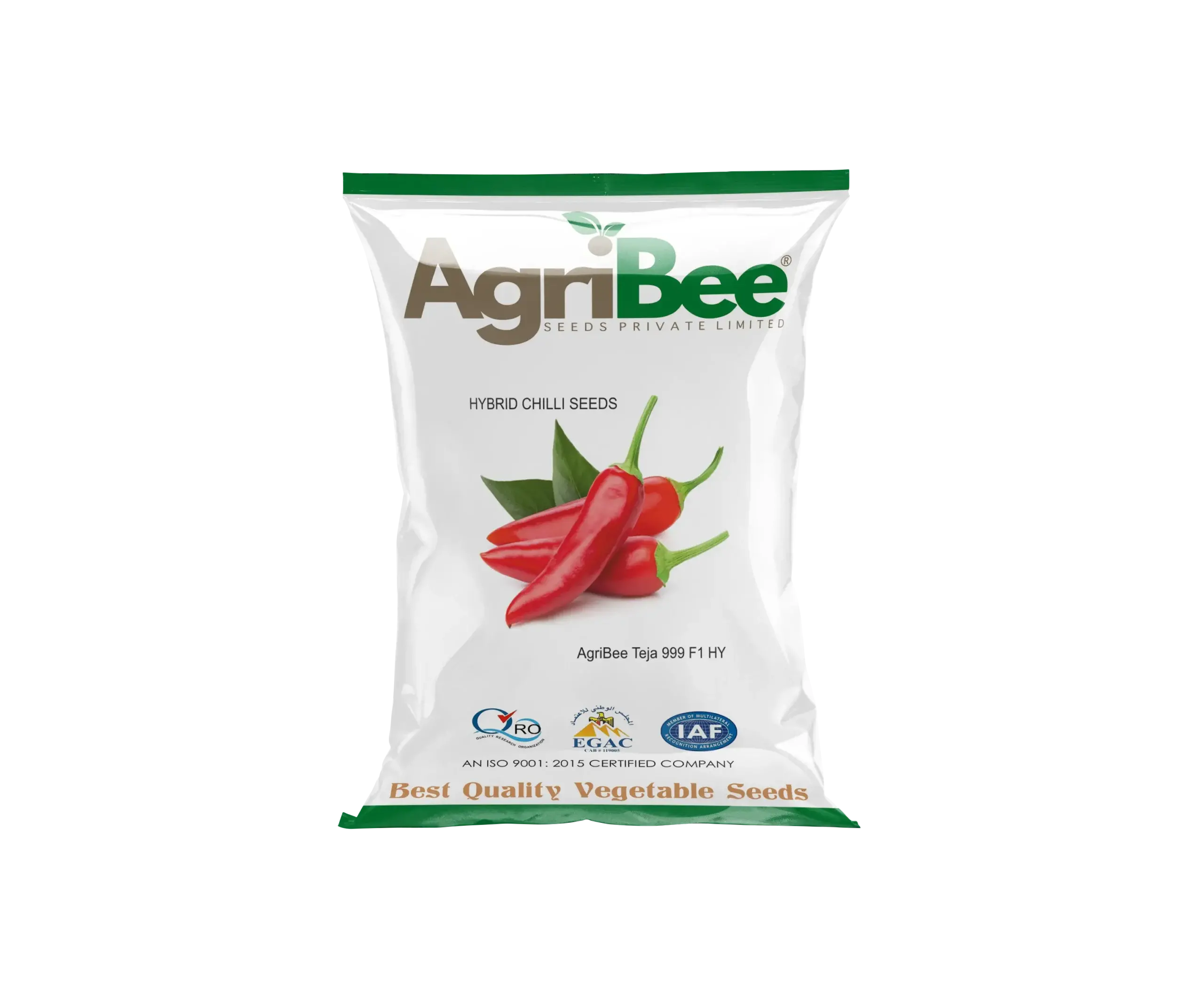
Farming & Cultivation Guide — Chilli Seeds AgriBee Tej 999 F1 HY
Complete step-by-step agronomic guide for optimal crop management, disease resistance, and premium produce quality.
🌾 Soil Preparation & Field Prep
Proper land preparation ensures uniform seedling emergence and robust root anchorage.
🌱 Ideal Soil Type & pH
Well-drained loamy to sandy-loam soils with pH range of 6.0–7.5. Good organic matter content and free from waterlogging are essential for healthy root development and optimum pungency expression.
✨ Core Advantage
Deep, friable soil profile ensures rapid seedling establishment, strong root penetration, and efficient nutrient uptake throughout the crop cycle.
- 1
Deep summer ploughing to 25–30 cm followed by 2–3 cross-harrowings for fine tilth and destruction of weed seed banks.
- 2
Field leveling with laser leveling equipment and preparation of adequate drainage channels to prevent water stagnation.
- 3
Incorporation of 8–10 tonnes per acre of well-decomposed FYM or vermicompost during the final harrowing for soil structure improvement.
- 4
Soil health conditioning — apply gypsum at 250 kg/acre in saline-affected soils and lime at 200–300 kg/acre in acidic soils to bring pH within the optimal 6.0–7.5 range.
🌱 Sowing Time & Method
Precise seed rate and spacing maximize light interception and canopy development.
| Parameter | Recommendation | Agronomic Importance |
|---|---|---|
| Sowing Window | Kharif: June–July | Rabi: October–November | Summer: February–March | Aligns crop cycle with favorable temperature and humidity, minimizing pest pressure and ensuring uniform fruit set. |
| Seed Rate | 300–400 g per Acre (Transplanted nursery method) | Ensures adequate plant population of 35,000–40,000 plants per acre with uniform stand emergence. |
| Spacing | 60 cm (row-to-row) x 45 cm (plant-to-plant) | Promotes balanced canopy spread, improves air circulation, reduces disease incidence, and facilitates interculture operations. |
| Sowing / Transplanting Depth | Sowing depth: 1–1.5 cm in nursery; Transplanting at 4–6 leaf stage into main field | Optimal depth ensures consistent germination and minimizes damping-off risk during the vulnerable seedling phase. |
💧 Irrigation & Water Management
Adequate moisture regulation supports strong vegetative and reproductive growth.
☀️ Water Requirement Profile
Chilli is moderately drought-tolerant but requires consistent soil moisture for uninterrupted flowering and fruit development. Drip irrigation is highly recommended, supplying 25–35 mm water per week during active growth. Under sprinkler or furrow irrigation, apply light and frequent watering every 7–10 days depending on soil texture and climatic conditions.
🌦️ Soil Moisture Management
In rainfed conditions, synchronize sowing with pre-monsoon showers and use mulching (straw or polyethylene film) to conserve soil moisture. Avoid moisture stress during flowering and fruit-setting stages, as even brief deficits cause flower drop and poor fruit set.
- ✓
First irrigation should be applied 2–3 days after transplanting to reduce transplanting shock and promote rapid root establishment.
- ✓
During the vegetative phase (20–45 DAT), maintain light irrigation every 7–10 days to support leaf and stem growth without encouraging excessive vegetative vigor.
- ✓
Critical irrigation is required during flowering and fruit-setting stages (45–75 DAT) — consistent moisture during this period ensures high fruit set, uniform fruit development, and maximum pungency expression.
- ✓
Reduce irrigation frequency 10–15 days before the end of the harvesting cycle to improve fruit firmness, enhance shelf life, and prevent fruit cracking or rotting.
🧪 Fertilizer & Nutrition Management
Balanced crop nutrition supports robust plant structure and premium produce quality.
| Nutrient | Recommended Dose (per Acre) | Application Method & Timing |
|---|---|---|
| Nitrogen (N) | 60–75 kg/acre | 50% basal at transplanting + 50% top-dressed as urea at 30 and 60 DAT |
| Phosphorus (P2O5) | 40–50 kg/acre | 100% basal application as DAP or superphosphate at last harrowing before transplanting |
| Potash (K2O) | 30–40 kg/acre | 50% basal at transplanting + 50% split-application as MOP at first and second fruiting stages for improved fruit quality and pungency |
🌿 Interculture & Weed Management
Timely weed control ensures optimal nutrient and moisture availability for crop seedlings.
-
1
First Weeding & Hoeing: Carry out shallow hoeing at 15–20 days after transplanting (DAT) to uproot early weeds and aerate the soil. Avoid deep hoeing near the plant base to prevent root damage. Maintain weed-free condition during the critical weed competition period (0–30 DAT).
-
2
Second Weeding & Earthing-Up: Perform second weeding and light earthing-up at 35–40 DAT to support the developing plant architecture, prevent lodging under heavy fruit load, and improve root zone aeration. Remove any weak or redundant lateral shoots to direct energy toward main-stem fruit production.
-
3
Mulching and Staking: Apply black polyethylene mulch or organic straw mulch immediately after transplanting to conserve soil moisture, suppress weeds, and raise soil temperature for faster early growth. For tall-growing plants under heavy fruit load, provide stake support using bamboo poles tied loosely to the main stem to prevent breakage during windy conditions.
🛡️ Pest & Disease Management
Proactive crop monitoring and integrated management ensure healthy crop development.
🐛 Insect Pest Management
- Thrips (Thrips tenuicornis): Suck sap from leaves and young fruits causing silvery scars, distortion, and stunted fruit growth. Control: Spray Imidacloprid 17.8% SL at 0.3 ml/liter or Thiamethoxam 25% WG at 0.2 g/liter. Repeat at 10–12 day intervals. Release predatory bugs (Megalopus sp.) as biological control adjunct.
- Fruit Borer (Helicoverpa armigera): Larvae bore into fruits causing entry holes, frass excretion, and premature fruit drop. Control: Spray Spinosad 45% SC at 0.3 ml/liter or Chlorantraniliprole 18.5% SC at 0.2 ml/liter at peak flowering. Use pheromone traps at 10/acre for monitoring and mass trapping. Destroy infected fruits promptly.
- Aphids (Aphis gossypii): Colonize underside of leaves and young shoots, causing curling, yellowing, and honeydew secretion promoting sooty mold. Control: Spray Imidacloprid 17.8% SL at 0.3 ml/liter or Acetamiprid 20% SP at 0.5 g/liter. Encourage natural enemies such as ladybird beetles and hoverfly larvae.
🔬 Disease Control
- Southern Blight (Sclerotium rolfsii): White mycelial growth at base of stem, sunken brown lesions, and small spherical sclerotia. Control: drench with Trichoderma viride at 5 g/liter at base of plants. Apply Carbendazim 50% WP at 1 g/liter as soil drench. Practice crop rotation with non-host crops for 2–3 seasons.
- Leaf Curl Virus (Chilli leaf curl virus transmitted by whitefly): Severe upward leaf curling, yellowing, reduction in leaf area, and stunted plant growth. Control: Eradicate whitefly vector with Imidacloprid 17.8% SL at 0.3 ml/liter. Rogue and destroy infected plants immediately. Use silver mulch film to repel whiteflies during nursery stage.
- Anthracnose (Colletotrichum capsici): Circular water-soaked spots on fruits turning dark brown to black with concentric sporulation under humid conditions. Control: Spray Mancozeb 75% WP at 2.5 g/liter or Copper oxychloride 50% WP at 3 g/liter at 10-day intervals. Ensure proper drainage and avoid overhead irrigation to reduce leaf wetness duration.
✂️ Harvesting & Produce Quality Guide
Harvesting at peak maturity ensures maximum commercial grade and long keeping quality.
⏱️ Harvesting Schedule & Timing
Begin first harvest at 65–70 days after transplanting (DAT). Subsequent pickings can be taken at 5–7 day intervals over a harvesting window of 30–45 days, depending on market requirements and fruit maturity stage.
⭐ Produce Quality Characteristics
Long, slender fruits of 8–10 cm length with dark green coloration and high pungency. Firm flesh texture, glossy surface, and uniform size make this variety highly attractive in fresh markets. High capsaicin content ensures strong heat retention post-harvest.
| Quality Parameter | Agronomic Standard | Farmer & Market Benefit |
|---|---|---|
| First Harvest Stage | 65–70 Days after Transplanting | Ensures peak quality and early market arrival, capturing premium prices in pre-monsoon or off-season markets. |
| Harvest Maturity Signs | Dark green, glossy skin; firm texture; 8–10 cm fruit length; uniform slender shape | Prevents over-maturity and deterioration while ensuring maximum pungency and visual appeal. |
| Shelf Life & Keeping Quality | 7–10 days under ambient conditions; up to 14 days under cool storage at 10–12°C with 85–90% relative humidity | Facilitates long-distance transport and extends the sales window for farmers supplying distant mandis and export markets. |
| Market Suitability | Fresh table market, wholesale mandi, export-grade trading, and dry chilli processing | Premium market rates due to superior appearance, high pungency, and consistent fruit quality preferred by traders and processors. |
⭐ Varietal Features — Chilli Seeds AgriBee Tej 999 F1 HY
Distinguishing characteristics that make this variety a top choice for Indian growers.
🌿 Core Variety Highlight
AgriBee Tej 999 F1 HY is a commercially superior F1 hybrid offering high pungency, dark green glossy fruits, and strong field vigor tailored for Indian chilli-growing conditions.
🌿 Produce Quality & Appearance
Long slender fruits measuring 8–10 cm with dark green color, firm texture, and consistent shape ensure excellent market appeal and buyer preference across fresh and processed segments.
🌿 Stress & Disease Tolerance
Demonstrates robust tolerance to major chilli diseases including Southern Blight, Anthracnose, and moderate resistance to Leaf Curl Virus, ensuring reliable field performance under diverse agro-climatic zones.
🌿 Growth Habit & Vigor
Mid-tall plant architecture with well-branched canopy, strong stem integrity, and vigorous root system supporting heavy fruit load without lodging under favorable management practices.
🌿 Crop Duration & Earliness
Early maturity with first harvest at 65–70 days after transplanting enables flexible crop scheduling, early market entry, and improved crop rotation efficiency for farmers.
🌿 Market & Farmer Preference
High pungency combined with dark green color and uniform slender fruit type makes this variety a favorite among traders, exporters, and progressive farmers seeking premium returns and consistent crop performance.