Description
Farming & Cultivation Guide — F1 Hybrid Cucumber
Complete step-by-step agronomic guide for optimal crop management, disease resistance, and premium produce quality.
🌾 Soil Preparation & Field Prep
Proper land preparation ensures uniform seedling emergence and robust root anchorage.
🌱 Ideal Soil Type & pH
Well-drained loamy or sandy-loam soils with pH 6.0 – 7.5. Heavy clay or waterlogged soils must be avoided as they cause root rot and poor fruit development.
✨ Core Advantage
Loose, fertile seedbed ensures rapid germination, healthy root establishment, and prevents water stagnation around the taproot system.
- 1
Deep summer ploughing followed by 2–3 cross-harrowings to obtain a fine, clod-free tilth suitable for shallow-rooted cucurbits.
- 2
Field leveling and formation of raised beds or ridges (15 cm height) to ensure superior drainage during monsoon or heavy irrigation.
- 3
Incorporation of 8–10 tonnes per acre of well-decomposed FYM or vermicompost during the last harrowing to improve soil structure and water-holding capacity.
- 4
Soil health conditioning with gypsum (50 kg/acre) in alkaline soils; sulfur (25 kg/acre) in calcareous soils to maintain optimal pH for nutrient availability.
🌱 Sowing Time & Method
Precise seed rate and spacing maximize light interception and canopy development.
| Parameter | Recommendation | Agronomic Importance |
|---|---|---|
| Sowing Window | Jan–Feb (Summer), Jul–Aug (Kharif), Oct–Nov (Rabi in North India warm pockets) | Cucumber is a warm-season crop; temperatures between 25–30°C promote rapid germination and vigorous vine growth |
| Seed Rate | 1.0–1.5 kg/acre direct; 200–250 g/acre for nursery transplanting | Ensures correct plant population and avoids over-thinning which damages root systems |
| Spacing | 60–75 cm row-to-row × 20–25 cm plant-to-plant | Provides adequate canopy spread, light penetration, and air circulation to reduce disease pressure |
| Sowing / Transplanting Depth | 2–3 cm for direct sowing; transplant at 2–3 true leaf stage | Proper depth ensures consistent emergence without seed rot; deeper sowing delays germination in cool soils |
💧 Irrigation & Water Management
Adequate moisture regulation supports strong vegetative and reproductive growth.
☀️ Water Requirement Profile
Cucumber has a shallow root system and moderate drought sensitivity. Consistent soil moisture is essential throughout the crop cycle. Drip irrigation is highly recommended — it delivers 2–3 liters per plant per day and maintains uniform moisture without waterlogging. Under sprinkler or furrow irrigation, apply 40–50 mm of water per event at 3–4 day intervals during active growth.
🌦️ Soil Moisture Management
In rainfed or marginal irrigation situations, maintain mulching with straw or white LDPE sheets to conserve soil moisture and moderate rhizosphere temperature. Avoid moisture stress during flowering and fruit set, as it causes flower drop, parthenocarpy failure, and fruit malformation.
- ✓
First irrigation should be given immediately after sowing (infiltration watering) to initiate seed germination; subsequent irrigation at 3–4 day intervals until 20 DAS.
- ✓
Vegetative phase (20–40 DAS): Maintain light but frequent irrigation every 2–3 days to support rapid vine growth and leaf area expansion.
- ✓
Critical stage (flowering to fruit development, 40–70 DAS): Do not allow soil to dry out completely; steady moisture ensures uniform fruit elongation and prevents bitter-tasting fruits caused by cucurbitacin accumulation under stress.
- ✓
Withhold heavy irrigation 3–4 days before final harvest to improve fruit firmness and shelf life; avoid wetting foliage to reduce downy mildew risk.
🧪 Fertilizer & Nutrition Management
Balanced crop nutrition supports robust plant structure and premium produce quality.
| Nutrient | Recommended Dose (per Acre) | Application Method & Timing |
|---|---|---|
| Nitrogen (N) | 60–80 kg/acre | 40% basal at sowing; 60% split as top-dressing in two equal doses at 20 DAS and 40 DAS |
| Phosphorus (P2O5) | 40–50 kg/acre | 100% basal application mixed with FYM and incorporated during final land preparation |
| Potash (K2O) | 40–50 kg/acre | 50% basal + 50% at 40 DAS to support fruit development and improve firmness |
🌿 Interculture & Weed Management
Timely weed control ensures optimal nutrient and moisture availability for crop seedlings.
-
1
First Weeding & Hoeing: Perform light hand weeding at 10–12 DAS before canopy closure. Shallow hoeing avoids root damage. Cucumber is a poor competitor with weeds during the early growth phase.
-
2
Second Weeding & Earthing-Up: Weed and lightly hill soil around the base at 25–30 DAS to encourage adventitious root formation and improve stem stability, especially before trellising.
-
3
Mulching and Trellising: Apply white LDPE mulch or organic straw mulch at transplanting to suppress weeds, retain moisture, and reflect light onto fruits for uniform color. Install trellis net or stake support at 15–20 DAS and guide primary tendrils upward manually for vertical growth.
🛡️ Pest & Disease Management
Proactive crop monitoring and integrated management ensure healthy crop development.
🐛 Insect Pest Management
- Fruit & Shoot Borer (Leucinodes orbonalis): Larvae bore into young fruits and tender shoots causing wilting and fruit rot. Management: Apply Cartap hydrochloride 50 WP at 0.5 g/liter or Emamectin benzoate 5 SG at 0.3 g/liter as foliar spray at 20 DAS and repeat at 10-day intervals. Use pheromone traps (10/acre) for monitoring adult populations.
- Cucumber Beetle / Flea Beetle (Aulacophora femoralis): Adults create shot-hole lesions on leaves; larvae attack roots. Management: Spray Chlorantraniliprole 18.5 SC at 0.3 ml/liter or Imidacloprid 17.8 SL at 0.5 ml/liter at first sign of infestation. Dust with carbaryl 5% GD at 10 kg/acre during peak beetle activity.
- Aphids (Aphis gossypii): Suck sap from young leaves and transmit cucumber mosaic virus. Management: Spray Thiamethoxam 25 WG at 0.3 g/liter or Neem-based pesticide (Neem oil 3%) at 5 ml/liter. Install yellow sticky traps (10–12/acre) for monitoring and reduction of alate aphid populations.
🔬 Disease Control
- Downy Mildew (Pseudoperonospora cubensis): Angular yellow lesions on upper leaf surface with purplish-gray sporulation on the underside under humid conditions. Management: Apply Metalaxyl 35 WS at 0.2 g/liter or Mancozeb 75 WP at 2.0 g/liter prophylactically every 7–10 days during high humidity. Avoid overhead irrigation to reduce leaf wetness duration.
- Powdery Mildew (Erysiphe cichoracearum): White powdery fungal growth on both leaf surfaces, leading to premature leaf senescence. Management: Spray Sulphar 80 WP at 2.5 g/liter or Penthiopyrad 40 WG at 0.2 g/liter at first appearance. Improve air circulation through proper spacing and trellising.
- Bacterial Wilt (Ralstonia solanacearum): Sudden wilting of vines with brown vascular discoloration; sticky bacterial ooze observed when cut stems are placed in water. Management: Practice 3–4 year crop rotation with non-cucurbit crops. Seed treatment with Streptocycline (200 ppm) for 30 minutes. Apply Copper oxychloride 50 WP at 3.0 g/liter at soil base as a drench at 30 DAS.
✂️ Harvesting & Produce Quality Guide
Harvesting at peak maturity ensures maximum commercial grade and long keeping quality.
⏱️ Harvesting Schedule & Timing
First picking begins at 45–50 days after sowing. Subsequent pickings are made at 2–3 day intervals over a harvesting window of 25–35 days, depending on growing conditions.
⭐ Produce Quality Characteristics
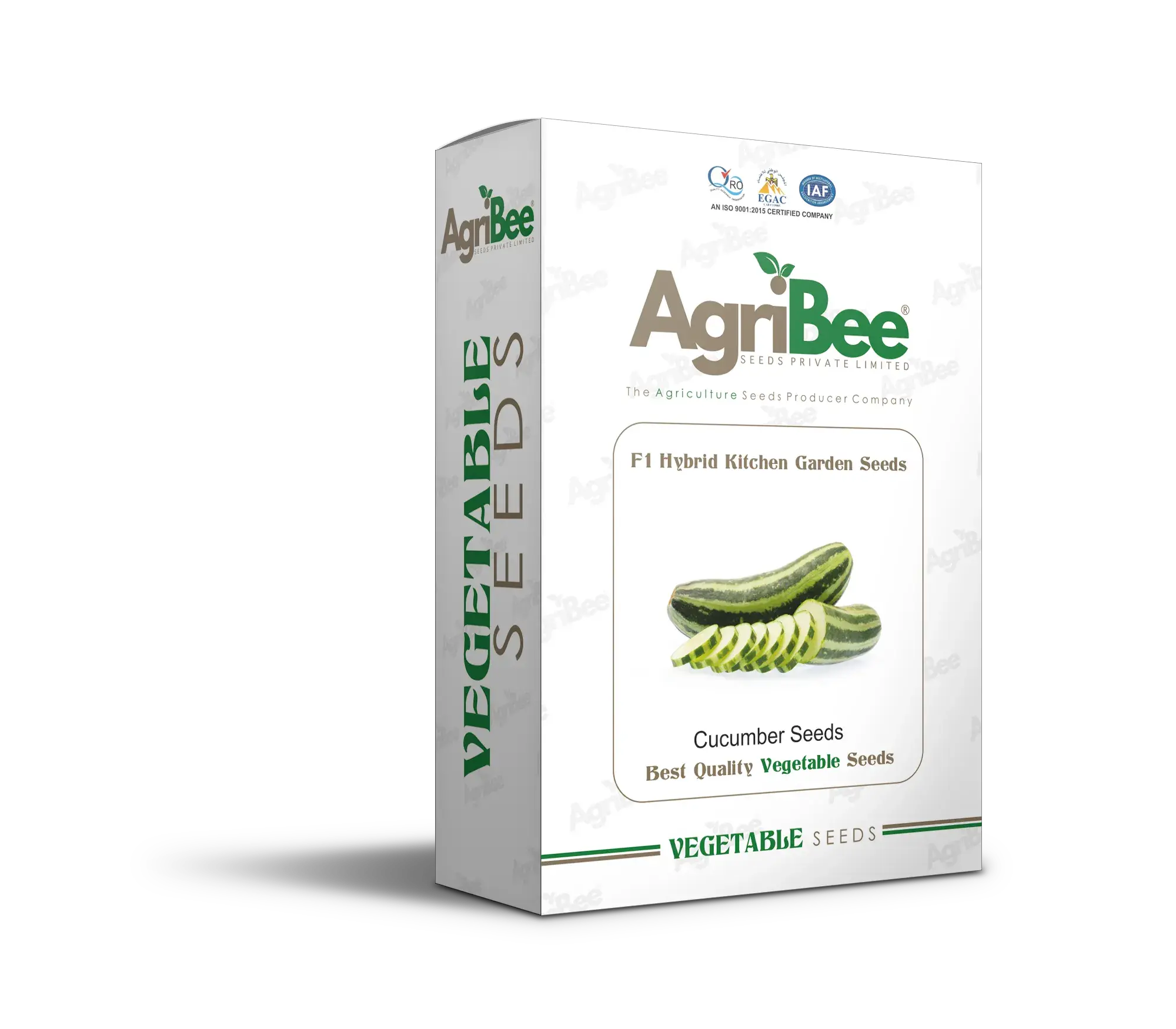
Fruits are cylindrical, uniformly shaped, with smooth light to medium green skin. Flesh is crisp, tender, and mildly flavored with minimal seed cavity development. The product exhibits excellent eating quality suited for fresh consumption.
| Quality Parameter | Agronomic Standard | Farmer & Market Benefit |
|---|---|---|
| First Harvest Stage | 45–50 Days after Sowing | Enables early market entry when prices are typically favorable due to limited supply |
| Harvest Maturity Signs | Fruit length 18–22 cm, uniform light-green color, firm texture, skin smooth without yellowing | Prevents over-maturity which causes hollow fruit, bitter taste, and seed hardening |
| Shelf Life & Keeping Quality | 7–10 days under refrigerated storage (8–10°C); 3–4 days at ambient temperature | Good post-harvest longevity allows transport to distant mandis and retail outlets with minimal quality loss |
| Market Suitability | Fresh table market, grocery stores, hotels & restaurants, urban retail chains | Attractive uniform fruit commands premium rates in organized and unorganized markets |
⭐ Varietal Features — F1 Hybrid Cucumber
Distinguishing characteristics that make this variety a top choice for Indian growers.
🌿 Core Variety Highlight
AgriBee F1 Hybrid Cucumber delivers exceptional field uniformity, strong early vigor, and consistent fruit set under diverse Indian growing conditions.
🌿 Produce Quality & Appearance
Cylindrical, uniformly sized fruits measuring 18–22 cm with attractive light to medium green coloration, firm crunchy flesh, and minimal seed development.
🌿 Stress & Disease Tolerance
Demonstrates good tolerance to common cucumber viral infections, moderate resistance to powdery mildew and downy mildew pressure, and reliable performance under temperate to subtropical environments.
🌿 Growth Habit & Vigor
Vigorous vine with compact branching habit, strong tendril attachment, and balanced vegetative-to-reproductive transition ideal for both trellised and open-canopy cultivation.
🌿 Crop Duration & Earliness
Early maturing hybrid reaching first harvest in 45–50 days, enabling faster crop turn-around and flexibility in sequential planting schedules.
🌿 Market & Farmer Preference
Trusted by progressive farmers and kitchen gardeners across India for its reliable fruit quality, visual appeal, and consistent performance season after season.