Description
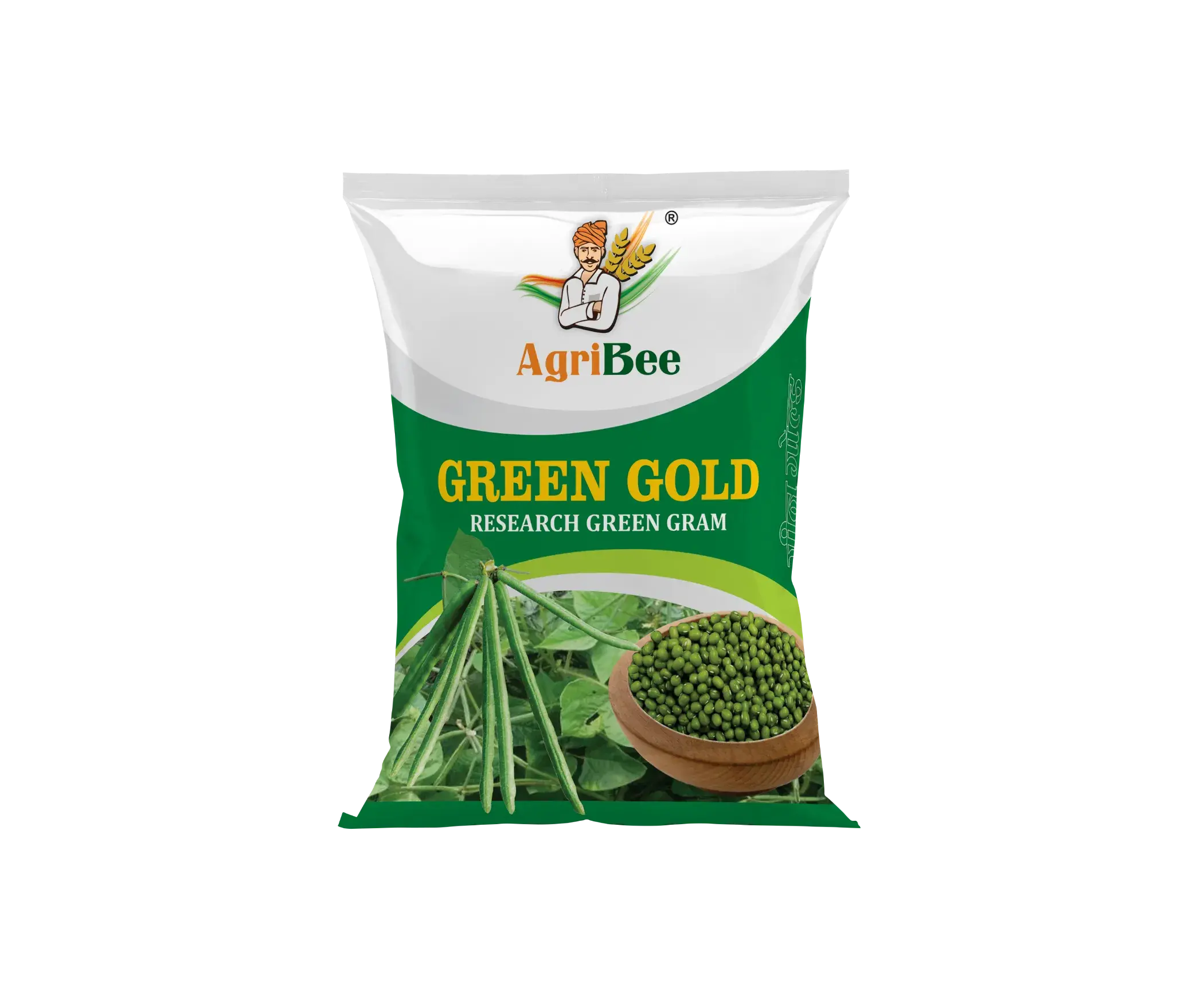
Farming & Cultivation Guide — GreenGram GreenGold
Complete step-by-step agronomic guide for optimal crop management, disease resistance, and premium produce quality.
🌾 Soil Preparation & Field Prep
Proper land preparation ensures uniform seedling emergence and robust root anchorage.
🌱 Ideal Soil Type & pH
Well-drained sandy loam to medium black cotton soils with pH 6.5–8.0. Deep, fertile soils with good organic matter content are preferred. Waterlogging must be strictly avoided.
✨ Core Advantage
Loose, friable seedbed ensures rapid seed germination and deep root penetration, promoting strong nodulation and overall canopy development.
- 1
Deep summer ploughing followed by 2–3 cross-harrowings to obtain fine tilth and break soil crusts.
- 2
Field leveling with burrowing or levelling for uniform moisture distribution and drainage preparation.
- 3
Incorporation of well-decomposed FYM (5–8 t/ha) or vermicompost at land preparation stage to boost soil biology and nutrient availability.
- 4
Application of sulphur (10 kg/ha) in low-sulphur soils and inoculation with Rhizobium culture and PSB biofertilizers for enhanced nitrogen fixation.
🌱 Sowing Time & Method
Precise seed rate and spacing maximize light interception and canopy development.
| Parameter | Recommendation | Agronomic Importance |
|---|---|---|
| Sowing Window | Early June to mid-July (Kharif) / Early October to mid-November (Rabi) depending on region | Aligns sowing with monsoon onset or post-monsoon soil moisture for optimal germination and growth |
| Seed Rate | 40–50 kg/ha (20–22 kg/acre) for line sowing; 50–60 kg/ha for broadcast | Ensures optimum plant population without overcrowding, supporting healthy branching and pod set |
| Spacing | 30 cm (row-to-row) × 10 cm (plant-to-plant) | Provides adequate canopy spread, air circulation, and light penetration for uniform pod development |
| Sowing Depth | 3–5 cm in normal soils; 4–5 cm in light sandy soils | Ensures sufficient soil contact for consistent moisture uptake while allowing easy seedling emergence |
💧 Irrigation & Water Management
Adequate moisture regulation supports strong vegetative and reproductive growth.
☀️ Water Requirement Profile
GreenGram GreenGold exhibits moderate drought tolerance, making it suitable for rainfed and limited-irrigation ecosystems. The crop requires approximately 400–500 mm of water over its lifecycle. Drip irrigation is highly compatible and can improve water use efficiency by 30–40%, especially in sandy soils of Gujarat and Rajasthan where frequent light irrigation is recommended.
🌦️ Soil Moisture Management
In rainfed conditions, moisture conservation through mulching (paddy straw @ 3–4 t/ha) and timely sowing within the optimal window is critical. Avoid waterlogging at any stage, as root rot and fungal diseases develop rapidly in saturated soils.
- ✓
First irrigation at 7–10 DAS to support uniform germination and early seedling establishment, especially in dry soils.
- ✓
Irrigate at 15-day intervals during the vegetative phase (15–35 DAS) depending on soil type and rainfall pattern; light but frequent irrigation for sandy soils.
- ✓
Critical irrigation at flowering initiation (35–40 DAS), pod set (40–50 DAS), and grain filling (50–60 DAS). Moisture stress during these stages significantly affects pod retention and grain quality.
- ✓
Stop irrigation 7–10 days before harvest to allow even drying, improve pod maturity, and reduce field losses during picking.
🧪 Fertilizer & Nutrition Management
Balanced crop nutrition supports robust plant structure and premium produce quality.
| Nutrient | Recommended Dose (per Acre) | Application Method & Timing |
|---|---|---|
| Nitrogen (N) | 20–25 kg N/ha (12–15 kg/acre) | 100% basal at sowing. In high-N soils with effective Rhizobium inoculation, zero external N may be applied. Split application not recommended unless soil tests indicate deficiency. |
| Phosphorus (P2O5) | 40–50 kg P2O5/ha (16–20 kg/acre) | 100% basal as DAP (21% N, 53% P2O5) or SSP along with seed treatment. Band placement 5–7 cm below seed improves P availability in fixed soils. |
| Potash (K2O) | 20–30 kg K2O/ha (8–12 kg/acre) | 100% basal as MOP or SOP. In potash-deficient black soils of Maharashtra and MP, split application (75% basal + 25% at first flower) enhances grain firmness and shelf life. |
🌿 Interculture & Weed Management
Timely weed control ensures optimal nutrient and moisture availability for crop seedlings.
-
1
First Weeding & Hoeing: Carried out at 10–12 DAS using a hand hoe or sickle. This is the most critical period for weed competition. Early weeding prevents performance loss and reduces labour cost in subsequent operations.
-
2
Second Weeding & Earthing-Up: Conducted at 25–30 DAS. Light earthing-up around the plant base supports root anchorage, improves aeration, and covers any exposed lateral roots formed during branching.
-
3
Mulching & Inter-row Cultivation: Organic mulching with paddy straw or dried weeds (@ 3–4 t/ha) applied at 20–25 DAS conserves soil moisture, suppresses weed flush, and moderates soil temperature. Inter-row hoeing should be shallow (5 cm depth) to avoid root damage.
🛡️ Pest & Disease Management
Proactive crop monitoring and integrated management ensure healthy crop development.
🐛 Insect Pest Management
- Leafhopper (Amritodus atkinsoni): Sucks sap from leaf undersides causing yellowing and silvering. Control: Spray Dimethoate 30 EC @ 2 ml/Litre or Imidacloprid 17.8 SL @ 0.5 ml/Litre. Deploy yellow sticky traps at 15/day for monitoring.
- Pod Borer (Helicoverpa armigera): Larvae bore into pods consuming developing seeds. Control: Apply Spinosad 45 SC @ 0.3 ml/Litre or Bacillus thuringiensis (@ 2 g/Litre) at first sign of infestation. Pheromone traps at 10/acre for population monitoring.
- Pod Bug / Stink Bug (Erinnyis spp.): Pierces pods causing shrivelled seeds and premature pod drop. Control: Spray Chlorantraniliprole 18.5 SC @ 0.3 ml/Litre or Carbaryl 50 WP @ 1 g/Litre. Destroy weed hosts around field margins.
🔬 Disease Control
- Yellow Mosaic Virus (YMV): Caused by Bharpuri latent virus transmitted by whitefly. Symptoms include bright yellow mosaic on leaves, stunting, and reduced branching. Prevention: Use resistant varieties, uproot infected plants immediately, and spray Imidacloprid 17.8 SL @ 0.3 ml/Litre to control whitefly vector. Avoid late Kharif sowing in endemic areas.
- Powdery Mildew (Erysiphe polygoni): White powdery growth on leaves and pods, leading to premature defoliation. Control: Spray Sulphur WP @ 2 g/Litre or Myclobutanil 70 WP @ 0.3 g/Litre at first appearance. Ensure proper spacing for air circulation.
- Root Rot (Macrophomina phaseolina): Fungal disease causing wilting, root blackening, and plant death. Prevention: Seed treatment with Thiram @ 2.5 g/kg seed or Trichoderma viride @ 4 g/kg seed. Avoid waterlogged conditions and practice 2–3 year rotation with non-legume crops.
✂️ Harvesting & Produce Quality Guide
Harvesting at peak maturity ensures maximum commercial grade and long keeping quality.
⏱️ Harvesting Schedule & Timing
harvest begins at 55–60 DAS. Subsequent pickings at 8–10 day intervals. GreenGram GreenGold produces pods sequentially from lower nodes upward, requiring 3–4 picking rounds over a 2–3 week period.
⭐ Produce Quality Characteristics
Pods are bright green, smooth, and uniformly filled with round-seeded grains. The variety produces attractive green pods that retain colour and firmness well after harvest. Grains are small, oval, and possess excellent cooking quality with a soft texture and pleasant flavour.
| Quality Parameter | Agronomic Standard | Farmer & Market Benefit |
|---|---|---|
| Harvest Stage | 55–60 Days After Sowing (DAS) — when lower pods turn brown and begin to dry on the plant | Ensures peak quality with full grain development and early market arrival for better price realization |
| Harvest Maturity Signs | Pods change from green to pale brown/yellow, seeds rattle inside when shaken, and pod stems begin to dry | Prevents over-maturity which leads to pod shattering, grain splitting, and quality deterioration |
| Shelf Life & Keeping Quality | Fresh green pods: 3–5 days at ambient temperature (15–28°C); Shelled green gram: 6–8 months under dry, cool storage with moisture content below 10% | Facilitates transport to distant markets and provides extended selling window without significant quality loss |
| Market Suitability | Fresh pod market, dry pulse mandi trade, food processing units, and direct consumer sales. Preferred by traders for uniform size and clean grain appearance | Commands premium rates in both fresh and dry markets due to consistent quality, good grading, and consumer acceptance |
⭐ Varietal Features — GreenGram GreenGold
Distinguishing characteristics that make this variety a top choice for Indian growers.
🌿 Core Variety Highlight
GreenGram GreenGold is a high-performing Phaseolus aureus variety developed for robust field performance under diverse Indian agro-climatic conditions, combining early maturity, strong branching, and uniform pod set.
🌿 Produce Quality & Appearance
Produces bright green, straight pods with attractive appearance. Grains are small, round, and green with excellent cooking quality — soft texture, quick cooking time, and appealing taste preferred by consumers across India.
🌿 Stress & Disease Tolerance
Demonstrates good field tolerance to Yellow Mosaic Virus, powdery mildew, and root rot under moderate pressure. Exhibits reasonable drought resilience, making it suitable for rainfed and marginal environments.
🌿 Growth Habit & Vigor
Compact plant stature of 50–60 cm with 5–8 productive branches per plant. Erect to semi-erect habit ensures efficient canopy architecture, good light interception, and ease of manual harvesting.
🌿 Crop Duration & Earliness
Reaches 50% flowering in 35–40 DAS and matures in 55–65 DAS, enabling timely land prep for succeeding Rabi or Kharif crops. Early maturity supports profitable double-cropping systems in central and western India.
🌿 Market & Farmer Preference
Favored by farmers for reliable germination, vigorous seedling growth, and uniform maturity. Traders and processors appreciate the clean, small-seeded variety with high grading consistency. Available in convenient 1 kg packing for precision sowing and easy handling.