Description
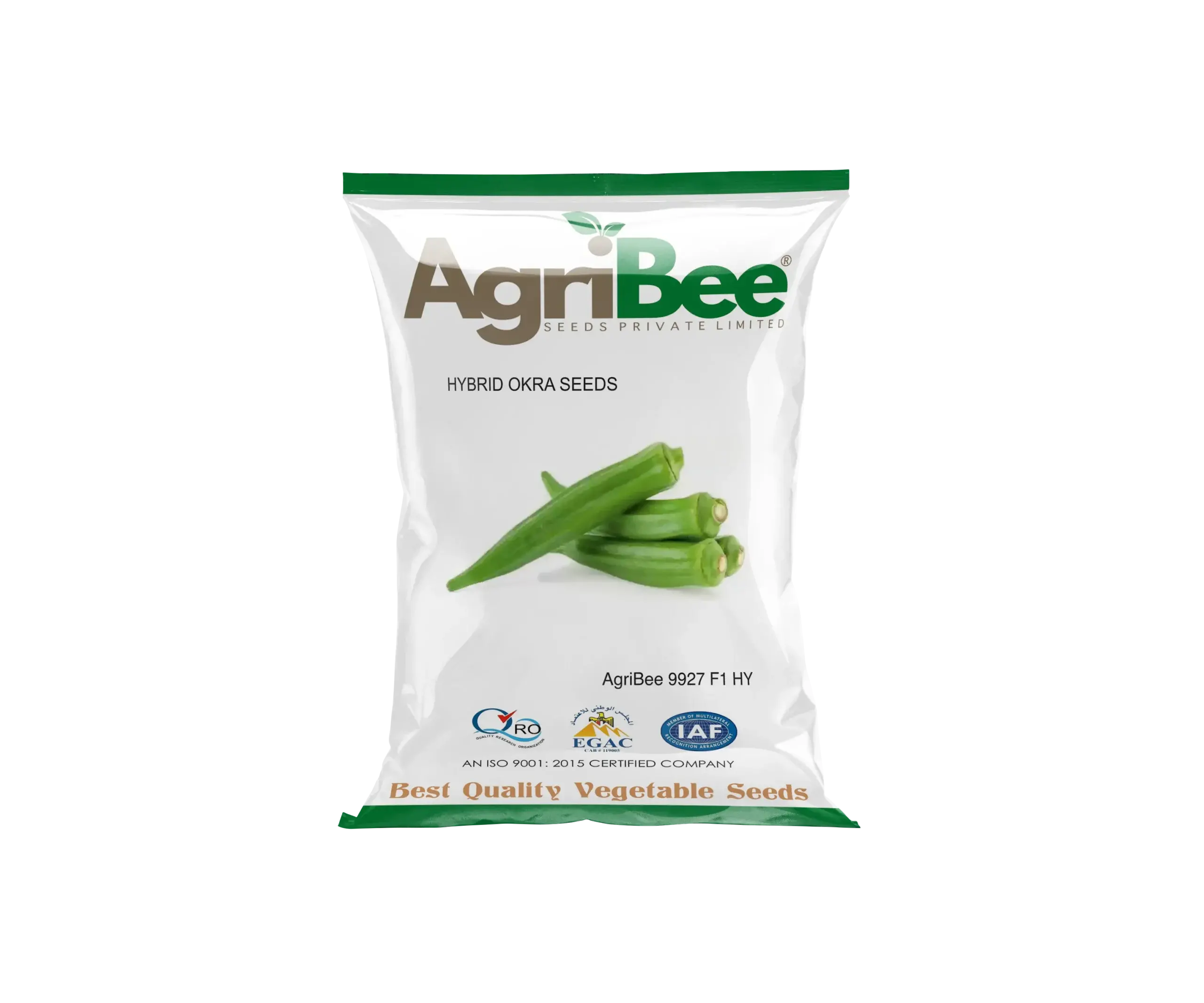
Farming & Cultivation Guide — Okra Seeds AgriBee 9927 F1 HY
Complete step-by-step agronomic guide for optimal crop management, disease resistance, and premium produce quality.
🌾 Soil Preparation & Field Prep
Proper land preparation ensures uniform seedling emergence and robust root anchorage.
🌱 Ideal Soil Type & pH
Well-drained loamy or sandy-loam soils with pH 6.0–7.5. Okra thrives in deep, fertile soils with good organic matter content and moderate moisture retention.
✨ Core Advantage
Loose, well-aerated seedbed ensures rapid and uniform germination of F1 hybrid seeds, strong early root development, and optimal anchorage for vigorous plant growth.
- 1
Deep summer ploughing to 25–30 cm followed by 2–3 cross-harrowings for fine tilth and weed seed burial.
- 2
Field leveling with laser levelling preferred; ensure proper drainage channels to prevent waterlogging during monsoon.
- 3
Incorporate 15–20 tonnes per hectare of well-decomposed FYM or compost 15 days before sowing for soil conditioning.
- 4
Test soil pH and apply gypsum (50 kg/ha) in acidic soils or neem-coated urea for balanced nutrition; avoid waterlogged or heavy clay soils.
🌱 Sowing Time & Method
Precise seed rate and spacing maximize light interception and canopy development.
| Parameter | Recommendation | Agronomic Importance |
|---|---|---|
| Sowing Window | Kharif: June–July | Rabi: Oct–Nov | Summer: March–April | Okra is a warm-season crop; sowing after soil temperature reaches 18°C ensures optimal germination and protects seedlings from chilling damage. |
| Seed Rate | 250–300 g per acre (direct sowing) | Hybrid F1 seeds have high viability; recommended rate maintains optimal plant population without wastage. |
| Spacing | 60 cm (row-to-row) x 45 cm (plant-to-plant) | Adequate canopy spread, improved air circulation, reduced humidity-related disease pressure, and easy interculture operations. |
| Sowing Depth | 2–3 cm below soil surface | Shallow sowing promotes uniform and rapid germination; deeper sowing delays emergence and reduces stand consistency. |
💧 Irrigation & Water Management
Adequate moisture regulation supports strong vegetative and reproductive growth.
☀️ Water Requirement Profile
Okra exhibits moderate drought tolerance due to its taproot system, but consistent soil moisture is critical during flowering and fruiting stages. Drip irrigation is highly compatible and improves water use efficiency by 30–40% compared to flood irrigation. Maintain soil moisture at 60–70% of field capacity throughout the crop cycle.
🌦️ Soil Moisture Management
In rainfed situations, sow during periods of reliable rainfall. Apply light irrigation immediately after sowing for germination. Use mulching (straw or polyethylene) to conserve soil moisture and reduce evapotranspiration during dry spells.
- ✓
First irrigation (dead irrigation) within 24–48 hours of sowing is essential for seed swelling and germination initiation.
- ✓
During vegetative phase (20–40 DAS), irrigate at 8–10 day intervals depending on soil type and weather conditions.
- ✓
Critical stage irrigation during flowering and fruit set (45–75 DAS) — moisture stress at this stage causes flower drop and malformed fruits.
- ✓
Withhold irrigation 5–7 days before last harvest to improve fruit firmness and shelf life; avoid water stagnation around the root zone.
🧪 Fertilizer & Nutrition Management
Balanced crop nutrition supports robust plant structure and premium produce quality.
| Nutrient | Recommended Dose (per Acre) | Application Method & Timing |
|---|---|---|
| Nitrogen (N) | 60–80 kg/acre | 50% basal at sowing + 50% top-dressing at 30 DAS for sustained vegetative growth and fruit production. |
| Phosphorus (P2O5) | 40–50 kg/acre | 100% basal application as DAP (18-46-0) or SSP during seedbed preparation for root development and early growth. |
| Potash (K2O) | 30–40 kg/acre | 100% basal application as MOP; split half at basal and half at 30 DAS for improved fruit quality and disease tolerance. |
🌿 Interculture & Weed Management
Timely weed control ensures optimal nutrient and moisture availability for crop seedlings.
-
1
First Weeding & Hoeing: Carry out at 15–20 DAS using a rotating hoe or hand weeding. Early weed control is critical as okra is a slow initial grower and competes poorly with weeds during the first three weeks.
-
2
Second Weeding & Earthing-Up: Perform at 30–35 DAS to control late-germinating weeds and mound soil around the base for improved root aeration and stability against lodging.
-
3
Mulching and Inter-row Cultivation: Apply black polyethylene mulch or straw mulch (@ 2–3 t/ha) immediately after sowing to suppress weeds, conserve moisture, and maintain soil temperature. Remove any side shoots (suckers) below the first fruit branch to direct energy toward main stem and fruit production.
🛡️ Pest & Disease Management
Proactive crop monitoring and integrated management ensure healthy crop development.
🐛 Insect Pest Management
- Shoot and Fruit Borer (Helicoverpa armigera): Larvae bore into young shoots and fruits causing wilting and fruit rot. Control: Spray cartap hydrochloride 50 WP @ 0.5 g/L or spinosad 45 SC @ 0.3 ml/L at 30, 45, and 60 DAS. Install pheromone traps @ 10/acre for monitoring and mass trapping.
- Jassid / Leafhopper (Amrasca biguttula biguttula): Sucks sap from leaves causing yellowing, curling, and drying. Vector of YVMV. Control: Spray imidacloprid 17.8 SL @ 0.3 ml/L or acetamiprid 20 SP @ 0.5 g/L. Use silver mulch film to repel jassids. Remove and destroy infected plants immediately.
- Whitefly (Bemisia tabaci): Causes honeydew deposition, sooty mould, and virus transmission. Control: Spray thiamethoxam 25 WG @ 0.3 g/L or clothianidin 50 WDG @ 0.4 g/L. Install yellow sticky traps @ 10–12/acre for monitoring and control.
🔬 Disease Control
- Yellow Vein Mosaic Virus (YVMV): Cause: Okra yellow vein mosaic virus (OYVMV), transmitted persistently by whitefly vector. Symptoms: chlorotic yellow veins on leaves, stunted growth, reduced fruiting. Control: Resistant varieties like AgriBee 9927 F1 HY. Whitefly management is critical — spray insecticides at 10-day intervals from 25 DAS. Rogue and destroy infected plants.
- Powdery Mildew (Erysiphe cichoracearum): White powdery growth on leaves and stems, causing premature leaf drying. Control: Spray sulphur dust @ 15–20 kg/acre or myclobutanil 8.4 WP @ 0.3 g/L. Ensure adequate spacing for air circulation and avoid overhead irrigation.
- Fruit and Shoot Borer with Bacterial Blight (Xanthomonas axonopodis pv. malvavascularum): Water-soaked lesions on leaves and fruits, eventual wilting. Control: Spray copper oxychloride 50 WP @ 2.5 g/L or streptocycline 50 ppm @ 0.1 g/L. Practice crop rotation with non-host crops and use disease-free certified seeds.
✂️ Harvesting & Produce Quality Guide
Harvesting at peak maturity ensures maximum commercial grade and long keeping quality.
⏱️ Harvesting Schedule & Timing
First picking begins 45–50 days after sowing. Subsequent pickings are taken every 2–3 days during peak production. Total harvesting period extends 45–60 days with 6–8 pickings.
⭐ Produce Quality Characteristics
Dark green, slender fruits with 5 prominent ridges, 10–12 cm length, firm texture, tender internal structure with minimal fibre. Superior taste and low mucilage content make this variety highly preferred in fresh market channels.
| Quality Parameter | Agronomic Standard | Farmer & Market Benefit |
|---|---|---|
| First Harvest Stage | 45–50 Days after Sowing | Enables early market arrival capturing premium prices during initial season scarcity. |
| Harvest Maturity Signs | Fruits 10–12 cm long, dark green, tender when bent, seeds not yet hardened | Ensures optimal tenderness, flavour, and commercial grade; prevents over-maturity leading to fibrous, inedible pods. |
| Shelf Life & Keeping Quality | 3–4 days under ambient conditions; 7–10 days at 8–10°C with high humidity | Good post-harvest longevity supports transport to distant mandis and retail chains with minimal quality degradation. |
| Market Suitability | Fresh table market, premium mandis, export-quality, processing units | Uniform dark green colour, slender shape, and YVMV tolerance make this variety highly sought after by traders and exporters for consistent quality supply. |
⭐ Varietal Features — Okra Seeds AgriBee 9927 F1 HY
Distinguishing characteristics that make this variety a top choice for Indian growers.
🌿 Core Variety Highlight
AgriBee 9927 F1 HY is a high-performing hybrid specifically bred for Yellow Vein Mosaic Virus resistance, making it one of the most reliable okra varieties for virus-prone regions across India.
🌿 Produce Quality & Appearance
Produces slender, dark green fruits with 5 well-defined ridges measuring 10–12 cm in length. The fruits are tender, fibre-free, and visually appealing with excellent gloss and uniform colouration.
🌿 Stress & Disease Tolerance
Field-tolerant to Yellow Vein Mosaic Virus (YVMV), the most devastating okra disease in India. Exhibits good tolerance to heat stress and moderate resistance to jassid and whitefly infestations.
🌿 Growth Habit & Vigor
Compact, upright plant architecture with vigorous vegetative growth. Strong primary stem with well-spaced branches ensures efficient light interception and high fruit-bearing capacity per plant.
🌿 Crop Duration & Earliness
Early maturity with first harvest in just 45–50 days, enabling multiple cropping cycles, quicker crop rotation, and faster return on investment for farmers.
🌿 Market & Farmer Preference
Farmers favour AgriBee 9927 F1 HY for its disease resilience, early return, uniform fruit quality, and consistent plant vigor. Traders and processors appreciate the dark green, slender, ridged fruits that meet premium market standards.