Description
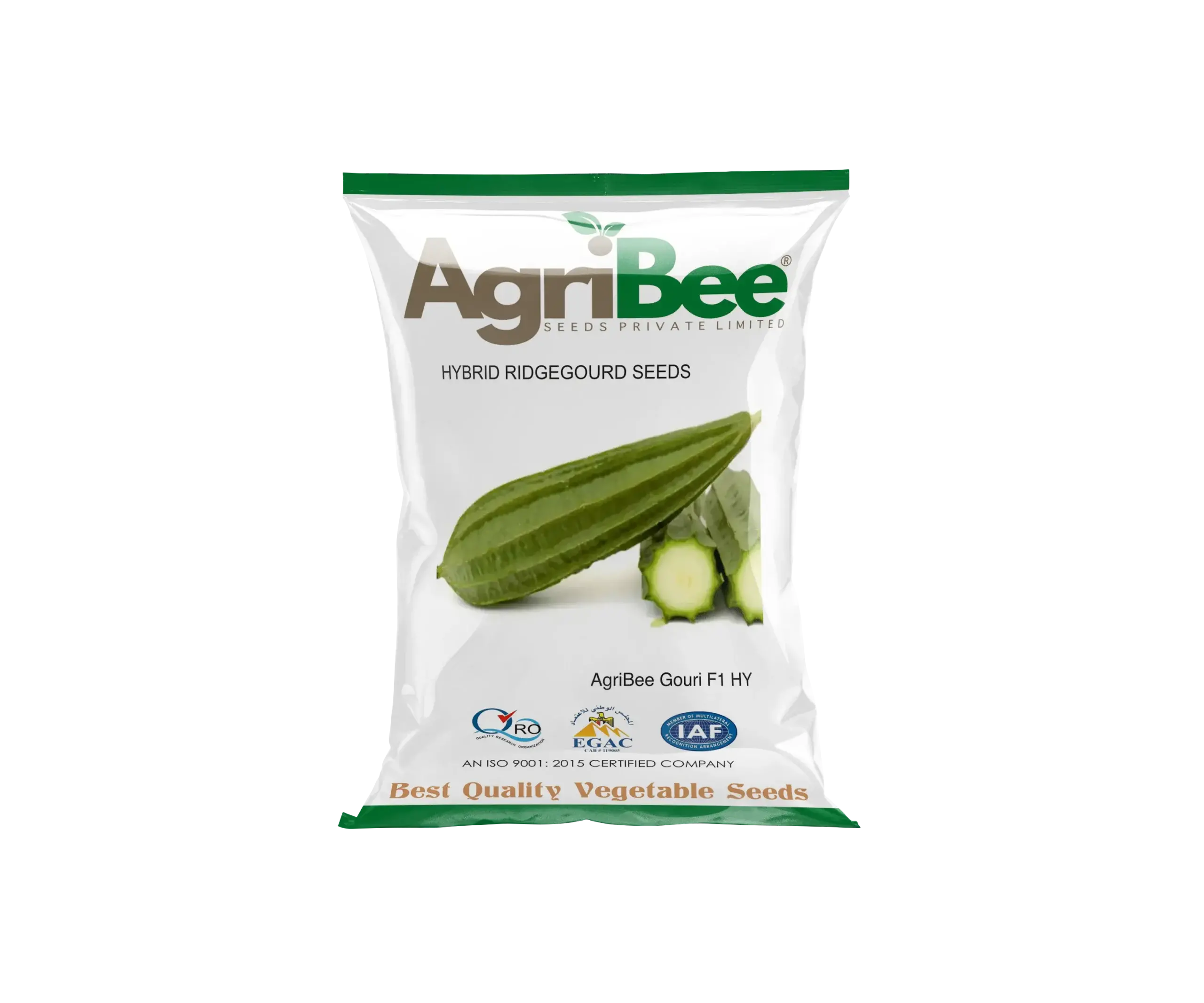
Farming & Cultivation Guide — Sponge Gourd Seeds AgriBee Gauri F1 HY
Complete step-by-step agronomic guide for optimal crop management, disease resistance, and premium produce quality.
🌾 Soil Preparation & Field Prep
Proper land preparation ensures uniform seedling emergence and robust root anchorage.
🌱 Ideal Soil Type & pH
Well-drained loamy or sandy-loam soils with good organic matter content. pH range: 6.0–7.5. Heavy clay or waterlogged soils should be avoided as they promote root rot and poor vine development.
✨ Core Advantage
Loose, well-aerated seedbed ensures rapid seed germination within 5–7 days, strong initial root establishment, and vigorous vine spread essential for Luffa cultivation.
- 1
Deep summer ploughing to a depth of 25–30 cm followed by 2–3 cross-harrowings for fine tilth and good seed-soil contact.
- 2
Field leveling and preparation of adequate drainage channels to prevent water stagnation during heavy monsoon rains.
- 3
Incorporation of 8–10 tonnes per acre of well-decomposed Farm Yard Manure (FYM) or compost during the last harrowing for improved soil structure and moisture retention.
- 4
Soil health conditioning with a pH test; if acidic (pH below 6.0), apply 200–250 kg/acre of agricultural lime 15 days before sowing for optimal nutrient uptake.
🌱 Sowing Time & Method
Precise seed rate and spacing maximize light interception and canopy development.
| Parameter | Recommendation | Agronomic Importance |
|---|---|---|
| Sowing Window | June–July for Kharif season; October–November for Rabi season in most Indian growing regions | Aligns sowing with warm soil temperatures (25–30°C) essential for rapid germination and avoids extreme cold damage during fruiting |
| Seed Rate | 50–75 g per acre (direct sowing); 25–30 g per acre (transplanted nursery method) | Maintains optimal plant population of 4,000–5,000 plants per acre ensuring uniform canopy development and vine spread |
| Spacing | Row-to-row: 1.5–2.0 m; Plant-to-plant: 60–75 cm on mounds or pits | Provides adequate inter-row spacing for vine spreading, field access during intercultural operations, and improved air circulation reducing disease incidence |
| Sowing Depth | 2.5–3.0 cm for direct sowing on mounds; 1.5–2.0 cm for nursery trays | Optimal depth ensures proper seed emergence without exhausting seed reserves; deeper sowing in light sandy soils and shallower in heavy soils |
💧 Irrigation & Water Management
Adequate moisture regulation supports strong vegetative and reproductive growth.
☀️ Water Requirement Profile
Sponge gourd is moderately drought-tolerant once established but requires consistent moisture during active vine growth and fruit development phases. Drip irrigation is highly recommended for efficient water use, reduced disease pressure, and uniform plant growth. Under drip systems, apply 2–3 mm of water every 3–4 days during peak summer months. The crop can sustain short dry spells of 7–10 days but fruit quality and vine vigor decline under prolonged moisture stress.
🌦️ Soil Moisture Management
In rainfed cultivation, ensure good soil moisture conservation through mulching with straw or dry leaves around the base of plants. Raised bed cultivation prevents waterlogging during heavy showers. Apply light irrigations immediately after sowing and then maintain soil moisture at field capacity during the critical flowering and fruiting stages, particularly during any dry breaks in monsoon rainfall.
- ✓
First irrigation must be applied within 24–48 hours after sowing to ensure uniform seed germination and seedling emergence across the field.
- ✓
During vegetative phase (15–30 DAS), irrigate every 7–10 days to support vigorous vine growth and leaf expansion; avoid waterlogging at all costs.
- ✓
Critical irrigation stage occurs during flowering and early fruit set (30–50 DAS); maintain consistent soil moisture to prevent flower drop, abortive fruits, and fruit formation.
- ✓
Reduce irrigation frequency 7–10 days before final harvest to improve fruit firmness, enhance shelf life, and concentrate flavors in the produce.
🧪 Fertilizer & Nutrition Management
Balanced crop nutrition supports robust plant structure and premium produce quality.
| Nutrient | Recommended Dose (per Acre) | Application Method & Timing |
|---|---|---|
| Nitrogen (N) | 40–50 kg/acre | 50% basal at sowing along with phosphorus and potash; remaining 50% top-dressed as a side dressing at 25–30 DAS for sustained vine growth and foliage development |
| Phosphorus (P2O5) | 25–30 kg/acre | 100% basal application incorporated into the soil at final harrowing along with FYM before sowing for strong root development and early establishment |
| Potash (K2O) | 20–25 kg/acre | Applied in two splits — 50% at basal sowing and 50% at 30 DAS to support fruit development, improve fruit shape uniformity, and enhance overall plant vigor |
🌿 Interculture & Weed Management
Timely weed control ensures optimal nutrient and moisture availability for crop seedlings.
-
1
First Weeding & Hoeing: Carried out at 10–15 DAS to remove early weed flush and loosen soil surface. Shallow hoeing (5 cm depth) is critical to avoid damaging the shallow root system of young seedlings while maintaining a weed-free zone around each plant for 30–45 days.
-
2
Second Weeding & Earthing-Up: Performed at 25–30 DAS with slightly deeper hoeing (8–10 cm) in inter-row spaces only. Light earthing-up around plant bases improves root anchorage for growing vines and prevents soil-borne pathogens from splashing onto lower leaves during irrigation or rain.
-
3
Special Interculture Operation: Apply 3–4 cm thick organic mulch (straw or dried leaves) around plants immediately after second weeding to conserve soil moisture, suppress weed growth, and moderate soil temperature. Train vines on trellis or support structure at 20–25 DAS by selecting 2–3 healthy primary vines per plant and guiding them upward. Remove suckers and lateral branches from the first 3–4 nodes to focus plant energy on main vine growth and fruit production.
🛡️ Pest & Disease Management
Proactive crop monitoring and integrated management ensure healthy crop development.
🐛 Insect Pest Management
- Aphids (Greenfly): Small green or black sap-sucking insects cluster on tender shoots and flower buds causing curling, stunted growth, and sooty mold development. Control: Spray Imidacloprid 17.8% SL at 0.3 ml/liter of water or Acephate 75% SP at 1.0 g/liter. Release ladybird beetles (Cryptolaemus montrouzieri) at 50,000 per acre as biological control. Apply yellow sticky traps at 10 per acre for monitoring and mass trapping.
- Fruit Borers (Melon Fruit Borer): Larvae bore into developing fruits causing entry holes with frass exudation and direct fruit destruction. Control: Spray Spinosad 45% SC at 0.5 ml/liter or Chlorantraniliprole 18.5% SC at 0.3 ml/liter at 15-day intervals starting from first flower appearance. Install pheromone traps (fruit borer specific) at 5 per acre for early detection. Remove and destroy infested fruits immediately to break the pest cycle.
- Whiteflies: Tiny white-winged insects feed on sap from leaf undersides causing yellowing, leaf curling, and honeydew-induced sooty mold. Control: Spray Thiamethoxam 25% WG at 0.2 g/liter or Diafenthiuron 50% WP at 1.5 g/liter. Blue sticky traps at 10 per acre aid in monitoring. Intercrop with marigold or cos sblosoma at field margins as a trap crop to divert whitefly populations.
🔬 Disease Control
- Powdery Mildew (Erysiphe cichoracearum): White powdery fungal growth on leaf surfaces appearing as circular patches, progressing to complete leaf coverage causing premature senescence and reduced photosynthetic activity. Prevention: Spray Sulphur 80% WP at 2.0 g/liter or Myclobutanil 6.9% WP at 0.5 g/liter at 10–12 day intervals starting from 30 DAS. Avoid overhead irrigation to reduce leaf wetness. Maintain adequate inter-row spacing for airflow.
- Downy Mildew (Pseudoperonospora cubensis): Yellow angular lesions on upper leaf surfaces with characteristic purple-gray sporulation on the underside during humid conditions leading to rapid defoliation. Prevention: Spray Metalaxyl 35% WS at 2.0 g/liter or Mancozeb 75% WP at 2.5 g/liter weekly during high humidity periods. Crop rotation with non-cucurbit crops for 2–3 seasons reduces soil-borne inoculum levels.
- Fusarium Wilt (Fusarium oxysporum f. sp. cucurbitae): Wilting of one or more vines starting from lower leaves, yellowing progressing upward, and brown discoloration of vascular tissues on stem cross-section. Prevention: Treat seeds with Trichoderma viride at 10 g/kg of seed before sowing. Apply soil drench of Carbendazim 50% WP at 2.5 g/liter at the first sign of wilting. Use raised beds for drainage and avoid waterlogging which favors pathogen proliferation.
✂️ Harvesting & Produce Quality Guide
Harvesting at peak maturity ensures maximum commercial grade and long keeping quality.
⏱️ Harvesting Schedule & Timing
First harvest begins 40–45 days after sowing when fruits reach marketable size. Subsequent pickings are made at 2–3 day intervals throughout the productive phase. Harvest in the early morning hours when temperatures are cool to maintain produce freshness and firmness.
⭐ Produce Quality Characteristics
Premium sponge gourd fruits exhibit uniform dark green coloration, smooth cylindrical shape without ridges deformation, firm texture, and tender flesh. The fruits should have a glossy appearance indicating fresh growth stage with no signs ofyellowing, blemishes, or pest damage. Optimal taste profile features mild sweetness with characteristic tenderness when cooked.
| Quality Parameter | Agronomic Standard | Farmer & Market Benefit |
|---|---|---|
| First Harvest Stage | 40–45 Days after Sowing | Ensures early market availability commanding premium prices and allows extended harvesting window for sustained income |
| Harvest Maturity Signs | Dark green uniform color, firm tactile feel, cylindrical shape reaching 35–40 cm length and 4–5 cm diameter | Prevents over-maturity that leads to fibrous texture, seed hardening, and reduced market acceptability |
| Shelf Life & Keeping Quality | 5–7 days under ambient conditions (25–30°C); 10–12 days under cool storage (10–12°C) with high humidity (85–90% RH) | Facilitates transportation to distant markets and retail outlets with minimal quality degradation and post-harvest losses |
| Market Suitability | Excellent for fresh market channels, wholesale mandis, modern retail chains, and processing units due to uniform size and attractive appearance | High consumer preference for consistent dark green, smooth-skinned fruits drives better realization and repeat purchases |
⭐ Varietal Features — Sponge Gourd Seeds AgriBee Gauri F1 HY
Distinguishing characteristics that make this variety a top choice for Indian growers.
🌿 Core Variety Highlight
AgriBee Gauri F1 HY is a hybrid sponge gourd variety specifically developed for Indian growing conditions, offering early fruiting capability with consistent vine performance across diverse agro-climatic zones including Kharif, Rabi, and Summer seasons.
🌿 Produce Quality & Appearance
Produces uniformly cylindrical, smooth-skinned fruits with rich dark green coloration. Fruit weight ranges 75–125 gm with ideal dimensions of 35–40 cm length and 4–5 cm diameter, meeting strict market grading standards preferred by traders and consumers.
🌿 Stress & Disease Tolerance
Demonstrates good field tolerance to common cucurbit pests including aphids, fruit borers, and whiteflies. Shows moderate resistance to powdery mildew and downy mildew under standard cultivation practices, reducing dependency on frequent chemical interventions.
🌿 Growth Habit & Vigor
Exhibits strong vine vigor with well-branched architecture suitable for both trellis and bush-type cultivation systems. Dense foliage canopy provides effective ground cover suppressing weeds naturally while supporting sustained fruit production over multiple picking cycles.
🌿 Crop Duration & Earliness
Earliest harvest at 40–45 days after sowing enables farmers to capture early market windows with favorable pricing. Extended productive phase supports 7–10 successive pickings over a prolonged harvesting period for continuous income generation.
🌿 Market & Farmer Preference
Consistent fruit uniformity, attractive dark green smooth appearance, and reliable early maturity make AgriBee Gauri F1 HY a preferred choice among progressive farmers, seed dealers, and traders seeking dependable quality and steady supply throughout the season.