Description
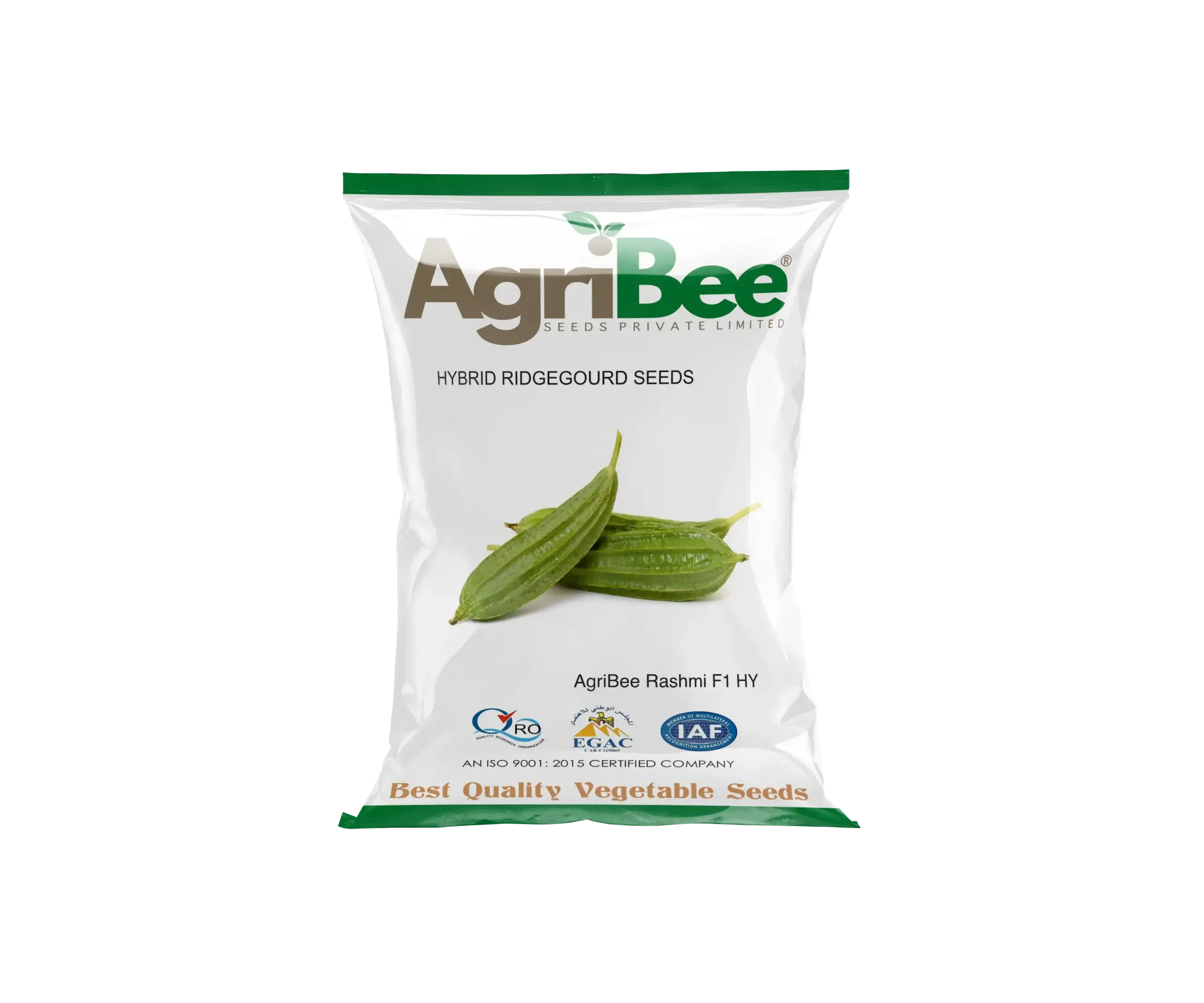
Farming & Cultivation Guide — Sponge Gourd Seeds AgriBee Rashmi F1 HY
Complete step-by-step agronomic guide for optimal crop management, disease resistance, and premium produce quality.
🌾 Soil Preparation & Field Prep
Proper land preparation ensures uniform seedling emergence and robust root anchorage.
🌱 Ideal Soil Type & pH
Well-drained sandy loam to loamy soils with good organic matter content. Soil pH range: 6.0–7.5. Deep, fertile soils with consistent moisture retention but free from waterlogging support vigorous vine growth and uniform fruit development.
✨ Core Advantage
Fine, loose seedbed texture ensures rapid and uniform germination, strong early root penetration, and effective anchorage for the sprawling vine habit of ridge gourd.
- 1
Deep summer ploughing (25–30 cm) followed by 2–3 cross-harrowings to achieve a fine tilth and break compacted layers.
- 2
Field leveling using a leveller or laser-leveling equipment; prepare adequate drainage channels to prevent water stagnation during monsoon rains.
- 3
Incorporate 8–10 tonnes per acre of well-decomposed Farm Yard Manure (FYM) or compost during the last harrowing to enhance soil structure and microbial activity.
- 4
Conduct a soil health test where feasible; if pH is below 6.0, apply 200–250 kg/acre of agricultural lime prior to sowing to optimize nutrient availability.
🌱 Sowing Time & Method
Precise seed rate and spacing maximize light interception and canopy development.
| Parameter | Recommendation | Agronomic Importance |
|---|---|---|
| Sowing Window | June–July (Kharif), Oct–Nov (Rabi), Feb–Mar (Summer) | Aligns with warm temperatures (25–32°C) essential for optimal germination and vine establishment. |
| Seed Rate | 60–80 g per Acre (Direct), 40–50 g per Acre (Transplanting) | Ensures adequate plant population without excessive competition for nutrients and light. |
| Spacing | 100 cm (Row-to-Row) × 30–40 cm (Plant-to-Plant) | Provides sufficient canopy spread, improves air circulation, and facilitates easy harvesting access. |
| Sowing Depth | 2–3 cm (1–1.5 inches) | Optimal depth ensures consistent moisture contact for uniform germination while preventing seed rot. |
💧 Irrigation & Water Management
Adequate moisture regulation supports strong vegetative and reproductive growth.
☀️ Water Requirement Profile
Ridge gourd requires moderate and regular irrigation throughout the growing cycle. The crop is moderately sensitive to drought stress, particularly during flowering and fruit development stages. Drip irrigation with fertigation is highly recommended for efficient water use, especially in sandy soils and summer seasons. Maintain soil moisture at 70–80% of field capacity for optimal vine growth and fruit quality.
🌦️ Soil Moisture Management
In rainfed environments, establish the crop at the onset of reliable rains. Mulching with straw or organic residue helps conserve soil moisture and suppress weeds. Avoid waterlogging at any stage, as saturated soils promote root rot and reduce vine vigor. Ensure proper surface drainage to quickly remove excess rainwater.
- ✓
First irrigation should be applied immediately after sowing (in dry soil conditions) to initiate germination. Subsequent light irrigations at 3–4 day intervals maintain seedbed moisture until emergence.
- ✓
During the active vegetative phase (15–30 DAS), irrigate at 5–7 day intervals to support rapid vine growth and leaf area expansion. Avoid prolonged dry spells that stunt foliage development.
- ✓
Critical irrigation is required from flowering initiation through fruit set (35–55 DAS). Consistent moisture during this period is vital for setting uniform, straight fruits and preventing flower drop. Reduce irrigation frequency slightly after 55 DAS to avoid excessive vegetative growth at the expense of fruit quality.
- ✓
Withhold irrigation 3–4 days before final harvest to improve fruit firmness and extend post-harvest shelf life. Do not over-water at harvest, as wet fruits are more prone to spoilage during transport.
🧪 Fertilizer & Nutrition Management
Balanced crop nutrition supports robust plant structure and premium produce quality.
| Nutrient | Recommended Dose (per Acre) | Application Method & Timing |
|---|---|---|
| Nitrogen (N) | 40–50 kg/acre | 50% basal at sowing + 50% top-dressed at 25–30 DAS. Split application prevents leaching losses and supports sustained vine growth. |
| Phosphorus (P2O5) | 25–30 kg/acre | 100% basal application at sowing through DAP or Single Super Phosphate. Promotes strong root development and early flowering. |
| Potash (K2O) | 20–25 kg/acre | 50% basal + 50% at 25–30 DAS through MOP. Enhances fruit firmness, disease tolerance, and overall crop vigor. |
🌿 Interculture & Weed Management
Timely weed control ensures optimal nutrient and moisture availability for crop seedlings.
-
1
First Weeding & Hoeing: Carried out at 10–12 DAS using a hand hoe or cultivator. Keeps the weed-free period during the critical early establishment phase. Shallow cultivation avoids damage to surface roots.
-
2
Second Weeding & Earthing-Up: Performed at 25–30 DAS to control residual weeds and provide gentle soil mounding around vine bases. This promotes adventitious root formation and improves stem stability as vines begin to climb.
-
3
Vine Training & Mulching: Train primary vines onto trellis wires or bamboo stakes at 20–25 DAS. Remove side shoots (suckers) beyond the 5th node to direct energy toward fruit production. Apply straw mulch between rows to conserve moisture, suppress weeds, and keep developing fruits clean and disease-free.
🛡️ Pest & Disease Management
Proactive crop monitoring and integrated management ensure healthy crop development.
🐛 Insect Pest Management
- Aphids (Aphis gossypii): Small, soft-bodied insects cluster on undersides of leaves and tender shoots, causing curling and yellowing. Control: Spray Imidacloprid 17.8% SL at 0.3 ml/L or Thiamethoxam 25% WG at 0.2 g/L. Apply at early infestation stage (15–20 DAS) and repeat at 7-day interval if needed. Encourage natural predators like ladybird beetles.
- Fruit & Shoot Borer (Deoproctis antiqualis): Larvae bore into young fruits and tender shoots, causing wilting and frass-filled holes. Control: Spray Chlorantraniliprole 18.5% SC at 0.3 ml/L or Spinosad 45% SC at 0.2 ml/L at 10–12 day intervals starting from flowering. Remove and destroyinfested shoots and fruits manually. Use pheromone traps at 10 traps/acre for monitoring.
- Cucurbit Fly (Melanomya laboriosa): Adult flies lay eggs near the soil line; larvae tunnel into roots and crown, causing sudden wilting and plant death. Control: Apply Carbofuran 3% GR at 10–12 kg/acre as soil drench at sowing. Practice crop rotation with non-cucurbits. Remove and burnInfected plants immediately to break the pest cycle.
🔬 Disease Control
- Powdery Mildew (Erysiphe cichoracearum): White powdery fungal growth on upper and lower leaf surfaces, leading to chlorosis and premature leaf senescence. Control: Spray Sulphur dust (80%) at 20 kg/acre or Propiconazole 25% EC at 0.5 ml/L at first appearance. Repeat at 10–12 day intervals. Avoid overhead irrigation to reduce leaf wetness.
- Downy Mildew (Pseudoperonospora cubensis): Angular yellow lesions on upper leaf surface with purplish-grey sporulation on the underside under humid conditions. Control: Spray Mancozeb 75% WP at 2.0 g/L or Metalaxyl 35% WS at 1.0 g/L at 7-day intervals from 25 DAS onwards. Apply early prophylactically in high-humidity Kharif conditions.
- Fusarium Wilt (Fusarium oxysporum f. sp. cucumerinum): Yellowing and wilting of lower leaves progressing upward; brown discoloration visible in vascular tissues on stem cross-section. Control: Seed treatment with Trichoderma viride at 4 g/kg seed or carbendazim at 2.5 g/L. Soil drench with Pseudomonas fluorescens at 10 g/L at 20 DAS. Remove and destroy affected plants; avoid planting in Infected fields for 2–3 seasons.
✂️ Harvesting & Produce Quality Guide
Harvesting at peak maturity ensures maximum commercial grade and long keeping quality.
⏱️ Harvesting Schedule & Timing
First picking begins at 40–45 days after sowing. Subsequent pickings are made at 2–3 day intervals throughout the harvest season, typically spanning 25–35 days of continuous fruit production.
⭐ Produce Quality Characteristics
Dark green, glossy cylindrical fruits with a smooth, firm texture and sweet, tender flavor. Uniform fruit shape and size with a tight, resilient skin indicate premium market quality. Fruits harvested at the tender stage have minimal seed development, making them ideal for culinary use.
| Quality Parameter | Agronomic Standard | Farmer & Market Benefit |
|---|---|---|
| First Harvest Stage | 40–45 Days after Sowing | Early market arrival commands better prices and shortens the overall crop cycle for subsequent plantings. |
| Harvest Maturity Signs | Fruits 35–40 cm long, 4–5 cm diameter, dark green color, firm to touch with smooth surface | Prevents over-maturity that leads to tough fibers, seeded interiors, and reduced market value. |
| Shelf Life & Keeping Quality | 5–7 days under ambient conditions; up to 10–12 days under cool storage (8–10°C) with high humidity | Extended shelf life enables wider market distribution and reduces post-harvest losses during transportation. |
| Market Suitability | Fresh market, local mandis, retail chains, and processing units across urban and semi-urban centers | Attractive dark green color and uniform cylindrical shape make this variety highly preferred by traders and consumers alike. |
⭐ Varietal Features — Sponge Gourd Seeds AgriBee Rashmi F1 HY
Distinguishing characteristics that make this variety a top choice for Indian growers.
🌿 Core Variety Highlight
AgriBee Rashmi F1 is a high-performing hybrid with superior genetic uniformity, vigorous vine growth, and consistently high fruit-setting ability under diverse Indian growing conditions.
🌿 Produce Quality & Appearance
Produces dark green, smooth-skinned, cylindrical fruits averaging 35–40 cm in length and 4–5 cm in diameter with excellent gloss, firmness, and tender texture throughout.
🌿 Stress & Disease Tolerance
Demonstrates robust field tolerance to common cucurbit diseases including powdery mildew and downy mildew, along with good resilience under moderate heat and variable moisture conditions.
🌿 Growth Habit & Vigor
Rapid early vine growth with balanced branching pattern and strong primary shoot development, ensuring efficient canopy coverage and healthy fruit-bearing nodes.
🌿 Crop Duration & Earliness
Earliest harvest window of 40–45 days after sowing enables quick crop turnaround, multiple picking cycles, and flexible integration into crop rotation systems across seasons.
🌿 Market & Farmer Preference
Farmers favor this AgriBee variety for its reliable fruit set, uniform size and color, long harvest span, and consistent performance that meets both domestic and commercial market standards.