Description
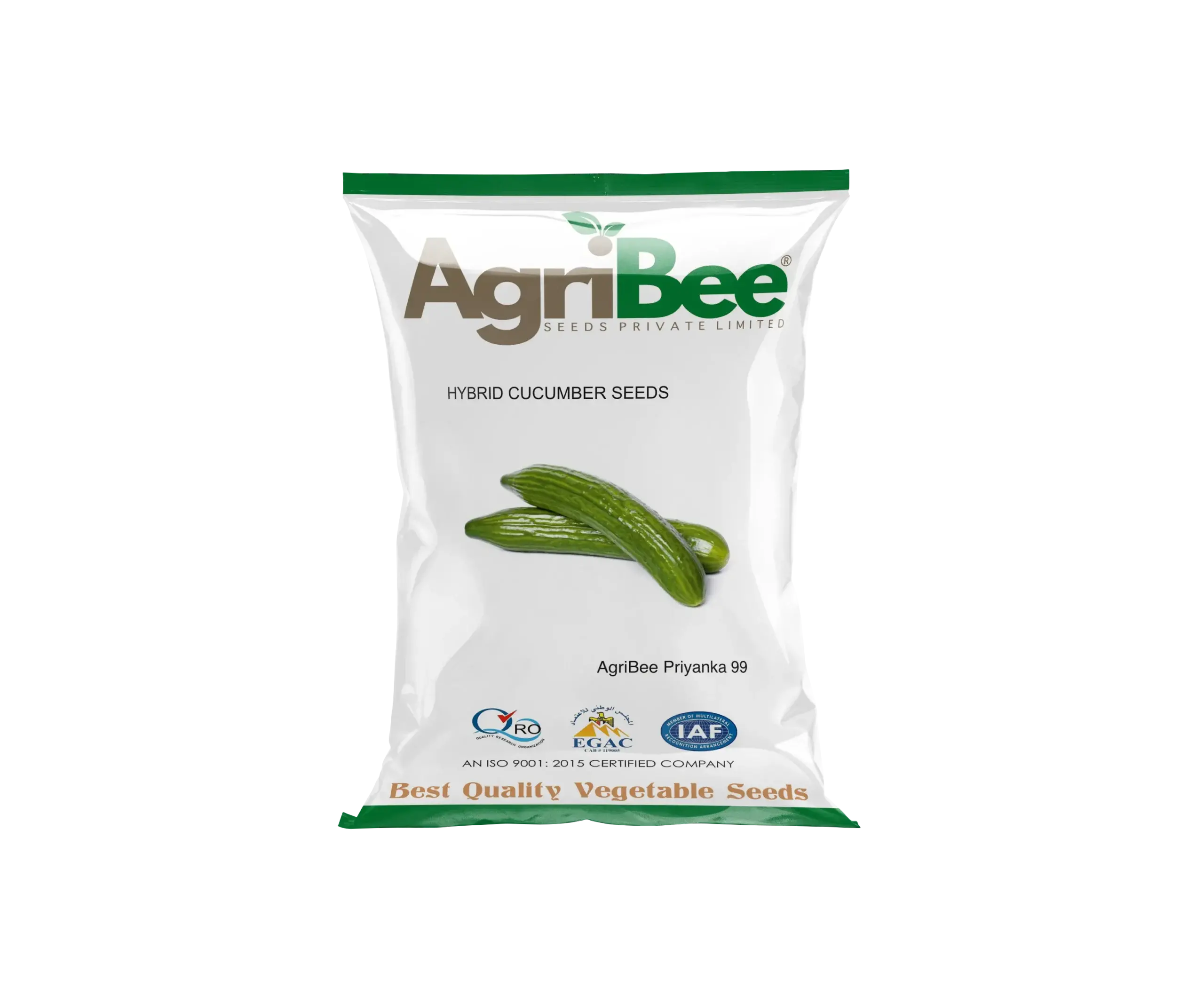
Farming & Cultivation Guide — Cucumber Seeds AgriBee Priyanka 99
Complete step-by-step agronomic guide for optimal crop management, disease resistance, and premium produce quality.
🌾 Soil Preparation & Field Prep
Proper land preparation ensures uniform seedling emergence and robust root anchorage.
🌱 Ideal Soil Type & pH
Well-drained sandy loam to loamy soils with pH 6.0–7.5. Cucumber thrives in soils with good organic matter content and efficient drainage to prevent waterlogging-induced root rot.
✨ Core Advantage
Fine, well-aerated seedbed ensures rapid imbibition, uniform germination, and strong early root development for AgriBee Priyanka 99.
- 1
Deep summer ploughing to 25–30 cm followed by 2–3 cross-harrowings to achieve fine tilth and destroy weed seed banks.
- 2
Field leveling using laser leveling equipment and preparation of proper drainage channels to prevent water stagnation.
- 3
Incorporation of 8–10 tonnes per acre of well-decomposed FYM or vermicompost during final land preparation for improved soil structure and moisture retention.
- 4
Soil health conditioning with lime (200–250 kg/acre) in acidic soils or gypsum (150 kg/acre) in alkaline soils to maintain optimal pH range of 6.0–7.5.
🌱 Sowing Time & Method
Precise seed rate and spacing maximize light interception and canopy development.
| Parameter | Recommendation | Agronomic Importance |
|---|---|---|
| Sowing Window | Kharif: June–July | Rabi: October–November | Summer: March–April (under shade net or greenhouse) | Optimal temperature (25–30°C) and humidity promote rapid germination and reduce disease pressure during vulnerable seedling stage. |
| Seed Rate | 800–1000 g per acre (Direct sowing) | 300–400 g per acre (Nursery transplant method) | Ensures optimum plant population of 25,000–30,000 plants per acre for balanced canopy and sustained fruit production. |
| Spacing | Row-to-row: 60–75 cm; Plant-to-plant: 30–40 cm (trellised system) | Adequate spacing promotes better canopy aeration, reduces humidity-related diseases, and facilitates easy harvesting operations. |
| Sowing / Transplanting Depth | 2–3 cm depth for direct sowing; Transplant at 2–3 leaf stage (18–21 DAS) | Shallow sowing ensures swift emergence; deeper placement risks poor germination and seedling damping-off. |
💧 Irrigation & Water Management
Adequate moisture regulation supports strong vegetative and reproductive growth.
☀️ Water Requirement Profile
Cucumber has shallow fibrous root system and moderate water requirement of approximately 40–50 mm per week during peak vegetative and fruiting stages. Drip irrigation is highly recommended with 2–3 frequent light irrigations per week. The crop shows moderate drought sensitivity; even brief moisture stress during flowering and fruit set can cause blossom end drop and fruit deformation. AgriBee Priyanka 99 maintains consistent fruit development under regulated drip supply.
🌦️ Soil Moisture Management
Under rainfed conditions, ensure thorough pre-sowing irrigation to moisten the soil profile to 30 cm depth. Use black plastic mulch to conserve soil moisture and regulate soil temperature. In Kharif conditions, construct raised beds with adequate side drainage to protect roots from waterlogging during heavy rainfall events.
- ✓
First irrigation should be applied immediately after sowing at 2–3 cm depth to ensure seed imbibition and trigger uniform germination within 5–7 days.
- ✓
During vegetative phase (15–30 DAS), maintain light irrigation at 3–4 day intervals depending on soil texture and weather conditions; avoid waterlogging.
- ✓
Critical stage irrigation during flowering and fruit set (30–50 DAS) requires consistent soil moisture; deficit at this stage directly affects fruit uniformity and marketable quality.
- ✓
Reduce irrigation frequency 3–4 days before final harvest to improve fruit firmness and extend post-harvest shelf life.
🧪 Fertilizer & Nutrition Management
Balanced crop nutrition supports robust plant structure and premium produce quality.
| Nutrient | Recommended Dose (per Acre) | Application Method & Timing |
|---|---|---|
| Nitrogen (N) | 60–80 kg/acre | 40% basal at sowing; 30% at 20 DAS as top-dressing; 30% at 35 DAS during active fruiting stage |
| Phosphorus (P2O5) | 40–50 kg/acre | 100% basal application at sowing through DAP (18-46-0) incorporated into seedbed |
| Potash (K2O) | 40–50 kg/acre | 50% basal at sowing; 50% split at 30 DAS via MOP to support fruit development and firmness |
🌿 Interculture & Weed Management
Timely weed control ensures optimal nutrient and moisture availability for crop seedlings.
-
1
First Weeding & Hoeing: Perform light hoeing and weeding at 10–12 DAS before canopy closure. Shallow cultivation (5 cm depth) avoids root damage. Early weed control is critical as cucumber is a slow initial grower and competes poorly with weeds.
-
2
Second Weeding & Earthing-Up: Second weeding at 20–25 DAS combined with light earthing-up around plant bases to support trailing vines and improve root zone aeration. Remove any surplus lateral shoots that compete with main vine vigor.
-
3
Special Interculture Operation: Apply white/black plastic mulch at transplanting to suppress weeds, conserve moisture, and keep fruits clean. Install vertical trellis system for upward vine growth. Regular pruning of lateral shoots and tendril trimming improves air circulation and directs assimilates toward fruit development.
🛡️ Pest & Disease Management
Proactive crop monitoring and integrated management ensure healthy crop development.
🐛 Insect Pest Management
- Aphids (Myzus persicae): Small green/black insects cluster on undersides of leaves causing curling and honeydew sooty mold. Spray Imidacloprid 17.8% SL at 0.3 ml/liter water or Neem-based biopesticide (Azadirachtin 1%) at 2 ml/liter. Repeat after 7–10 days if infestation persists.
- Cucumber Beetle (Acalymma vittatum): Striped beetles chew foliage creating characteristic shot-hole damage and transmit bacterial wilt. Spray Chlorantraniliprole 18.5% SC at 0.4 ml/liter or Spinosad 45% SL at 0.3 ml/liter. Use yellow sticky traps at 10 traps/acre for monitoring and reduction.
- Fruit Fly (Bactrocera cucurbitae): Adult flies lay eggs inside developing fruits causing larval infestation and fruit rot. Apply protein bait spray (Sanmitra) at 2.5 ml/liter mixed with hydrolyzed protein on cotton pads placed at 10 points per acre. Spray Emamectin benzoate 5% SG at 0.3 gm/liter on affected areas.
🔬 Disease Control
- Powdery Mildew (Podosphaera xanthii): White powdery fung growth on upper leaf surfaces causing premature senescence. Spray Sulphur wettable powder 80% WP at 2 gm/liter or Myclobutanil 5% EW at 1 ml/liter. Preventive sprays at 20-day intervals are effective under high humidity conditions.
- Downy Mildew (Pseudoperonospora cubensis): Yellow angular lesions on upper leaf surface with purple-gray sporulation on lower surface. Spray Metalaxyl 35% WP at 2 gm/liter or Mancozeb 75% WP at 2.5 gm/liter. Ensure good canopy ventilation and avoid overhead irrigation to reduce leaf wetness duration.
- Fusarium Wilt (Fusarium oxysporum f.sp. cucumerinum): Progressive wilting of individual vines starting from base, yellowing and vascular browning. Remove and destroy infected plants immediately. drench soil with Trichoderma viride at 10 g/liter around healthy plants as preventive biocontrol. Avoid waterlogging and ensure proper crop rotation with non-cucurbit crops.
✂️ Harvesting & Produce Quality Guide
Harvesting at peak maturity ensures maximum commercial grade and long keeping quality.
⏱️ Harvesting Schedule & Timing
First picking begins at 45–50 days after sowing. Subsequent pickings are done at 2–3 day intervals throughout the productive harvest window. Total harvest duration spans approximately 25–30 days with continuous fruit production.
⭐ Produce Quality Characteristics
AgriBee Priyanka 99 produces cylindrical, uniformly shaped fruits with light to medium green skin, firm crisp flesh, minimal bitterness, and excellent market appearance. Fruits measure 18–22 cm in length and weigh 150–200 gm at optimal harvest stage, meeting premium table-grade standards.
| Quality Parameter | Agronomic Standard | Farmer & Market Benefit |
|---|---|---|
| First Harvest Stage | 45–50 Days after Sowing | Enables early market arrival capturing premium prices during initial season demand. |
| Harvest Maturity Signs | Fruit attains 18–22 cm length, light-medium green uniform color, firm texture, and smooth skin without yellowing | Prevents over-maturity which leads to seedy fruit, skin toughening, and loss of consumer appeal. |
| Shelf Life & Keeping Quality | 7–10 days under ambient conditions (25–30°C); up to 14 days at 8–10°C with 90–95% relative humidity | Superior firmness and thick rind provide excellent transport durability and extended sales window for distant markets. |
| Market Suitability | Fresh table market, wholesale mandis, supermarket chains, and processing units for pickles | Uniform fruit shape, attractive color, and consistent size make it highly preferred by traders and retailers across India. |
⭐ Varietal Features — Cucumber Seeds AgriBee Priyanka 99
Distinguishing characteristics that make this variety a top choice for Indian growers.
🌿 Core Variety Highlight
AgriBee Priyanka 99 delivers early maturity (45–50 days to first harvest) enabling farmers to enter the market sooner than conventional varieties and benefit from favorable price realization during early season windows.
🌿 Produce Quality & Appearance
Produces uniformly cylindrical fruits of 18–22 cm length and 150–200 gm weight with attractive light to medium green color, firm texture, and minimal bitterness — a profile highly demanded by modern retail and export-oriented markets.
🌿 Stress & Disease Tolerance
Demonstrates field-level tolerance to common cucurbit diseases including powdery mildew and downy mildew under moderate pressure conditions, along with resilience to typical summer temperature fluctuations.
🌿 Growth Habit & Vigor
Vigorous vine growth with well-branched architecture supporting sustained fruit set. The compact yet spreading habit adapts efficiently to both trellis and bush cultivation systems with good canopy coverage.
🌿 Crop Duration & Earliness
With first harvest at 45–50 DAS, this variety supports faster crop turnover, enabling growers to fit 2–3 successive cucumber crops in a single growing season under favorable conditions.
🌿 Market & Farmer Preference
Trusted AgriBee brand seed with proven uniformity, excellent fruit appearance, and reliable field performance makes Priyanka 99 a preferred choice among progressive cucumber growers across Gujarat, Maharashtra, Rajasthan, Madhya Pradesh, and South Indian states.