Description
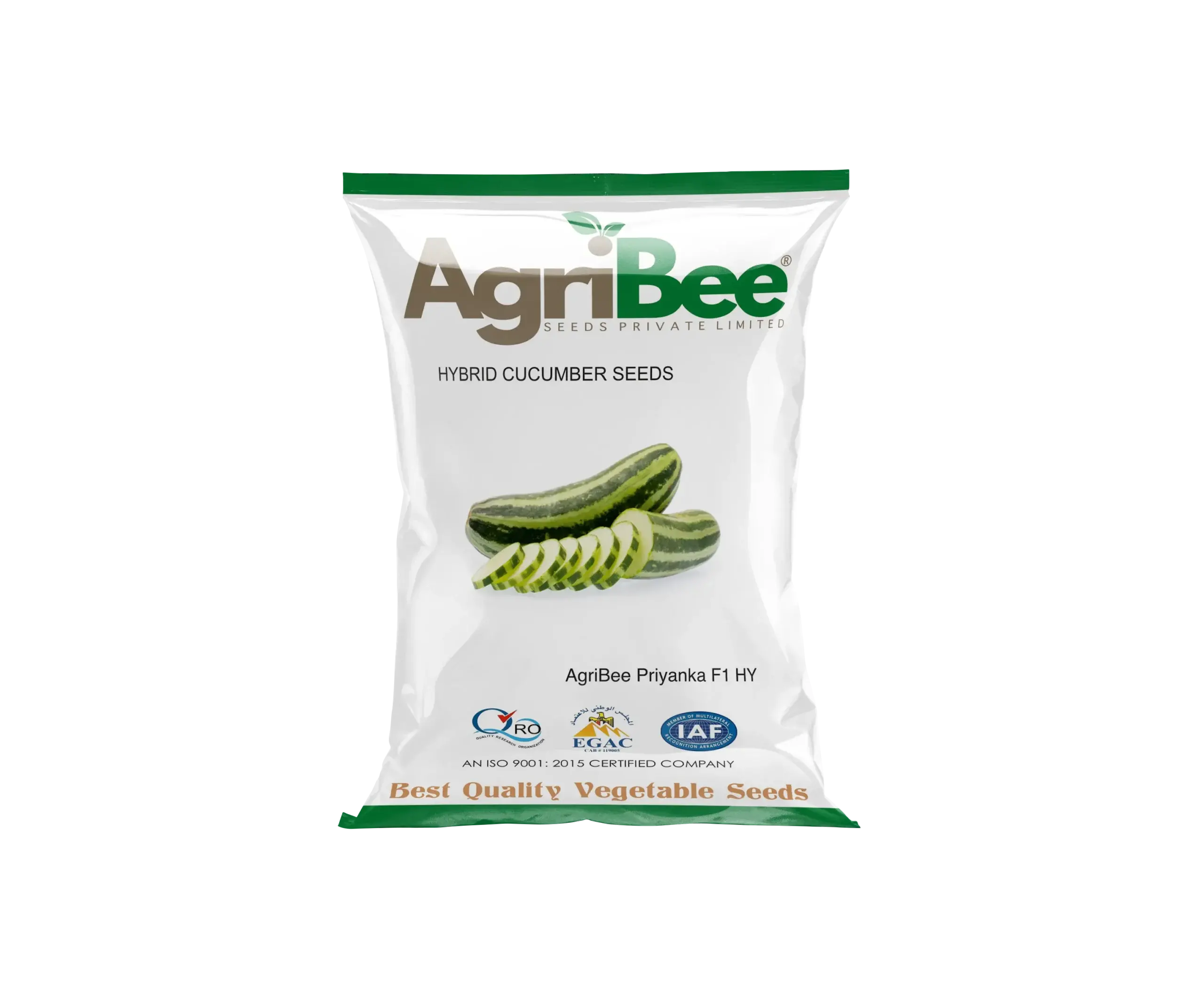
Farming & Cultivation Guide — Cucumber Seeds AgriBee Priyanka F1 HY
Complete step-by-step agronomic guide for optimal crop management, disease resistance, and premium produce quality.
🌾 Soil Preparation & Field Prep
Proper land preparation ensures uniform seedling emergence and robust root anchorage.
🌱 Ideal Soil Type & pH
Well-drained sandy loam to loamy soils with pH 6.0–7.5. Deep, fertile soils with high organic matter content are ideal. Cucumber is sensitive to waterlogging and saline alkali soils.
✨ Core Advantage
Loose, well-aerated seedbed ensures rapid seed germination and strong taproot development, which is critical for this F1 hybrid's vigorous early growth.
- 1
Deep summer ploughing to 25–30 cm followed by 2–3 cross-harrowings for fine tilth and destruction of weed seeds.
- 2
Field leveling using laser levelling for uniform irrigation and drainage; ensure raised beds of 10–15 cm height in heavy rainfall zones.
- 3
Incorporate 15–20 tonnes per acre of well-decomposed FYM or vermicompost during final ploughing to improve soil structure and moisture retention.
- 4
Conduct soil health testing; if pH is below 6.0, apply agricultural lime at 200–250 kg/acre; if above 7.5, apply gypsum at 300 kg/acre before sowing.
🌱 Sowing Time & Method
Precise seed rate and spacing maximize light interception and canopy development.
| Parameter | Recommendation | Agronomic Importance |
|---|---|---|
| Sowing Window | June–July (Kharif), Oct–Nov (Rabi), Feb–Mar (Summer under shade net) | Aligns with favorable temperature (25–30°C) and humidity for optimal germination and vine growth. |
| Seed Rate | 800–1000 g/Acre (Direct), 300–400 g/Acre (Transplant) | Ensures adequate plant population without overcrowding; F1 hybrid seed is high-quality and requires conservative rates. |
| Spacing | 60–75 cm (Row-to-Row) x 20–25 cm (Plant-to-Plant) | Provides adequate canopy spread, airflow, and light penetration for healthy foliage and fruit development. |
| Sowing / Transplanting Depth | 2–3 cm for direct sowing; 2 cm depth for transplant seedlings | Optimal depth ensures consistent moisture contact and prevents seed rot while promoting uniform emergence. |
💧 Irrigation & Water Management
Adequate moisture regulation supports strong vegetative and reproductive growth.
☀️ Water Requirement Profile
Cucumber is a shallow-rooted crop with moderate drought sensitivity. Consistent soil moisture is essential, especially during flowering and fruit set. Drip irrigation with 3–4 mm per session, 2–3 times per week, is highly recommended. Avoid both waterlogging and prolonged moisture deficit, which cause bitter fruits and flower drop.
🌦️ Soil Moisture Management
Under rainfed conditions, ensure raised beds with good surface drainage to prevent water stagnation. Apply organic mulch (paddy straw at 2–3 kg/m²) immediately after sowing to conserve soil moisture and suppress weeds. Supplemental irrigation at flowering and fruiting stages is critical for maintaining fruit quality.
- ✓
First irrigation should be applied 2–3 days after sowing (light soak) to ensure germination. Do not flood irrigate.
- ✓
During vegetative phase (15–30 DAS), irrigate at 3–4 day intervals depending on soil type and weather. Maintain soil moisture at field capacity.
- ✓
Critical stage: Flowering and fruit set (30–50 DAS) — irrigate every 2–3 days. Water stress during this period causes floral abortion, poor fruit set, and misshapen fruits.
- ✓
Withhold heavy irrigation 3–4 days before last picking to improve shelf life and prevent fruit rot. Reduce frequency in cool Rabi season.
🧪 Fertilizer & Nutrition Management
Balanced crop nutrition supports robust plant structure and premium produce quality.
| Nutrient | Recommended Dose (per Acre) | Application Method & Timing |
|---|---|---|
| Nitrogen (N) | 40–50 kg/acre | 50% basal at sowing + 50% top-dressing at 25–30 DAS |
| Phosphorus (P2O5) | 25–30 kg/acre | 100% basal application with FYM at sowing |
| Potash (K2O) | 30–40 kg/acre | 100% basal + second half at 25–30 DAS for fruit quality and firmness |
🌿 Interculture & Weed Management
Timely weed control ensures optimal nutrient and moisture availability for crop seedlings.
-
1
First Weeding & Hoeing: Perform at 10–12 DAS using a hand hoe or cultivator. Keep weeding shallow (5 cm depth) to avoid root damage. Early weed control is critical as cucumber has weak early growth.
-
2
Second Weeding & Earthing-Up: Carry out at 20–25 DAS. Gentle earthing-up around the base supports vine establishment and improves root aeration. Remove any competing weeds between rows.
-
3
Mulching and Trellising: Apply black polythene mulch or organic mulch immediately after sowing to conserve moisture and suppress weeds. Install trellis nets or stakes at 15–20 DAS to guide vine growth vertically, reducing disease incidence and improving fruit straightness.
🛡️ Pest & Disease Management
Proactive crop monitoring and integrated management ensure healthy crop development.
🐛 Insect Pest Management
- Aphids (Aphis gossypii): Cluster on undersides of leaves causing curling and yellowing. Control: Spray imidacloprid 17.8% SL at 0.3 ml/litre or neonicotinoid-based insecticide. Release ladybird predators (Cheilomenes sexmaculata) at 5000/acre as biological control.
- Fruit Borer (Helicoverpa armigera): Larvae bore into young fruits causing wilting and decay. Control: Apply chlorantraniliprole 18.5% SC at 0.3 ml/litre or spinosad 45% SC at 0.2 ml/litre. Install pheromone traps at 10/acre for monitoring. Remove and destroy infested fruits.
- Cucurbit Whitefly (Bemisia tabaci): Sucking damage causes leaf yellowing, honeydew sooty mould, and virus transmission. Control: Spray thiamethoxam 25% WG at 0.1 g/litre or acetamiprid 20% SP at 0.5 g/litre. Use yellow sticky traps at 10–12 traps/acre.
🔬 Disease Control
- Powdery Mildew (Podosphaera xanthii): White powdery patches on upper leaf surface causing premature senescence. Control: Spray propineb 50% WP at 2.5 g/litre or sulphur colloidal 0.3% at 3 g/litre. Preventive spraying at 20 DAS is recommended in humid conditions.
- Downy Mildew (Pseudoperonospora cubensis): Angular yellow lesions on upper leaf surface with purple-grey sporulation underneath. Control: Spray mancozeb 75% WP at 2 g/litre or metalaxyl + mancozeb 8% + 64% WP at 2.5 g/litre. Apply at first sign and repeat at 7-day intervals.
- Fusarium Wilt (Fusarium oxysporum f. sp. cucumerinum): Wilting of vines, yellowing, and vascular browning. Control: Soil drench with carbendazim 50% WP at 2 g/litre or Trichoderma viride paste at 5 g/litre. Use raised beds with good drainage and crop rotation with non-cucurbit crops for 2–3 years.
✂️ Harvesting & Produce Quality Guide
Harvesting at peak maturity ensures maximum commercial grade and long keeping quality.
⏱️ Harvesting Schedule & Timing
First harvest begins at 45–50 days after sowing. Subsequent pickings are made at 2–3 day intervals throughout the harvest period. Prompt harvesting encourages continued fruit set and maintains plant vigor.
⭐ Produce Quality Characteristics
Fruits are cylindrical with uniform shape, light to medium green skin, smooth texture, crisp flesh, and mild sweet taste. Seeds are small and soft. The variety is suited for fresh market consumption and maintains excellent visual appeal.
| Quality Parameter | Agronomic Standard | Farmer & Market Benefit |
|---|---|---|
| First Harvest Stage | 45–50 Days after Sowing | Ensures peak quality, early market arrival, and maximizes total harvest window. |
| Harvest Maturity Signs | Fruit reaches 18–22 cm length, light-medium green color, firm texture, cylindrical uniform shape | Prevents over-maturity which leads to seed hardening, yellowing, and inferior market grade. |
| Shelf Life & Keeping Quality | 7–10 days under ambient conditions; up to 14 days under 10–12°C controlled storage | Facilitates transportation to distant markets and extends selling window for farmers. |
| Market Suitability | Excellent for fresh market, mandis, retail chains, and export-grade sorting | Uniform fruit size, attractive color, and good firmness attract premium rates from traders and processors. |
⭐ Varietal Features — Cucumber Seeds AgriBee Priyanka F1 HY
Distinguishing characteristics that make this variety a top choice for Indian growers.
🌿 Core Variety Highlight
AgriBee Priyanka F1 is a high-performing hybrid developed for superior field vigor, uniform fruit development, and reliable performance across multiple Indian growing zones.
🌿 Produce Quality & Appearance
Cylindrical, uniform fruits measuring 18–22 cm in length with light to medium green color. Smooth skin, firm flesh, and attractive appearance that commands preference in fresh markets.
🌿 Stress & Disease Tolerance
Demonstrates strong field tolerance to common cucurbit pests and diseases including downy mildew, powdery mildew, and aphid pressure. Robust root system provides resilience under moderate moisture stress.
🌿 Growth Habit & Vigor
Vigorous vine growth with balanced branching architecture. Plants respond well to trellising, producing clean fruits free from soil contact and deformity.
🌿 Crop Duration & Earliness
Early maturity with first harvest at 45–50 days after sowing, enabling multiple cropping cycles and flexible crop rotation planning for farmers.
🌿 Market & Farmer Preference
Trusted by progressive farmers across India for its consistent fruit uniformity, extended harvesting window, and dependable performance in both Kharif and Rabi seasons. Recommended by AgriBee Seeds for commercial cultivation.