Description
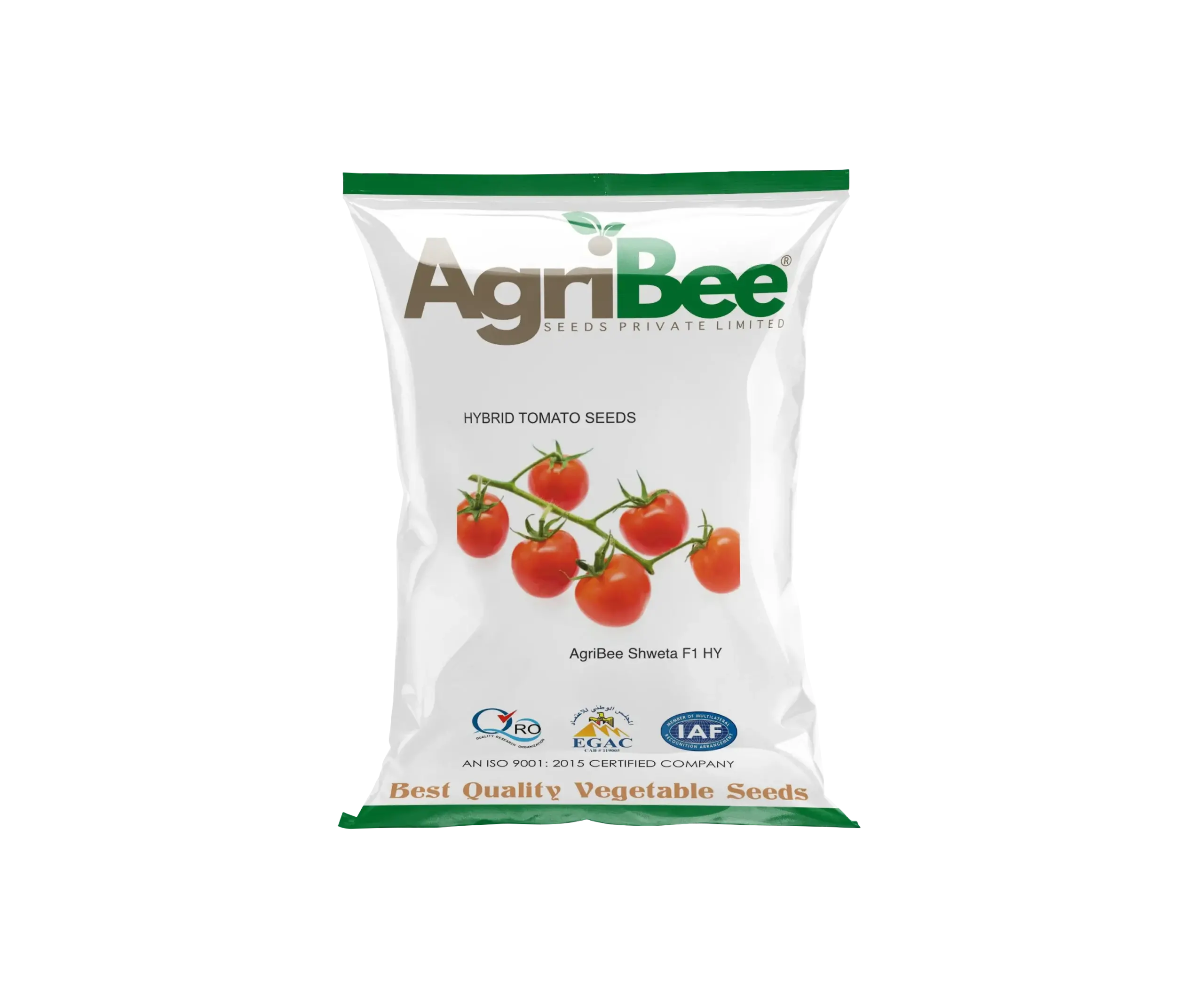
Farming & Cultivation Guide — Tomato Seeds AgriBee Shweta F1 HY
Complete step-by-step agronomic guide for optimal crop management, disease resistance, and premium produce quality.
🌾 Soil Preparation & Field Prep
Proper land preparation ensures uniform seedling emergence and robust root anchorage.
🌱 Ideal Soil Type & pH
Well-drained loamy to sandy-loam soils with a pH range of 6.0–6.8. Rich in organic matter and free from waterlogging are ideal for optimum root development and fruit quality.
✨ Core Advantage
Fine, well-aerated seedbed ensures rapid and uniform germination while promoting deep root penetration for better nutrient uptake and plant stability.
- 1
Deep summer ploughing followed by 2–3 cross-harrowings to achieve a fine tilth and eliminate weed seeds.
- 2
Field leveling with levelling boards and creation of drainage channels to prevent water stagnation during heavy rains.
- 3
Incorporation of 8–10 tonnes per acre of well-decomposed FYM or compost during the final harrowing for improved soil structure.
- 4
Soil health conditioning — if pH is below 6.0, apply agricultural lime at 250 kg/acre; if above 7.5, apply gypsum at 200 kg/acre along with a soil test-based amendment plan.
🌱 Sowing Time & Method
Precise seed rate and spacing maximize light interception and canopy development.
| Parameter | Recommendation | Agronomic Importance |
|---|---|---|
| Sowing Window | June–July for Kharif / October–November for Rabi season | Aligns transplantation with favorable temperature and reduced pest pressure, ensuring strong early growth |
| Seed Rate | 250–300 g per acre (for transplanting) | Ensures adequate seedling population to compensate for nursery losses and maintain uniform stand |
| Spacing | 60 cm (row-to-row) × 45 cm (plant-to-plant) | Provides adequate canopy spacing for light penetration, air circulation, and healthy fruit development |
| Sowing / Transplanting Depth | 0.5–1.0 cm for direct sowing; seedlings transplanted at 25–30 days after sowing with 2–3 true leaves | Optimal depth ensures uniform emergence; proper transplant age avoids root damage and promotes quick field establishment |
💧 Irrigation & Water Management
Adequate moisture regulation supports strong vegetative and reproductive growth.
☀️ Water Requirement Profile
Tomato is moderately sensitive to drought stress, especially during flowering and fruit set. Drip irrigation is highly recommended — it conserves water, delivers nutrients fertigation-style, and keeps foliage dry, reducing disease incidence. Under drip, apply light and frequent irrigations every 2–3 days depending on soil texture and weather conditions.
🌦️ Soil Moisture Management
Under rainfed or limited irrigation conditions, maintain consistent soil moisture using organic mulch (paddy straw or sugarcane trash) at 5–7 cm thickness around the plant base. This conserves moisture, suppresses weeds, and moderates soil temperature. Avoid alternating between severe drought and heavy irrigation, as this can cause blossom end rot and fruit cracking.
- ✓
First irrigation should be applied immediately after transplanting (well watering) to ensure root-soil contact and reduce transplant shock.
- ✓
During vegetative phase (2–5 weeks after transplanting), irrigate at 5–7 day intervals to support active leaf and stem growth without encouraging excessive lushness.
- ✓
Critical stage — flowering through fruit development: maintain steady moisture with irrigation every 3–4 days. Water stress during this phase leads to poor fruit set, flower drop, and misshapen fruits.
- ✓
Reduce irrigation frequency 7–10 days before the first picking to improve fruit firmness and extend shelf life. Do not completely withhold water as this causes sunscald and shriveling.
🧪 Fertilizer & Nutrition Management
Balanced crop nutrition supports robust plant structure and premium produce quality.
| Nutrient | Recommended Dose (per Acre) | Application Method & Timing |
|---|---|---|
| Nitrogen (N) | 80–100 kg/acre (as Urea or Ammonium Sulphate) | 50% basal at transplanting; remaining 50% split into two top-dressings at 30 and 45 days after transplanting |
| Phosphorus (P2O5) | 50–60 kg/acre (as DAP or Single Super Phosphate) | 100% basal application at the time of final land preparation and seedbed mixing |
| Potash (K2O) | 40–50 kg/acre (as MOP or SOP) | 60% basal at transplanting; remaining 40% applied at first flowering to support fruit quality and firmness |
🌿 Interculture & Weed Management
Timely weed control ensures optimal nutrient and moisture availability for crop seedlings.
-
1
First Weeding & Hoeing: Carry out first weeding and shallow hoeing at 15 days after transplanting (DAT) to eliminate early weed competition without damaging shallow roots. Use a conformable hand hoe or inter-cultivator.
-
2
Second Weeding & Earthing-Up: Perform second weeding and earthing-up at 30 DAT to promote adventitious root formation along the stem base, improve plant stability, and reduce surface runoff erosion.
-
3
Special Interculture Operation — Staking and Suckering: Stake plants individually using bamboo sticks tied loosely at 30–35 DAT to prevent lodging under fruit load. Remove lateral shoots (suckers) below the first flower cluster regularly to direct energy toward primary fruit production. Mulch between rows with organic material to conserve moisture and suppress weeds.
🛡️ Pest & Disease Management
Proactive crop monitoring and integrated management ensure healthy crop development.
🐛 Insect Pest Management
- Helicoverpa armigera (Fruit Borer): Larvae bore into fruits causing entry holes and secondary decay. Symptoms include frass-filled tunnels inside fruits and defoliation. Control: Apply pheromone traps at 10/acre for monitoring; spray Chlorantraniliprole 18.5% SC at 60 ml/acre or Spinetoram 11.7% WS at 40 ml/acre at 7-day intervals during peak flowering. Use neem-based biopesticides (NSKE 5%) as a preventive measure.
- Bemisia tabaci (Whitefly): Small white insects clustering on leaf undersides, causing yellowing, curling, and honeydew deposition leading to sooty mold. Vector of ToLCV — critical to manage. Control: Install yellow sticky traps at 15/cm height; spray Imidacloprid 17.8% SL at 150 ml/acre or Thiamethoxam 25% WG at 40 g/acre. Intercrop with marigold or cowpea as a trap crop to divert whitefly populations.
- Phthorimaea operculella (Tomato Fruitworm): Larvae mine leaves and tunnel into stems and fruits creating serpentine galleries. Control: Apply Bacillus thuringiensis kurstaki (Btk) at 1–1.5 g/litre or spinosad 45% SC at 0.3 ml/litre. Practice destroy infested plant debris after harvest to break the life cycle.
🔬 Disease Control
- Tomato Leaf Curl Virus (ToLCV): Severe leaf curling, upward rolling, yellowing, stunting, and flower drop. Transmitted primarily by Bemisia tabaci whiteflies. The AgriBee Shweta F1 HY has built-in tolerance to ToLCV. Control vector aggressively with yellow sticky traps and targeted insecticide sprays. Remove and destroy severely infected plants immediately to prevent spread. Use certified virus-free seed and healthy transplants only.
- Early Blight (Alternaria solani): Concentric ring-shaped brown lesions on lower older leaves, followed by defoliation and fruit spotting. Control: Spray Mancozeb 75% WP at 2.5 g/litre or Chlorothalonil 50% WP at 2 g/litre starting at 30 DAT at 10-day intervals. Ensure adequate plant spacing for canopy airflow and avoid overhead irrigation to keep foliage dry.
- Bacterial Wilt (Ralstonia solanacearum): Sudden wilting of individual branches or whole plant with green leaves; brown vascular discoloration visible when stem is cut. Control: Practice 3–4 year crop rotation with non-Solanaceous crops. Treat seedlings with Streptocycline 0.1 g/litre or Copper oxychloride 0.3% drench at transplanting. Solarize soil during fallow period by covering moist fields with clear polythene for 4–6 weeks to reduce soil-borne inoculum.
✂️ Harvesting & Produce Quality Guide
Harvesting at peak maturity ensures maximum commercial grade and long keeping quality.
⏱️ Harvesting Schedule & Timing
First harvest begins 65–70 days after transplanting. Subsequent pickings are made at 3–4 day intervals over a 4–5 week harvesting window. Harvest during early morning hours when temperatures are low for best fruit firmness and handling quality.
⭐ Produce Quality Characteristics
Fruits exhibit a rich, uniform deep red color with a flat round to oval shape. The skin is smooth, thick, and glossy with firm flesh texture and a well-balanced sweet-tart flavor profile. Average fruit weight of 80–100 gm makes them ideal for table market grading and consumer preference. The fruits hold their shape well under handling, reflecting strong cell wall integrity and good internal quality.
| Quality Parameter | Agronomic Standard | Farmer & Market Benefit |
|---|---|---|
| First Harvest Stage | 65–70 Days after Transplanting (DAT) | Early market arrival commands premium prices due to seasonal supply gaps |
| Harvest Maturity Signs | Full deep red color development, firm but slightly yielding to gentle pressure, uniform size (80–100 gm) | Ensures peak flavor, color, and consumer acceptability while preventing over-softening on the vine |
| Shelf Life & Keeping Quality | 5–7 days under ambient conditions; up to 10–12 days under cool storage at 10–12°C with 85–90% relative humidity | Thick skin and dense flesh provide excellent post-harvest durability for distant market transport and reduced spoilage losses |
| Market Suitability | Fresh table market, wholesale mandis, supermarkets, and retail chains. Also suitable for processing units requiring uniform red fruits. | Consistent deep red color and uniform fruit size attract buyers and enable grade-based pricing for higher farmer realization |
⭐ Varietal Features — Tomato Seeds AgriBee Shweta F1 HY
Distinguishing characteristics that make this variety a top choice for Indian growers.
🌿 Core Variety Highlight
AgriBee Shweta F1 HY is a high-performance hybrid specifically bred for strong tolerance to Tomato Leaf Curl Virus (ToLCV), one of the most destructive diseases affecting tomato cultivation across India.
🌿 Produce Quality & Appearance
Produces uniformly shaped flat round to oval fruits with a striking deep red color, smooth glossy skin, and firm flesh. Each fruit averages 80–100 gm, offering excellent visual appeal and consistent grading.
🌿 Stress & Disease Tolerance
Engineered with documented tolerance to ToLCV, reducing crop loss in high-pressure regions. Exhibits good field resilience under moderate heat and variable moisture conditions common in Indian farming systems.
🌿 Growth Habit & Vigor
Demonstrates vigorous indeterminant-to-semi-determinant growth habit with strong branching architecture. Healthy dark green foliage provides effective canopy cover, protecting developing fruits from sunscald while supporting robust photosynthetic activity.
🌿 Crop Duration & Earliness
Reaches first harvest in 65–70 days after transplanting, enabling earlier market entry and flexible cropping sequence. Short crop duration allows farmers to fit additional crops or cover crops in the rotation calendar.
🌿 Market & Farmer Preference
Preferred by progressive farmers and agri-business operators for its combination of virus tolerance, early bearing, attractive fruit color, and firm handling quality. Its compact yet vigorous plant type suits both open-field and protected cultivation systems across diverse agro-climatic zones.