Description
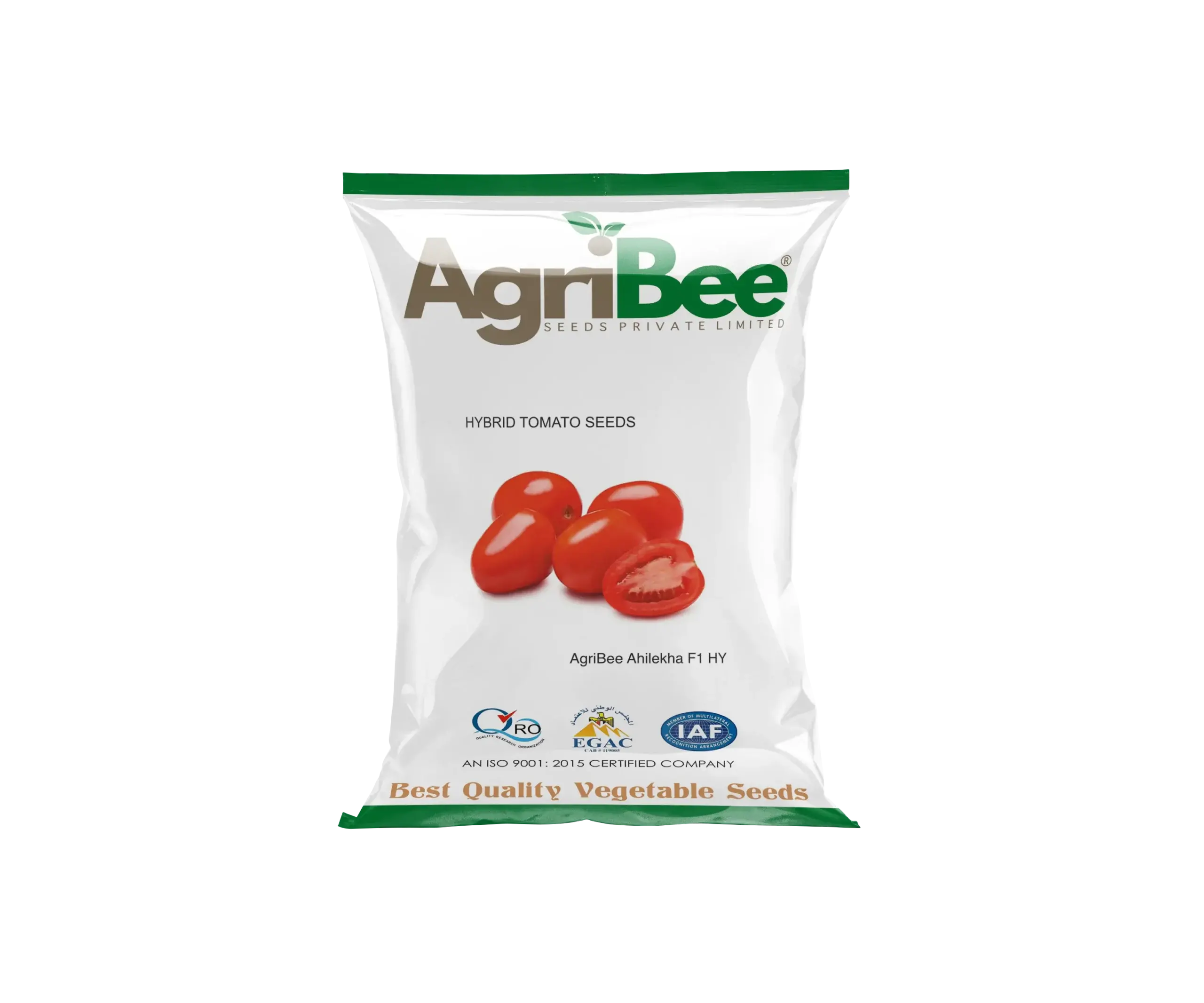
Farming & Cultivation Guide — Tomato Seeds AgriBee Abhilekha F1 HY
Complete step-by-step agronomic guide for optimal crop management, disease resistance, and premium produce quality.
🌾 Soil Preparation & Field Prep
Proper land preparation ensures uniform seedling emergence and robust root anchorage.
🌱 Ideal Soil Type & pH
Well-drained loamy or sandy loam soil with pH 6.0–6.8. Deep, fertile soils with good organic matter content support robust vine development and healthy fruit set.
✨ Core Advantage
Well-aerated seedbed ensures rapid and uniform germination, strong early root development, and excellent anchorage for upright tomato vines.
- 1
Deep summer ploughing followed by 2–3 cross-harrowings to obtain a fine, crumbly tilth.
- 2
Field leveling and drainage channel preparation, especially important during Kharif rains to prevent waterlogging.
- 3
Incorporation of 8–10 tonnes/acre of well-decomposed FYM or compost during the last harrowing for improved soil structure.
- 4
Soil health conditioning — maintain pH between 6.0 and 6.8; apply gypsum if alkalinity is observed.
🌱 Sowing Time & Method
Precise seed rate and spacing maximize light interception and canopy development.
| Parameter | Recommendation | Agronomic Importance |
|---|---|---|
| Sowing Window | June – July (Kharif) or October – November (Rabi) | Aligns crop growth with favorable temperature and humidity, minimizing disease pressure and maximizing vegetative vigor. |
| Seed Rate | 250–300 g per Acre (for transplanting) | Ensures adequate plant population while accounting for nursery losses and selection of healthy seedlings. |
| Spacing | 60 cm (row-to-row) × 45 cm (plant-to-plant) | Provides optimal canopy spread, aeration, and sunlight penetration for sustained flowering and fruit development. |
| Sowing / Transplanting Depth | Sow seeds 0.5–1.0 cm deep in nursery trays; transplant seedlings at 8–10 cm depth (buried up to first true leaf) | Proper depth promotes uniform germination and encourages adventitious root formation for stronger transplant establishment. |
💧 Irrigation & Water Management
Adequate moisture regulation supports strong vegetative and reproductive growth.
☀️ Water Requirement Profile
Tomato requires moderate but consistent soil moisture throughout its lifecycle. The crop is moderately sensitive to drought, particularly during flowering and fruit development. Drip irrigation is highly recommended as it maintains uniform soil moisture, conserves water, and reduces foliar disease incidence.
🌦️ Soil Moisture Management
Under rainfed conditions, ensure proper field drainage to avoid water stagnation. Mulching with straw or polyethylene sheets helps retain soil moisture and suppress weeds. Avoid water stress during critical stages—flowering, fruit set, and fruit expansion—as this leads to blossom-end rot, flower drop, and distorted fruits.
- ✓
First Irrigation: Immediately after transplanting (day 0) with 250–300 litres per plant to reduce transplant shock and promote root establishment.
- ✓
Vegetative Phase (DAT 10–35): Light and frequent irrigation at 3–4 day intervals depending on soil type and weather conditions to sustain lush foliage growth.
- ✓
Critical Growth Stage (Flowering to Fruit Development, DAT 35–65): Maintain consistent soil moisture without waterlogging. Drip irrigation at 2–3 litres per plant per application is ideal during this period for optimal fruit set and expansion.
- ✓
Pre-Harvest Water Withholding (last 7–10 days before harvest): Reduce irrigation frequency to allow fruit colouring and improve shelf life. Avoid overhead watering post-fruit set to minimise fungal disease risk.
🧪 Fertilizer & Nutrition Management
Balanced crop nutrition supports robust plant structure and premium produce quality.
| Nutrient | Recommended Dose (per Acre) | Application Method & Timing |
|---|---|---|
| Nitrogen (N) | 80–100 kg/acre | Basal: 40 kg/acre; Top-dress: 40–60 kg/acre split into two applications — first at DAT 30, second at DAT 50 |
| Phosphorus (P2O5) | 50 kg/acre | 100% basal application incorporated during final land preparation |
| Potash (K2O) | 40–50 kg/acre | Basal: 20 kg/acre; Remaining split at flowering and early fruit set for improved fruit colour and firmness |
🌿 Interculture & Weed Management
Timely weed control ensures optimal nutrient and moisture availability for crop seedlings.
-
1
First Weeding & Hoeing: Carry out light hoeing and weeding 15 days after transplanting (DAT) to remove early weed flush and loosen soil for improved aeration. Avoid deep hoeing near plant bases to prevent root damage.
-
2
Second Weeding & Earthing-Up: Perform second weeding and earthing-up at 30 DAT. Mounding soil around the stem base supports the plant, improves root aeration, and helps distribute lateral roots for better nutrient and water uptake.
-
3
Special Interculture Operation — Staking and De-suckering: Stake or trellis plants from DAT 20–25 using bamboo stakes or string systems to keep vines upright. Regular de-suckering (removal of lateral branches below the first flower cluster) maintains plant architecture, improves air circulation, and directs energy toward fruit production rather than excessive vegetative growth. Apply polythene mulch at transplanting for moisture conservation and weed suppression.
🛡️ Pest & Disease Management
Proactive crop monitoring and integrated management ensure healthy crop development.
🐛 Insect Pest Management
- Whitefly (Bemisia tabaci): Small white flying insects clustering on undersides of leaves; causes yellowing, curling, and stunted growth. It is the primary vector of ToLCV. Control: Install yellow sticky traps at 15/m²; spray Neem-based formulations (NSKE 5%) or imidacloprid 17.8% SL at 0.3 ml/litre at 7-day intervals. Rotate chemistries to prevent resistance.
- Tomato Fruit Borer (Helicoverpa armigera): Larvae bore into fruits causing holes and secondary rot. Eggs and early larvae found on flower buds and young fruits. Control: Pheromone traps at 10/acre; spray chlorantraniliprole 18.5% SC at 0.3 ml/litre or spinosad 45% SC at 0.4 ml/litre. Collect and destroy infected fruits.
- Thrips (Frankliniella occidentalis): Slender insects causing silvery streaks and distortion on leaves and fruit surface scars. Control: Blue sticky traps; spray thiacloprid 21.7% SC at 0.4 ml/litre or spinosad at recommended dosage. Maintain field sanitation and remove weed hosts.
🔬 Disease Control
- Tomato Leaf Curl Virus (ToLCV): Causal organism is begomovirus transmitted by whitefly. Symptoms include upward leaf curling, yellowness, dwarfism, and flower drop. Prevention: Use only certified ToLCV-resistant seeds; raise net-house nurseries; install yellow sticky traps; rogue out infected plants immediately; control whitefly populations aggressively.
- Early Blight (Alternaria solani): Causal fungus produces concentric ring spots on lower leaves, leading to defoliation and fruit rot. Control: Preventive spray of mancozeb 75% WP at 2.5 g/litre or chlorothalonil 50% WP at 2 g/litre at 10–12 day intervals. Remove and destroy infected plant debris.
- Powdery Mildew (Leveillula taurica): White powdery growth on leaf surfaces, predominantly in dry and cool conditions. Control: Spray sulfur-based fungicides (wettable sulfur 80% WP at 2 g/litre) or myclobutanil at recommended rates. Ensure proper spacing for air circulation and avoid overhead irrigation.
✂️ Harvesting & Produce Quality Guide
Harvesting at peak maturity ensures maximum commercial grade and long keeping quality.
⏱️ Harvesting Schedule & Timing
First harvest begins 65–70 days after transplanting. Subsequent pickings are taken at 3–4 day intervals, continuing for 6–8 harvest rounds over a 4–6 week period depending on growing conditions.
⭐ Produce Quality Characteristics
Fruits are flat-round to oval-shaped with a rich, deep red colour. Average fruit weight of 80–100 gm makes them ideal for table use and retail packing. Firm flesh, thick pericarp, good taste, and balanced acidity-sweetness profile appeal to consumers. The produce exhibits excellent colour uniformity and minimal defect incidence.
| Quality Parameter | Agronomic Standard | Farmer & Market Benefit |
|---|---|---|
| First Harvest Stage | 65–70 Days after Transplanting | Enables early market entry when prices are typically favourable and competitors have not yet reached peak supply. |
| Harvest Maturity Signs | Full red colour development, firm texture, and normal fruit size (80–100 gm); fruits detach easily with gentle twist. | Harvesting at correct maturity ensures optimal taste, colour, and post-harvest durability while preventing over-softening. |
| Shelf Life & Keeping Quality | 7–10 days under ambient conditions; up to 14 days under cool storage (10–12°C) with high relative humidity. | Thick pericarp and firm fruit structure enable long-distance transportation with minimal breakdown, widening market reach. |
| Market Suitability | Premium table variety suitable for fresh market, mandis, retail chains, and export-quality grading. | Uniform fruit size, deep red colour, and attractive flat-round shape command better pricing and meet buyer specifications consistently. |
⭐ Varietal Features — Tomato Seeds AgriBee Abhilekha F1 HY
Distinguishing characteristics that make this variety a top choice for Indian growers.
🌿 Core Variety Highlight
AgriBee Abhilekha F1 HY is a hybrid tomato variety bred specifically for strong field tolerance to Tomato Leaf Curl Virus (ToLCV), one of the most destructive viral diseases affecting tomato cultivation across India.
🌿 Produce Quality & Appearance
Produces flat-round to oval-shaped, deep red fruits averaging 80–100 gm with firm texture, attractive gloss, thick pericarp, and balanced flavour — highly desirable for fresh market channels.
🌿 Stress & Disease Tolerance
Demonstrates robust tolerance to ToLCV and good field vigour under conditions. Resilient foliage with sustained green canopy supports continuous fruiting even under moderate pest pressure.
🌿 Growth Habit & Vigor
Indeterminate to semi-indeterminate growth habit with strong central stem, well-branched architecture, and vigorous root system ensuring efficient nutrient and water uptake throughout the crop cycle.
🌿 Crop Duration & Earliness
First harvest at 65–70 days after transplanting, offering earliness advantage that allows farmers to capture early-season price premiums and fit the crop within diverse rotation systems.
🌿 Market & Farmer Preference
Farmers value this variety for its reliable ToLCV tolerance, uniform fruit set, excellent shelf life, and consistent market acceptability. Dealers and traders prefer the attractive deep red colour and gradeable fruit size that meet commercial standards.