Description
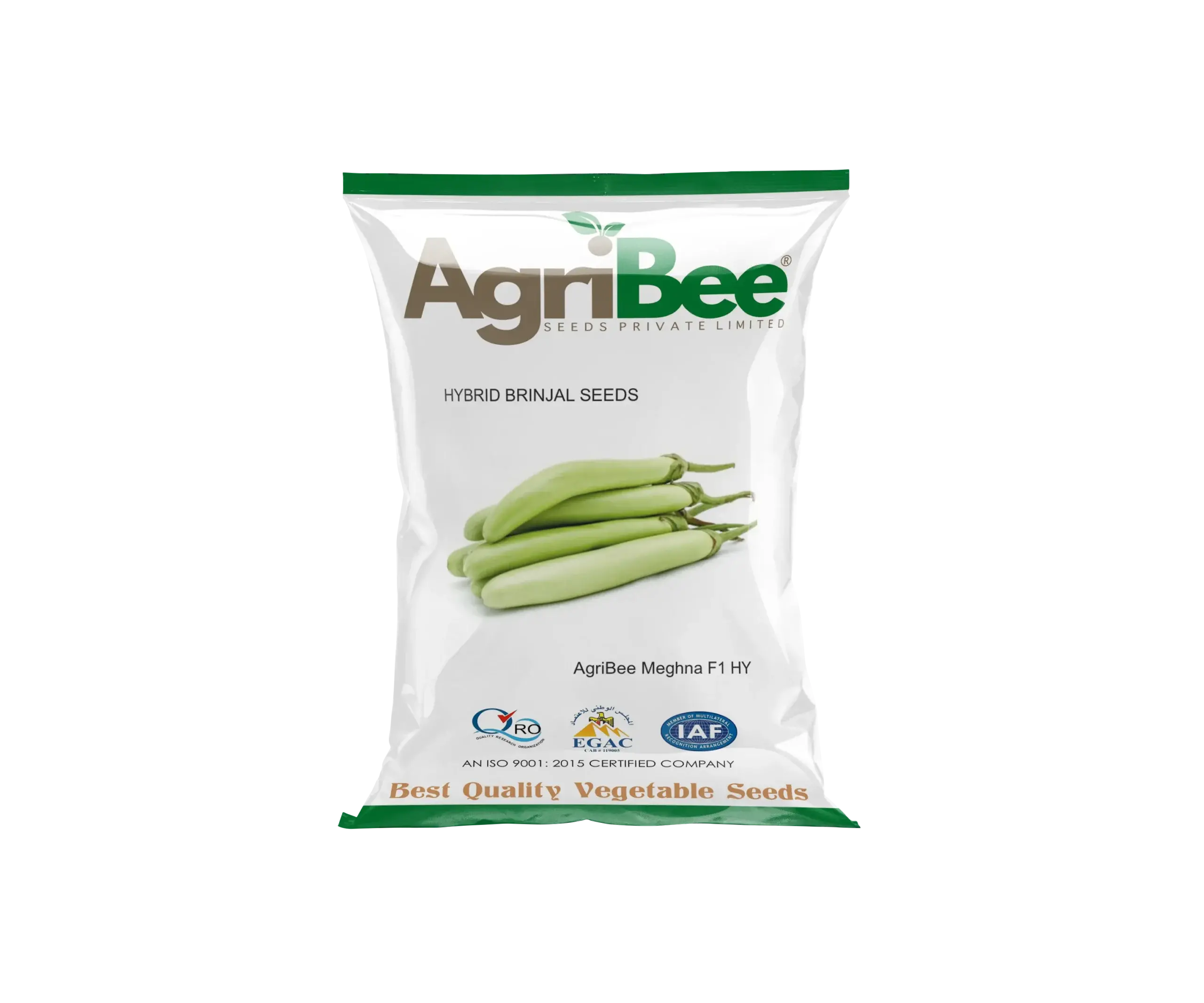
Farming & Cultivation Guide — Brinjal Seeds AgriBee Meghna F1 HY
Complete step-by-step agronomic guide for optimal crop management, disease resistance, and premium produce quality.
🌾 Soil Preparation & Field Prep
Proper land preparation ensures uniform seedling emergence and robust root anchorage.
🌱 Ideal Soil Type & pH
Well-drained loamy or sandy-loam soils with pH 6.0–7.5. Heavy soils must be avoided due to poor drainage and susceptibility to root rot. Soil rich in organic matter ensures vigorous vegetative growth and uniform fruit development.
✨ Core Advantage
Loamy soils with high organic carbon support rapid seedling establishment, strong root penetration, and sustained nutrient availability throughout the cropping cycle.
- 1
Deep summer ploughing followed by 2–3 cross-harrowings to achieve a fine, well-tilthed seedbed free of clods.
- 2
Field leveling and drainage channel preparation to prevent water stagnation, especially critical during monsoon Kharif seasons.
- 3
Incorporation of 15–20 tonnes per hectare of well-decomposed FYM or compost during final land preparation to improve soil structure and water-holding capacity.
- 4
Soil health conditioning: test pH and apply gypsum (10–15 kg/acre) for alkaline soils or elemental sulphur (5–8 kg/acre) for acidic soils to maintain optimal pH range.
🌱 Sowing Time & Method
Precise seed rate and spacing maximize light interception and canopy development.
| Parameter | Recommendation | Agronomic Importance |
|---|---|---|
| Sowing Window | Kharif: June–July | Rabi: October–November | Summer: February–March | Aligns crop growth with favorable temperature and humidity, minimizing stress during critical flowering and fruiting phases. |
| Seed Rate | 250–300 g per hectare for transplanting; 400–500 g per hectare for direct sowing | Ensures adequate plant population while accounting for nursery mortality and thinning. |
| Spacing | 60 cm × 45 cm (Row-to-row × Plant-to-plant) | Provides sufficient canopy spread, improves air circulation, reduces disease pressure, and facilitates field operations. |
| Sowing / Transplanting Depth | Sow seeds 0.5–1.0 cm deep; transplant seedlings at 4–5 leaf stage (25–30 days after sowing) | Shallow sowing ensures rapid and uniform germination; proper transplanting age avoids root shock and promotes early establishment. |
💧 Irrigation & Water Management
Adequate moisture regulation supports strong vegetative and reproductive growth.
☀️ Water Requirement Profile
Brinjal is moderately sensitive to drought stress, particularly during flowering and fruit development. Consistent soil moisture is essential for sustained fruit set and quality. Drip irrigation is highly recommended as it maintains uniform moisture, reduces weed pressure, and minimizes foliar disease incidence. Over-irrigation must be avoided to prevent root rot and fungal diseases.
🌦️ Soil Moisture Management
In rainfed conditions, ensure raised beds or ridges for effective drainage during heavy rainfall. Mulching with straw or polythene film helps conserve soil moisture and suppress weeds. Supplemental irrigation at critical stages—flower initiation, fruit set, and active fruit expansion—is crucial even under partial rainfed systems.
- ✓
First irrigation should be applied immediately after transplanting (drenching) to reduce wilting and promote root establishment. Subsequent irrigations at 3–4 day intervals in summer and 5–7 day intervals in cooler seasons.
- ✓
During vegetative phase (20–40 DAT), maintain moderate soil moisture without waterlogging. Light and frequent irrigations support vigorous foliage development.
- ✓
Critical stages—flowering and fruit setting (40–70 DAT)—require consistent moisture. Water stress during this period causes flower drop, fruit deformity, and poor fruit fill. Ensure regular irrigation every 4–5 days.
- ✓
Reduce irrigation frequency 7–10 days before final harvest to improve fruit firmness, enhance shelf life, and prevent cracking or rotting in stored produce.
🧪 Fertilizer & Nutrition Management
Balanced crop nutrition supports robust plant structure and premium produce quality.
| Nutrient | Recommended Dose (per Acre) | Application Method & Timing |
|---|---|---|
| Nitrogen (N) | 80–100 kg/acre as Urea (46% N) | 50% basal at transplanting; 25% at 30 DAT; 25% at 60 DAT for sustained vegetative and fruiting support. |
| Phosphorus (P2O5) | 50–60 kg/acre as DAP (18% P2O5) or SSP | 100% basal application at transplanting for root development and early growth vigor. |
| Potash (K2O) | 40–50 kg/acre as MOP (60% K2O) | 50% basal at transplanting; 50% split at 45 DAT to support fruit development, firmness, and disease tolerance. |
🌿 Interculture & Weed Management
Timely weed control ensures optimal nutrient and moisture availability for crop seedlings.
-
1
First Weeding & Hoeing: Carry out at 15–20 days after transplanting (DAT) to eliminate early weed competition. Shallow hand hoeing avoids root damage. Weeds compete aggressively for nutrients and moisture during the critical early establishment phase.
-
2
Second Weeding & Earthing-Up: Perform at 30–35 DAT with deeper hoeing between rows. Earthing-up around plant bases improves root aeration, prevents lodging, and supports adventitious root formation under heavier soils.
-
3
Mulching and Stake Support: Apply organic mulch (straw or leaf litter) at 20–25 DAT to conserve soil moisture, suppress weeds, and moderate soil temperature. For tall-growing plants, provide stake support at 40–45 DAT to prevent branch breakage under fruit load. Remove suckers (side shoots) below the first true branch to direct energy toward main stem fruit production.
🛡️ Pest & Disease Management
Proactive crop monitoring and integrated management ensure healthy crop development.
🐛 Insect Pest Management
- Shoot and Fruit Borer (Helicoverpa armigera): Larvae bore into young shoots and fruits causing wilting, defoliation, and fruit rot. Management: Install pheromone traps at 10 traps/acre. Spray Emamectin benzoate 5% SG at 0.3 g/L or Chlorantraniliprole 18.5% SC at 0.2 ml/L at 7-day intervals starting from initial flowering. Release Trichogramma japonicum at 50,000/acre weekly for biological control.
- Brinjal Shoot and Fruit Borer – Second Generation (Earias vitella): Cotton bollworm attacks fruits and shoots, creating entry holes with frass accumulation. Management: Spraying of Spinosad 45% SC at 0.3 ml/L or Lufenuron 5% EC at 1 ml/L. Destroy infested shoots and fruits manually. Use neem-based biopesticides (Neem oil 3ml/L) as a preventive measure during early growth stages.
- Fruit and Shoot Aphid (Aphis gossypii): Colonies on young shoots and underside of leaves cause curling, yellowing, and sooty mold. Also vectors viral diseases. Management: Spray Imidacloprid 17.8% SL at 0.3 ml/L or Thiamethoxam 25% WG at 0.2 g/L. Introduce natural predators like ladybird beetles and lacewings. Use yellow sticky traps at 10/acre for monitoring and reduction.
🔬 Disease Control
- Bacterial Wilt (Ralstonia solanacearum): Sudden wilting of one side of the plant, vascular browning, and bacterial ooze from cut stems. Management: Practice 3-year crop rotation with non-Solanaceous crops. Treat seeds with Streptocycline 0.1% or Cupric oxychloride 0.3%. drench the soil with Carbendazim 50% WP at 2 g/L or Pseudomonas fluorescens at 10 g/L around susceptible plants. Remove and destroy infected plants immediately.
- Early Blight (Alternaria solani): Concentric ring-shaped brown spots on lower leaves, leading to defoliation and reduced photosynthetic capacity. Management: Spray Mancozeb 75% WP at 2.5 g/L or Chlorothalonil 50% WP at 2 g/L at 10-day intervals. Maintain proper spacing for canopy airflow. Remove and destroy infected plant debris after harvest to reduce inoculum load.
- Pink Rot / Damping Off (Phytophthora nicotianae): Water-soaked lesions on fruits turning pinkish, followed by soft rot. Seedlings show damping-off with pre- and post-emergence collapse. Management: Seed treatment with Metalaxyl 35% WS at 3 g/kg seed. Soil drench with Metalaxyl + Mancozeb (Ridomil Gold) at 2.5 g/L at 30 DAT and repeat at 15-day intervals. Ensure proper drainage and avoid overhead irrigation to minimize leaf wetness duration.
✂️ Harvesting & Produce Quality Guide
Harvesting at peak maturity ensures maximum commercial grade and long keeping quality.
⏱️ Harvesting Schedule & Timing
First picking begins 60–65 days after transplanting. Subsequent pickings are made at 5–7 day intervals over a continuous harvesting period of 4–6 weeks. Harvest when fruits attain full size, glossy skin, and firm texture but before seed hardening begins.
⭐ Produce Quality Characteristics
Premium purple-black to dark green oval-oblong fruits with uniform size (100–250 g), attractive glossy skin, minimal bitterness, tender flesh with few seeds, and a green non-spiny calyx. Excellent internal quality with firm mesocarp, appealing color retention after cooking, and desirable taste profile preferred by consumers.
| Quality Parameter | Agronomic Standard | Farmer & Market Benefit |
|---|---|---|
| First Harvest Stage | 60–65 Days after Transplanting | Early market arrival commands premium prices and enables faster crop turnover for successive planting. |
| Harvest Maturity Signs | Fruit attains full size, glossy uniform purple-black/green skin, firm to touch, calyx prominently green and expanded | Prevents over-maturity which leads to seed hardening, skin toughening, andmarket rejection. |
| Shelf Life & Keeping Quality | 7–10 days under ambient conditions (25–30°C); up to 14–16 days under cool storage (8–10°C with 85–90% RH) | Extended shelf life facilitates transport to distant markets and reduces post-harvest losses significantly. |
| Market Suitability | Fresh market, mandis, retail chains, and food processing units. Uniform size and attractive color appeal to both wholesale and premium retail segments. | High consumer acceptance and consistent appearance ensure better price realization and market demand throughout the harvesting window. |
⭐ Varietal Features — Brinjal Seeds AgriBee Meghna F1 HY
Distinguishing characteristics that make this variety a top choice for Indian growers.
🌿 Core Variety Highlight
AgriBee Meghna F1 HY is a hybrid brinjal variety delivering early and uniform fruiting with strong plant vigor, dense foliage cover, and robust branching architecture suited for diverse Indian growing conditions.
🌿 Produce Quality & Appearance
Fruits exhibit an attractive combination of oval-oblong to round shape with glossy purple-black to dark green skin, green non-spiny calyx, uniform 100–250 g weight, tender flesh, and excellent table quality with low bitterness.
🌿 Stress & Disease Tolerance
Demonstrates strong field tolerance to common brinjal stresses including bacterial wilt, early blight, and aphid pressure. The dense canopy and vigorous growth habit provide natural microclimate buffering against temperature fluctuations and moisture stress.
🌿 Growth Habit & Market Preference
Compact to semi-compact plant architecture with upright branching facilitates efficient spacing and mechanized field operations. Early harvest window (60–65 DAT) combined with sustained picking capacity makes it a preferred choice among progressive farmers, traders, and value-chain partners across India.