Description
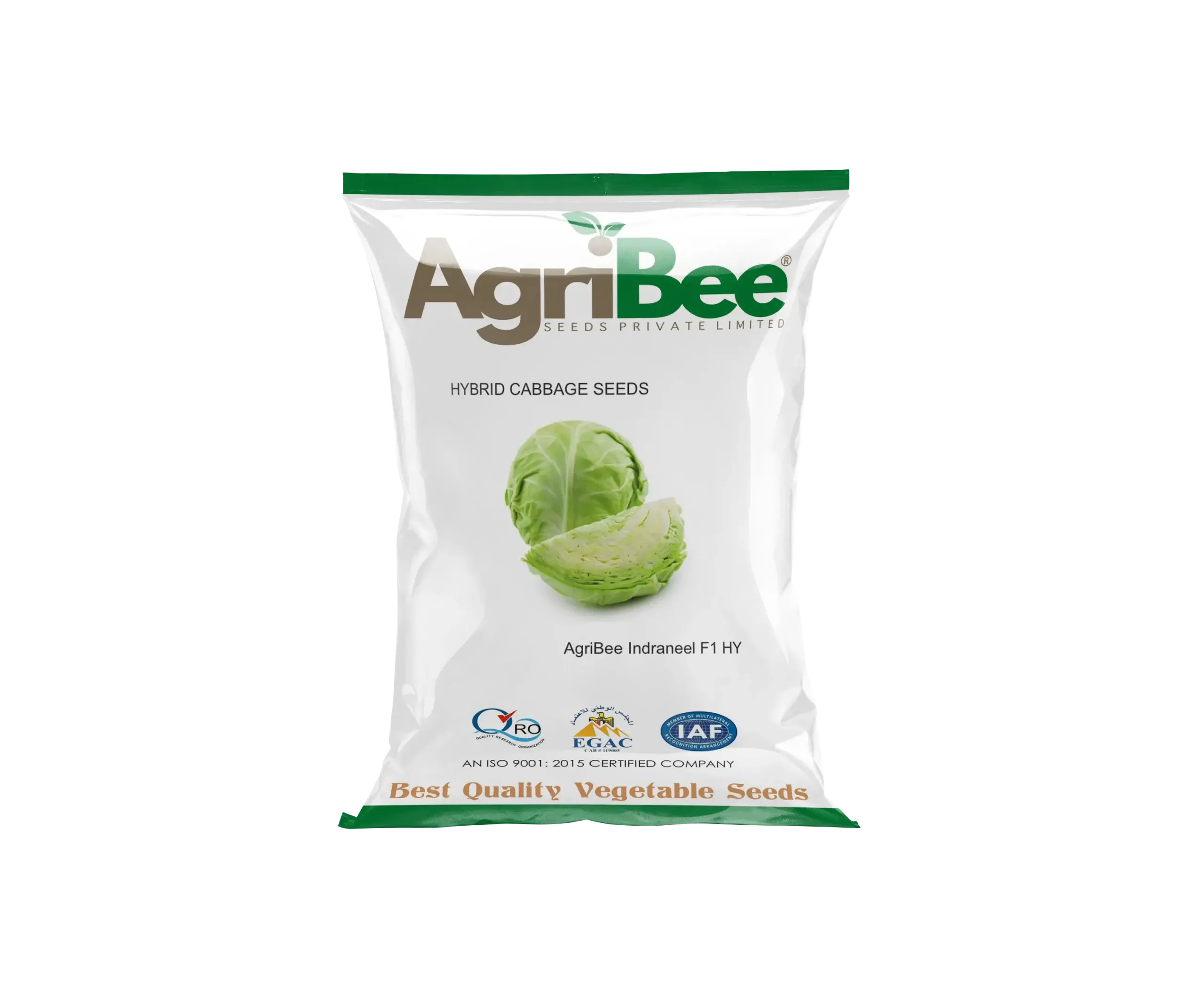
Farming & Cultivation Guide — Cabbage Seeds AgriBee Indraneel F1 HY
Complete step-by-step agronomic guide for optimal crop management, disease resistance, and premium produce quality.
🌾 Soil Preparation & Field Prep
Proper land preparation ensures uniform seedling emergence and robust root anchorage.
🌱 Ideal Soil Type & pH
Well-drained loamy or sandy-loam soils with good organic matter content. pH range: 6.0–7.5. Deep, fertile soils with adequate moisture retention are ideal for developing compact, heavy heads.
✨ Core Advantage
Fine tilth and good structure promote rapid root establishment, uniform seedling growth, and strong head formation without waterlogging stress.
- 1
Deep summer ploughing followed by 2–3 cross-harrowings to achieve fine, crumbly tilth for optimal seedbed preparation.
- 2
Field leveling and drainage channel preparation to prevent water stagnation, especially critical during monsoon Kharif season.
- 3
Incorporation of 15–20 tonnes per acre of well-decomposed FYM or compost during final harrowing to improve soil structure and nutrient availability.
- 4
Soil health conditioning with gypsum (if sodium buildup is observed) and lime application (where pH falls below 6.0) to maintain optimal nutrient uptake.
🌱 Sowing Time & Method
Precise seed rate and spacing maximize light interception and canopy development.
| Parameter | Recommendation | Agronomic Importance |
|---|---|---|
| Sowing Window | June–July (Kharif) and October–November (Rabi); protected-culture summer sowings possible in North India | Cool, dry weather post-transplanting ensures vigorous vegetative growth and tight head formation without bolting or heat stress. |
| Seed Rate | 300–350 g per Acre (Transplanted nursery method) | Ensures adequate healthy seedlings for optimal plant population while minimizing waste and thinning labor. |
| Spacing | 60 cm (Row-to-Row) × 45 cm (Plant-to-Plant) | Provides sufficient canopy spread for full head development, improves air circulation, and reduces disease pressure. |
| Sowing / Transplanting Depth | Sowing depth: 0.5–1.0 cm; Transplanting: 25–30 days old seedlings at cotyledon to 2-true-leaf stage | Shallow sowing ensures rapid and uniform germination; young transplants establish quickly with minimal shock. |
💧 Irrigation & Water Management
Adequate moisture regulation supports strong vegetative and reproductive growth.
☀️ Water Requirement Profile
Cabbage is a shallow-rooted crop with moderate drought sensitivity. Consistent soil moisture is essential throughout the growing cycle, particularly during active head development (40–70 DAT). Drip irrigation is highly compatible and improves water use efficiency while reducing foliar disease incidence. Average water requirement is approximately 400–500 mm over the crop cycle.
🌦️ Soil Moisture Management
Under rainfed conditions, ensure well-timed monsoon sowings and maintain soil cover with mulch to conserve moisture. Avoid waterlogging during heavy rains by maintaining raised beds and clear drainage channels. Irrigate immediately if leaf wilting or curling is observed during dry spells.
- ✓
First irrigation immediately after transplanting (within 6 hours) to promote rapid root establishment and reduce transplant shock.
- ✓
Vegetative phase (15–45 DAT): Light and frequent irrigation at 7–10 day intervals depending on soil type and weather conditions.
- ✓
Critical head formation stage (45–65 DAT): Maintain consistent soil moisture without waterlogging; uneven irrigation causes hollow stem and tip burn disorders.
- ✓
Pre-harvest water withholding: Reduce irrigation 5–7 days before planned harvest to improve firmness and post-harvest keeping quality.
🧪 Fertilizer & Nutrition Management
Balanced crop nutrition supports robust plant structure and premium produce quality.
| Nutrient | Recommended Dose (per Acre) | Application Method & Timing |
|---|---|---|
| Nitrogen (N) | 80–100 kg/acre | 50% basal at last ploughing; 25% at 25 DAT (top-dressing); 25% at 40 DAT (side-dressing during head initiation) |
| Phosphorus (P2O5) | 40–50 kg/acre | 100% basal application incorporated during final harrowing as DAP (18:46:00) |
| Potash (K2O) | 40–50 kg/acre | 50% basal + 50% at 40 DAT as MOP to support head firmness and overall crop vigor |
🌿 Interculture & Weed Management
Timely weed control ensures optimal nutrient and moisture availability for crop seedlings.
-
1
First Weeding & Hoeing: Carry out light hoeing and weeding at 10–12 days after transplanting (DAT) to eliminate early weed competition and loosen soil crust. Shallow cultivation avoids root damage.
-
2
Second Weeding & Earthing-Up: Perform second weeding and light earthing-up around plant bases at 25–30 DAT to improve root aeration, support developing heads, and prevent lodging.
-
3
Mulching and Intra-row Cultivation: Apply straw or polyethylene mulch between rows after second weeding to conserve soil moisture, suppress weed growth, and keep developing heads clean. Conduct intra-row manual weeding as needed until canopy closure at 50 DAT.
🛡️ Pest & Disease Management
Proactive crop monitoring and integrated management ensure healthy crop development.
🐛 Insect Pest Management
- Diamondback Moth (Plutella xylostella): Small larvae create skeletonized holes in leaves; severe infestation defoliates plants. Spray Chlorantraniliprole 18.5% SC at 0.3 ml/liter or Bacillus thuringiensis (Bt) var. kurstaki at 2–3 g/liter. Repeat at 7-day intervals under heavy pressure. Use yellow sticky traps for monitoring adult populations.
- Aphids (Brevicoryne brassicae): Green/black clustered colonies on underside of leaves cause curling, stunting, and honeydew accumulation promoting sooty mold. Spray Imidacloprid 17.8% SL at 0.3 ml/liter or Thiamethoxam 25% WG at 0.2 g/liter. Introduce ladybird beetles for biological control in low-infestation fields.
- Cabbage Butterfly (Pieris brassicae): Large green caterpillars chew extensive holes in leaves and bore into heads. Spray Spinosad 45% SC at 0.5 ml/liter or Chlorpyriphos 20% EC at 2.5 ml/liter. Apply neem-based biopesticides as preventive measure at 15 DAT intervals.
🔬 Disease Control
- Clubroot (Plasmodiophora brassicae): Swollen, distorted roots and stunted yellowing plants; soil-borne pathogen persists for many years. Pre-sowing soil drench with Captan 75% WP at 2.5 g/liter or Carbendazim 50% WP at 1.0 g/liter. Maintain soil pH above 7.2 with agricultural lime to suppress pathogen activity. Rotate with non-brassica crops for 3–4 years.
- Black Rot (Xanthomonas campestris pv. campestris): V-shaped yellow lesions at leaf margins progressing to black vascular streaks; spreads rapidly in humid conditions. Spray Copper oxychloride 50% WP at 3.0 g/liter or Streptocycline 50% SP at 0.5 g/liter at 10-day intervals. Use disease-free certified seeds and practice 2-year rotation.
- Downy Mildew (Peronospora parasitica): Yellow angular lesions on upper leaf surface with dense purple-gray sporulation on underside; favored by cool, moist weather. Spray Mancozeb 75% WP at 2.0 g/liter or Metalaxyl 35% WS at 1.5 g/liter as preventive protectant. Ensure adequate plant spacing for canopy airflow and avoid overhead irrigation.
✂️ Harvesting & Produce Quality Guide
Harvesting at peak maturity ensures maximum commercial grade and long keeping quality.
⏱️ Harvesting Schedule & Timing
First harvest at 65–75 days after transplanting (DAT). Each head is harvested once when it reaches full maturity and compactness. No multiple pickings; entire head is cut at the base.
⭐ Produce Quality Characteristics
Round, very compact heads with attractive bluish-green outer foliage. Dense leaf packing provides excellent crunch, mild sweetness, and low fiber content. Heads weighing 1.5–2.0 kg exhibit uniform size distribution preferred by wholesale and retail markets. High Vitamin C, folate, and antioxidant content enhance nutritional appeal.
| Quality Parameter | Agronomic Standard | Farmer & Market Benefit |
|---|---|---|
| First Harvest Stage | 65–75 Days after Transplanting | Ensures peak quality and early market arrival when prices are favorable |
| Harvest Maturity Signs | Heads feel firm and solid when gently squeezed; outer leaves turn lighter green and spread outward; characteristic round shape fully developed | Prevents over-maturity, splitting, and internal leaf deterioration |
| Shelf Life & Keeping Quality | 7–10 days under ambient conditions; 14–18 days at 0–2°C with 95% relative humidity | Facilitates long-distance transport, extended sales window, and reduced post-harvest losses |
| Market Suitability | Fresh table market, mandis, supermarkets, export-grade processing; appealing bluish-green color and compact round shape attract premium rates | Versatile commercial utilization with strong consumer demand across urban and semi-urban markets |
⭐ Varietal Features — Cabbage Seeds AgriBee Indraneel F1 HY
Distinguishing characteristics that make this variety a top choice for Indian growers.
🌿 Core Variety Highlight
AgriBee Indraneel F1 HY delivers exceptional head uniformity and compactness, making it a standout hybrid choice for farmers seeking reliable field performance and consistent output across Indian growing conditions.
🌿 Produce Quality & Appearance
Round, very compact heads with attractive bluish-green coloration and smooth outer foliage. The dense leaf arrangement and uniform 1.5–2.0 kg head weight meet premium market standards for fresh consumption and retail display.
🌿 Stress & Disease Tolerance
Strong field tolerance to common brassica pests and diseases including clubroot, black rot, and diamondback moth pressure. Vigorous root system supports resilience under moderate moisture stress during head formation.
🌿 Growth Habit & Vigor
Upright, bushy plant architecture with vigorous early vegetative growth. Rapid canopy development ensures effective weed suppression and optimal light interception for robust photosynthetic activity.
🌿 Crop Duration & Earliness
First harvest at 65–75 days after transplanting enables flexible crop sequencing within Kharif-Rabi rotation systems. Early maturity supports multiple cropping opportunities and timely market entry.
🌿 Market & Farmer Preference
Consistent head quality, attractive color, and excellent shelf life make Indraneel F1 HY a preferred choice among progressive farmers, commission agents, and traders seeking dependable supply chain performance.