Description
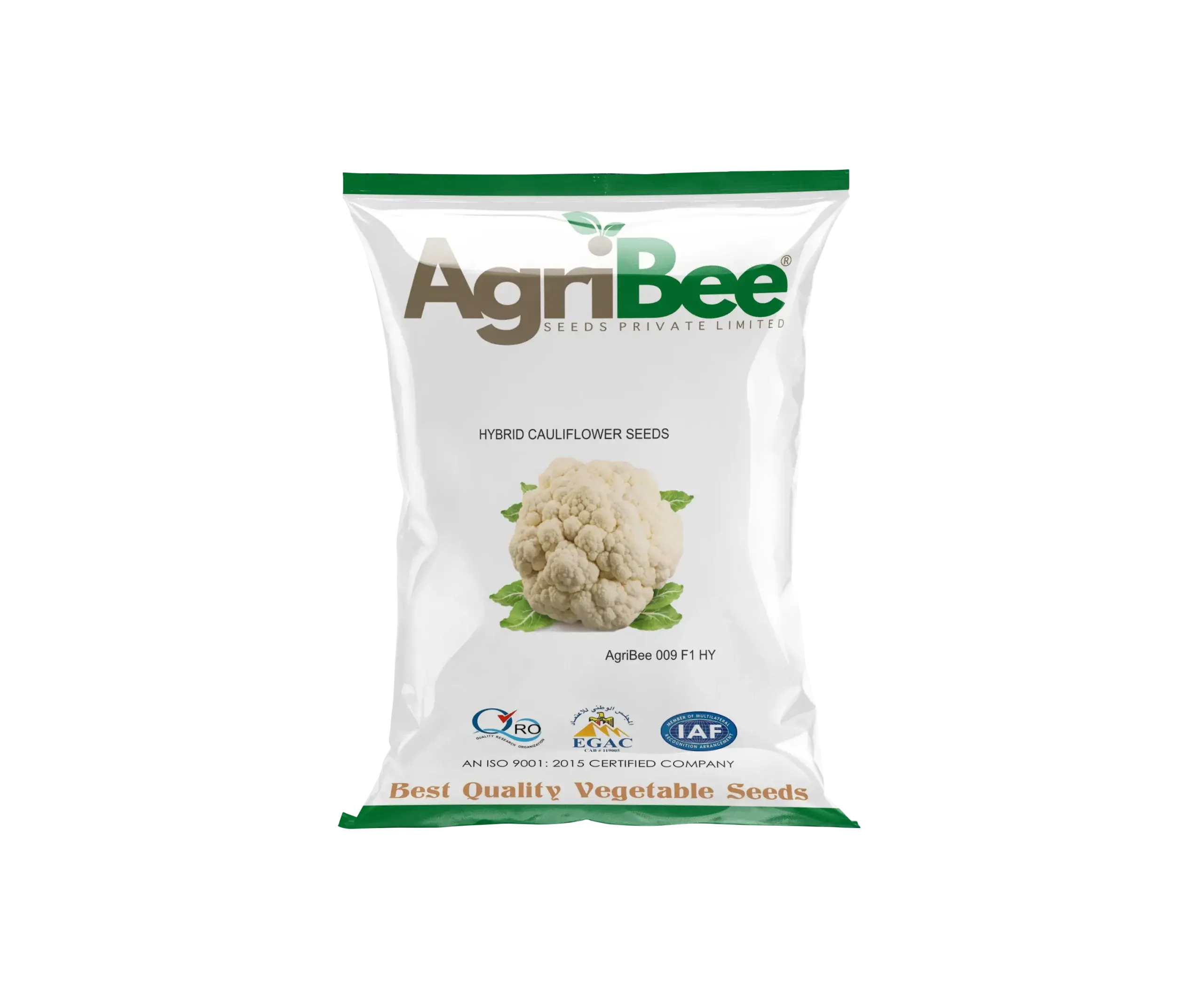
Farming & Cultivation Guide — Cauliflower Seeds AgriBee 009 F1 HY
Complete step-by-step agronomic guide for optimal crop management, disease resistance, and premium produce quality.
🌾 Soil Preparation & Field Prep
Proper land preparation ensures uniform seedling emergence and robust root anchorage.
🌱 Ideal Soil Type & pH
Well-drained loamy or clay-loam soils with pH 6.0–7.5. Deep, fertile soils rich in organic matter are ideal for curd development.
✨ Core Advantage
Fine seedbed with good structure ensures rapid root establishment and uniform plant stand, critical for F1 hybrid performance.
- 1
Deep summer ploughing followed by 2–3 cross-harrowings for fine tilth.
- 2
Field leveling and drainage preparation to prevent waterlogging.
- 3
Incorporate 8–10 tonnes of well-decomposed FYM or vermicompost during final land preparation.
- 4
Maintain soil pH between 6.0–7.5; apply gypsum (10 kg/acre) if soil is alkaline.
🌱 Sowing Time & Method
Precise seed rate and spacing maximize light interception and canopy development.
| Parameter | Recommendation | Agronomic Importance |
|---|---|---|
| Sowing Window | Kharif: June–July | Rabi: October–November | Summer: February–March | Avoids extreme temperatures that cause buttoning and poor curd formation |
| Seed Rate | 250–300 g per Acre (Transplanted) | Ensures adequate seedling population with uniform vigor |
| Spacing | 60 cm x 45 cm (Row-to-row x Plant-to-plant) | Allows adequate canopy spread, airflow, and curd development space |
| Sowing / Transplanting Depth | Sow seeds 0.5–1.0 cm deep; transplant at 4–5 leaf stage (25–30 DAS) | Optimal depth ensures uniform emergence and strong root system establishment |
💧 Irrigation & Water Management
Adequate moisture regulation supports strong vegetative and reproductive growth.
☀️ Water Requirement Profile
Cauliflower has shallow root systems and requires consistent soil moisture throughout the crop cycle. Drought stress during curd initiation leads to small, loose curds and buttoning. Drip irrigation with frequent light applications (every 2–3 days) is highly recommended for water efficiency and uniform growth.
🌦️ Soil Moisture Management
Under rainfed conditions, ensure residual soil moisture is maintained through mulching. Avoid moisture stress during the critical curd initiation stage (45–60 DAT). Supplemental irrigation is essential even in high-rainfall seasons to prevent waterlogging damage.
- ✓
First irrigation immediately after transplanting (dasperani) to reduce transplant shock.
- ✓
Vegetative phase: irrigate every 7–10 days depending on soil type and weather conditions.
- ✓
Curd initiation stage (45–60 DAT) requires frequent irrigation every 5–7 days to support rapid curd bulging.
- ✓
Reduce irrigation frequency 5–7 days before harvest to improve curd firmness and shelf life.
🧪 Fertilizer & Nutrition Management
Balanced crop nutrition supports robust plant structure and premium produce quality.
| Nutrient | Recommended Dose (per Acre) | Application Method & Timing |
|---|---|---|
| Nitrogen (N) | 80–100 kg/acre | 50% basal at transplanting + 2 splits at 25 DAT and 45 DAT |
| Phosphorus (P2O5) | 50 kg/acre | 100% basal application at final land preparation via DAP |
| Potash (K2O) | 40–50 kg/acre | 50% basal + 50% at 45 DAT for curd quality and firmness |
🌿 Interculture & Weed Management
Timely weed control ensures optimal nutrient and moisture availability for crop seedlings.
-
1
First Weeding & Hoeing: Carry out at 10–12 DAT to control early weed flush and loosen soil for root aeration. Shallow hoeing prevents root damage.
-
2
Second Weeding & Earthing-Up: Conduct at 25–30 DAT along with moderate earthing-up around plants for better root anchorage and improved water infiltration.
-
3
Blanching / Curd Protection: When curds reach marble size (~5–7 cm), tie outer leaves over the curd using soft twine or clip to protect from sun exposure, ensuring milky white, bruise-free curds.
🛡️ Pest & Disease Management
Proactive crop monitoring and integrated management ensure healthy crop development.
🐛 Insect Pest Management
- Diamondback Moth (Plutella xylostella): Larvae create shot-hole damage on leaves and bore into curds. Spray Spinosad 45% SC at 0.3 ml/liter or Bt formulation (1 ml/liter). Apply during evening hours for better contact.
- Aphids (Bemisia tabaci / Myzus persicae): Suck sap causing yellowing, curling, and viral transmission. Spray Imidacloprid 17.8% SL at 0.3 ml/liter or Neem-based pesticide at 3 ml/liter. Use yellow sticky traps at 15 traps/acre for monitoring.
- Cutworms (Agrotis ipsilon): Chew seedlings at base causing wilting and death. Apply Carbendazim 50% WP @ 2 g/kg seed for pre-sowing treatment. For established infestation, spray Chlorantraniliprole 18.5% SC at 0.5 ml/liter near plant base in the evening.
🔬 Disease Control
- Black Rot (Xanthomonas campestris pv. vesicatoria): V-shaped yellow lesions on leaf margins with blackened veins. Preventive spray of Copper oxychloride 50% WP at 2.5 g/liter at 10-day intervals. Remove and destroy infected plants immediately.
- Downy Mildew (Peronospora rapani): Yellow angular leaf spots with white downy growth on undersides. Spray Metalaxyl 35% WS at 1.5 g/liter or Mancozeb 75% WP at 2 g/liter as preventive measures. Ensure proper spacing for air circulation.
- Club Root (Plasmodiophora brassicae): Swollen, club-shaped galls on roots causing stunting and wilting. Maintain soil pH above 7.2 by applying agricultural lime at 50 kg/acre. Practice 3-year crop rotation with non-brassica crops. Drench seedling roots with Thiram 75% WP at 2.5 g/liter before transplanting.
✂️ Harvesting & Produce Quality Guide
Harvesting at peak maturity ensures maximum commercial grade and long keeping quality.
⏱️ Harvesting Schedule & Timing
First main harvest begins at 65–70 days after transplanting when curds reach full size and remain compact. Secondary pickings may be taken from lateral buds 7–10 days apart after the primary curd is harvested.
⭐ Produce Quality Characteristics
Dome-shaped, highly compact milky white curds with excellent texture, sweet taste, and uniform size ranging 1.0–1.5 kg. Dense curd structure ensures minimal bruising during handling and transport.
| Quality Parameter | Agronomic Standard | Farmer & Market Benefit |
|---|---|---|
| First Harvest Stage | 65–70 Days after Transplanting | Ensures peak curd development and early market arrival for better price realization |
| Harvest Maturity Signs | Curd fully formed, dome-shaped, milky white, firm to touch, wrapped by green outer leaves | Prevents over-maturity, loose curd formation, and yellowing of inner leaves |
| Shelf Life & Keeping Quality | 5–7 days under ambient conditions; up to 10–12 days under refrigerated storage (0–4°C) | Facilitates long-distance transport and extends sales window for farmers |
| Market Suitability | Excellent for fresh market, supermarkets, and institutional supply chains due to uniform appearance and compact curd | Attracts premium market rates for farmers due to superior visual appeal and customer preference |
⭐ Varietal Features — Cauliflower Seeds AgriBee 009 F1 HY
Distinguishing characteristics that make this variety a top choice for Indian growers.
🌿 Core Variety Highlight
AgriBee 009 F1 is a high-performance hybrid specifically bred for Indian growing conditions, combining early maturity with excellent curd quality and field adaptability across diverse agro-climatic zones.
🌿 Produce Quality & Appearance
Produces dome-shaped, highly compact milky white curds weighing 1.0–1.5 kg. The dense curd structure and uniform whiteness make it highly attractive in wholesale and retail markets.
🌿 Stress & Disease Tolerance
Demonstrates strong tolerance to common brassica diseases including black rot and downy mildew, with good resilience against temperature fluctuations during curd formation.
🌿 Growth Habit & Vigor
Vigorous vegetative growth with sturdy foliage that effectively shades and protects developing curds. Plants maintain healthy canopy throughout the crop cycle with good structural integrity.
🌿 Crop Duration & Earliness
Early maturity at 65–70 days after transplanting enables flexible crop planning, multiple cropping cycles per year, and faster capital turnaround for farmers.
🌿 Market & Farmer Preference
Preferred by traders and retailers due to consistent curd shape, superior white color, compact texture, and good post-harvest keeping quality. Farmers benefit from reliable field performance and uniform maturity across the crop.