Description
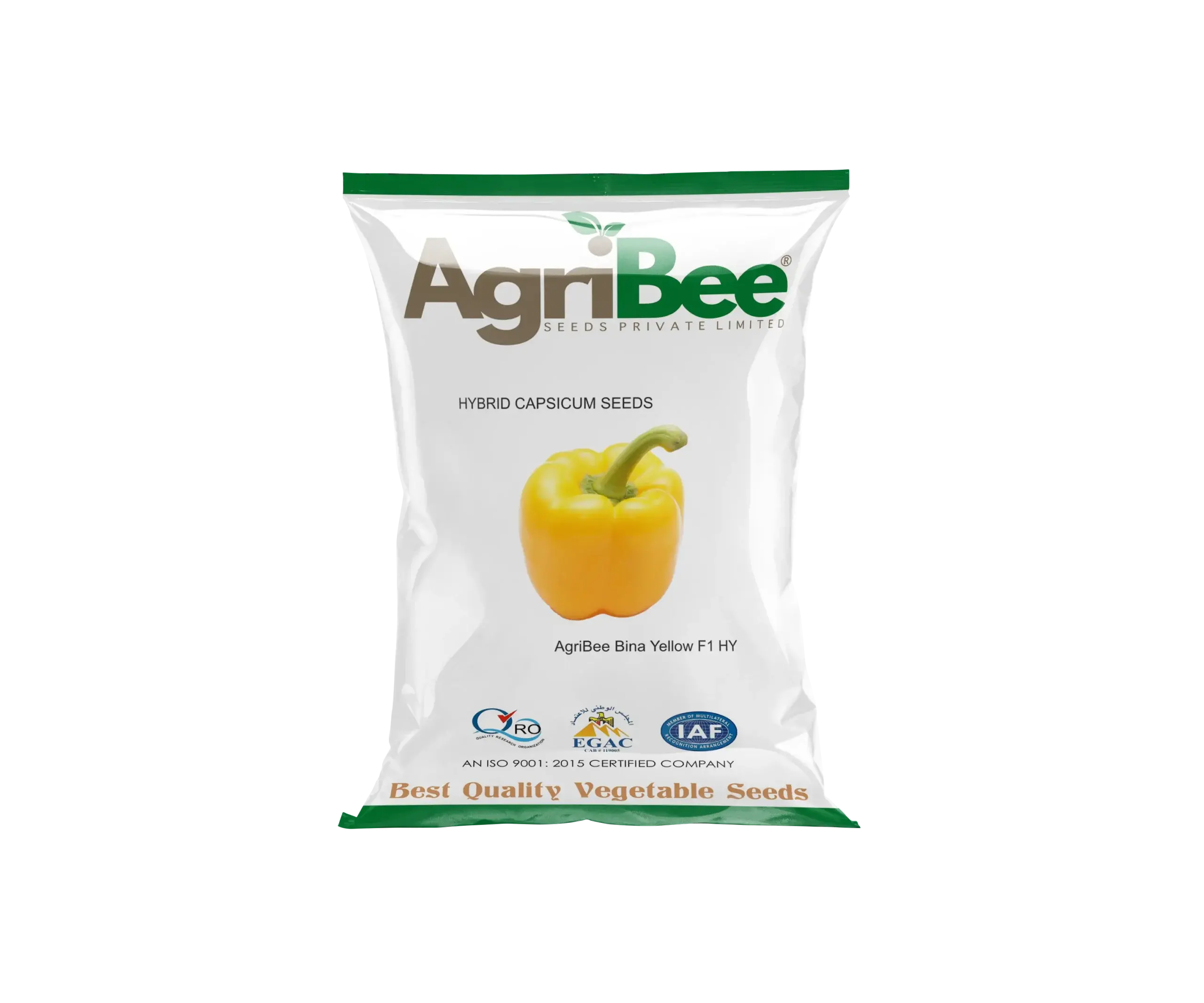
Farming & Cultivation Guide — Capsicum Seeds AgriBee Bina Yellow F1 HY
Complete step-by-step agronomic guide for optimal crop management, disease resistance, and premium produce quality.
🌾 Soil Preparation & Field Prep
Proper land preparation ensures uniform seedling emergence and robust root anchorage.
🌱 Ideal Soil Type & pH
Well-drained loamy to sandy-loam soils with pH 6.0–7.0. Deep, fertile soils rich in organic matter are ideal. Waterlogged or heavy clay soils must be avoided as they predispose plants to root rot and poor vigor.
✨ Core Advantage
Fine tilth with excellent drainage promotes rapid seed germination, strong root penetration, and uniform early crop establishment across varied Indian agro-climatic zones.
- 1
Deep summer ploughing to 25–30 cm followed by 2–3 cross-harrowings to achieve a fine, crumbly tilth.
- 2
Field leveling using laser leveler and preparation of adequate drainage channels to prevent water stagnation.
- 3
Incorporation of 15–20 tonnes per hectare of well-decomposed FYM or compost during final harrowing for improved soil structure and nutrient retention.
- 4
Soil health conditioning: apply gypsum at 250 kg/ha in acidic soils (pH below 6.0) and conduct a soil test before planting to tailor fertilizer recommendations.
🌱 Sowing Time & Method
Precise seed rate and spacing maximize light interception and canopy development.
| Parameter | Recommendation | Agronomic Importance |
|---|---|---|
| Sowing Window | Kharif: June–July | Rabi: October–November | Summer: February–March under shade net | Aligns with favorable temperature range of 18–30°C for optimal vegetative growth and fruit set |
| Seed Rate | 300–400 g per Acre (Transplanted) | Ensures adequate plant population of 30,000–35,000 plants per hectare without overcrowding |
| Spacing | 60 cm (Row-to-Row) × 45 cm (Plant-to-Plant) | Provides optimal canopy spread, airflow, and light penetration for healthy foliage and fruit development |
| Sowing / Transplanting Depth | 0.5–1.0 cm for direct sowing; transplant at 4–5 true leaf stage (25–30 DAS) | Shallow depth ensures quick and uniform emergence while preventing damping-off in nursery beds |
💧 Irrigation & Water Management
Adequate moisture regulation supports strong vegetative and reproductive growth.
☀️ Water Requirement Profile
Capsicum is moderately sensitive to water stress. Drip irrigation is highly recommended, supplying 25–35 mm of water per week during active growth. The crop requires consistent soil moisture but is intolerant of waterlogging. Maintaining 60–70% field capacity ensures uninterrupted vegetative growth and reduces fruit cracking.
🌦️ Soil Moisture Management
Under rainfed conditions, grow on raised beds with well-defined drainage furrows. Mulching with black polythene or paddy straw conserves soil moisture and suppresses weeds. Avoid moisture fluctuations between dry and wet extremes as this causes blossom-end rot and fruit drop.
- ✓
First irrigation should be applied immediately after transplanting (within 6 hours) to reduce transplant shock and ensure rapid root establishment.
- ✓
During vegetative phase (15–45 DAT), irrigate at 3–4 day intervals depending on soil type and weather conditions to support vigorous foliage development.
- ✓
Critical stages — flowering, fruit set, and fruit expansion (45–90 DAT) — require regular irrigation every 2–3 days. Stress during fruiting causes small, misshapen fruits and flower drop.
- ✓
Withhold irrigation 5–7 days before final harvest to improve firmness, shelf life, and fruit color uniformity.
🧪 Fertilizer & Nutrition Management
Balanced crop nutrition supports robust plant structure and premium produce quality.
| Nutrient | Recommended Dose (per Acre) | Application Method & Timing |
|---|---|---|
| Nitrogen (N) | 80–100 kg/ha (65–80 kg/acre) | 50% basal at transplanting; remaining 50% split into two top-dressings at 30 DAT and 60 DAT |
| Phosphorus (P2O5) | 50–60 kg/ha (40–50 kg/acre) | 100% basal application along with FYM at last harrowing before transplanting |
| Potash (K2O) | 50–60 kg/ha (40–50 kg/acre) | 100% basal except for a side-dressing of 25% at first picking to support fruit quality and color development |
🌿 Interculture & Weed Management
Timely weed control ensures optimal nutrient and moisture availability for crop seedlings.
-
1
First Weeding & Hoeing: Carry out at 10–15 DAT using a hand hoe or inter-row cultivator. Early weed control is critical as capsicum is a slow-growing seedling susceptible to weed competition during the first three weeks after transplanting.
-
2
Second Weeding & Earthing-Up: Perform at 25–30 DAT simultaneously with second fertilizer top-dressing. Gentle earthing-up around plant bases improves root aeration, supports laterals, and prevents lodging as the crop matures.
-
3
Mulching and Staking: Lay black polythene mulch at transplanting to conserve moisture, suppress weeds, and maintain soil temperature. Stake plants using string trellis or vertical stake system starting at 30 DAT to support heavy fruit load and improve air circulation within the canopy.
🛡️ Pest & Disease Management
Proactive crop monitoring and integrated management ensure healthy crop development.
🐛 Insect Pest Management
- Thrips (Thrips tabaci): Causes silvery scars on leaves and distorted new growth. Control: Spray thiamethoxam 25% WG at 0.1 g/L or spinosad 45% SC at 0.3 ml/L. Deploy blue sticky traps at 15 traps per acre for monitoring and mass trapping.
- Whitefly (Bemisia tabaci): Sucks sap, causes yellowing and sooty mold development. Control: Spray imidacloprid 17.8% SL at 0.3 ml/L or clothianidin 50% WS at 0.1 g/L. Install yellow sticky traps at 20 traps per acre. Preserve natural enemies like Encarsia formosa.
- Fruit and Shooting Borer (Spodoptera litura): Larvae bore into fruits causing direct performance loss and secondary infections. Control: Spray chlorantraniliprole 18.5% SC at 0.3 ml/L or emamectin benzoate 5% SG at 0.2 g/L. Destroy affected fruits and deploy pheromone traps at 10 traps per acre.
🔬 Disease Control
- Bacterial Leaf Spot (Xanthomonas campestris pv. vesicatoria): Small water-soaked spots with yellow halos on leaves and lesions on fruits. Prevention: Apply copper oxychloride 50% WP at 2.5 g/L as a preventive spray at 15-day intervals. Use disease-free certified seeds and practice crop rotation with non-host crops for 2–3 years.
- Anthracnose (Colletotrichum gloeosporioides): Sunken, circular rot spots on mature fruits, often with pinkish sporulation in humid conditions. Control: Spray mancozeb 75% WP at 2.0 g/L or azoxystrobin 25% WG at 0.1 g/L. Ensure proper spacing for air circulation and avoid overhead irrigation to reduce leaf wetness duration.
- Phytophthora Blight (Phytophthora capsici): Wilting, brown necrotic lesions on stems and fruits, and root rot. Prevention: drench soil with metalaxyl 35% WS at 2.5 g/L at transplanting and repeat at 30-day intervals. Maintain strict drainage and avoid waterlogging. Remove and destroy infected plants immediately.
✂️ Harvesting & Produce Quality Guide
Harvesting at peak maturity ensures maximum commercial grade and long keeping quality.
⏱️ Harvesting Schedule & Timing
First harvest begins at 70–75 days after transplanting when fruits attain full size and show initial yellow coloration. Subsequent pickings are made at 7–10 day intervals over a harvesting period of 4–6 weeks.
⭐ Produce Quality Characteristics
Blocky, 3–4 lobed fruits with thick walls, smooth glossy surface, and bright golden-yellow coloration. Firm texture, sweet mild flavor, and excellent internal cavity-to-wall ratio. High vitamin C and provitamin A content add nutritional value.
| Quality Parameter | Agronomic Standard | Farmer & Market Benefit |
|---|---|---|
| First Harvest Stage | 70–75 Days after Transplanting | Ensures peak quality and early market arrival when yellow capsicum commands premium prices |
| Harvest Maturity Signs | Fruits reach full size (150–180 gm), uniform bright yellow color, firm and glossy skin | Prevents over-maturity and tissue softening that reduces marketability and shelf life |
| Shelf Life & Keeping Quality | 10–14 days under ambient conditions; 18–21 days at 8–10°C with 90–95% relative humidity | Facilitates long-distance transport, extended sales window, and minimal post-harvest losses |
| Market Suitability | Fresh table market, export-grade packing, processing units, and modern retail chains | Attracts premium market rates from farmers due to uniform appearance, attractive yellow color, and excellent handling quality |
⭐ Varietal Features — Capsicum Seeds AgriBee Bina Yellow F1 HY
Distinguishing characteristics that make this variety a top choice for Indian growers.
🌿 Core Variety Highlight
AgriBee Bina Yellow F1 is an F1 hybrid delivering exceptional field vigor, uniform plant type, and high percentage of packable #1 grade fruits with outstanding yellow color development.
🌿 Produce Quality & Appearance
Blocky, 3–4 lobed fruits weighing 150–180 gm with thick walls, smooth glossy yellow skin, and sweet crunchy texture. Superior color uniformity and minimal shoulder greenness at maturity.
🌿 Stress & Disease Tolerance
Demonstrates strong field tolerance to common capsicum diseases including bacterial leaf spot and phytophthora blight. Exhibits good adaptability to temperature fluctuations across Indian growing seasons.
🌿 Growth Habit & Vigor
Compact, bushy plant architecture with strong stem and vigorous lateral branching. Dense but open canopy promotes excellent light penetration and air circulation for healthy foliage and fruit development.
🌿 Crop Duration & Earliness
First harvest at 70–75 days after transplanting enables early market entry and flexible crop rotation planning, making it suitable for multiple growing cycles per year under protected cultivation.
🌿 Market & Farmer Preference
Trusted by progressive farmers and traders for consistent growth potential, uniform fruit sizing, vibrant yellow color, and excellent post-harvest shelf life. The variety's reliability and premium visual appeal make it a preferred choice for both domestic mandis and export-oriented packaging.