Description
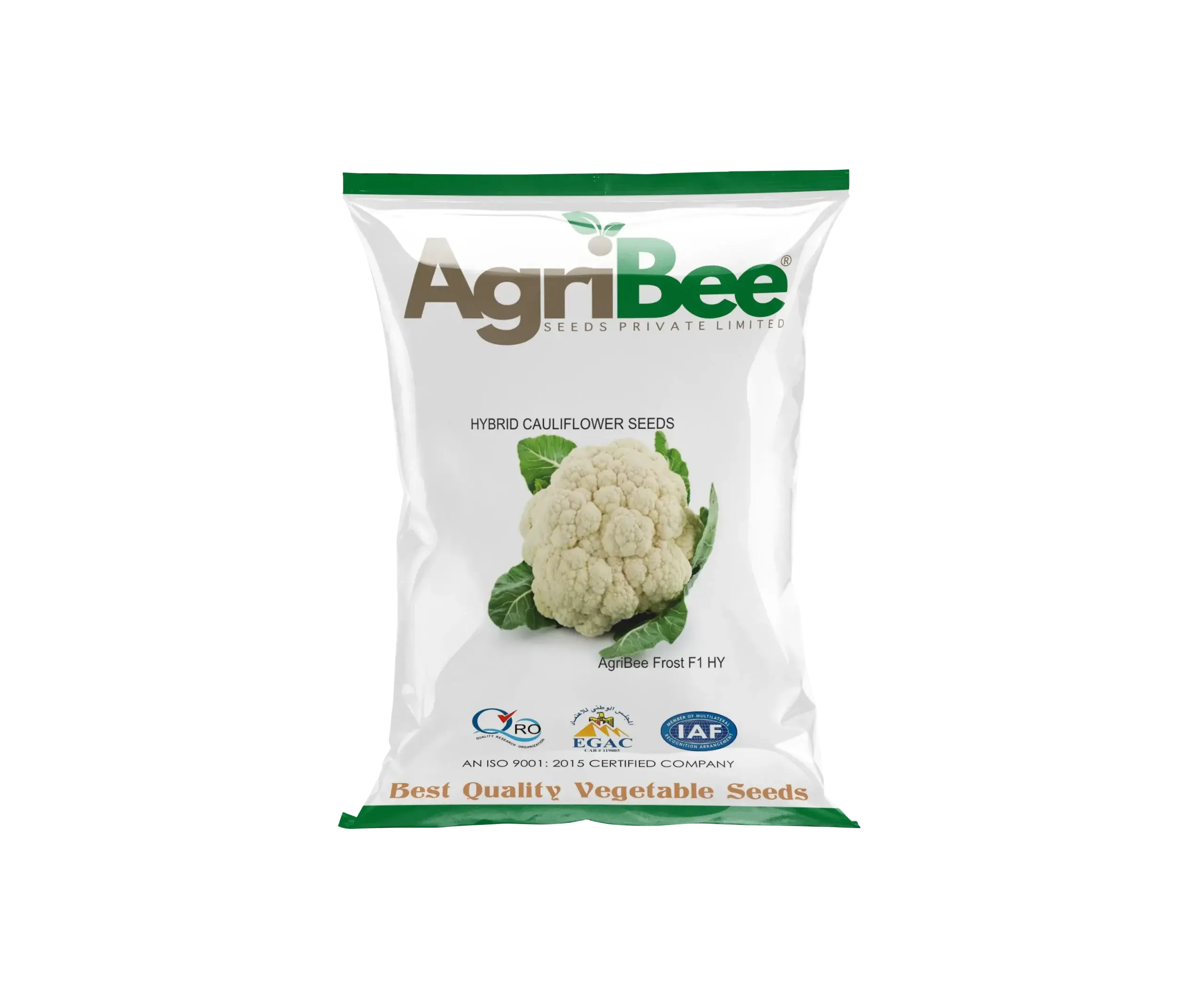
Farming & Cultivation Guide — Cauliflower Seeds AgriBee Frost F1 HY
Complete step-by-step agronomic guide for optimal crop management, disease resistance, and premium produce quality.
🌾 Soil Preparation & Field Prep
Proper land preparation ensures uniform seedling emergence and robust root anchorage.
🌱 Ideal Soil Type & pH
Well-drained loamy or sandy-loam soils rich in organic matter. pH range: 6.0–7.5. Avoid waterlogged or heavy clay soils that predispose curds to bacterial rot.
✨ Core Advantage
Loose, friable soil texture ensures rapid seedling root penetration and strong anchorage, supporting healthy foliage development and uniform curd formation.
- 1
Deep summer ploughing to a depth of 25–30 cm followed by 2–3 cross-harrowings to obtain a fine, clod-free tilth.
- 2
Field leveling using a laser leveler or board leveling to ensure uniform drainage and prevent water stagnation in raised beds.
- 3
Incorporate 15–20 t/ha of well-decomposed FYM or compost during the last harrowing to improve soil structure and nutrient-holding capacity.
- 4
Conduct a soil test and apply gypsum at 250–300 kg/ha if pH is above 7.5 or if sodium buildup is detected in problem soils.
🌱 Sowing Time & Method
Precise seed rate and spacing maximize light interception and canopy development.
| Parameter | Recommendation | Agronomic Importance |
|---|---|---|
| Sowing Window | Nursery sowing in Oct–Nov for Rabi; Mar–Apr for Summer; Jul–Aug for Kharif in cooler zones | Cauliflower is a cool-season crop; sowing outside these windows exposes plants to heat stress causing buttoning and poor curd quality. |
| Seed Rate | 300–350 g per Acre for transplanted crop (nursery requires ~50–60 g per acre-equivalent nursery bed) | Optimal seed rate ensures adequate plant population without overcrowding in the nursery, promoting uniform seedling vigor. |
| Spacing | 60 cm (row-to-row) × 45 cm (plant-to-plant) | Provides sufficient canopy spread for photosynthesis and air circulation, reducing humidity-related disease pressure around the curd. |
| Sowing / Transplanting Depth | Sow seeds 0.5–1.0 cm deep in nursery; transplant seedlings at 4–5 true leaf stage (25–30 DAS) | Shallow sowing ensures rapid and uniform germination; correct transplant age prevents transplant shock and promotes early establishment. |
💧 Irrigation & Water Management
Adequate moisture regulation supports strong vegetative and reproductive growth.
☀️ Water Requirement Profile
Cauliflower has shallow roots and moderate water demand throughout its growth cycle. Consistent soil moisture is critical from plate formation through curd development. Drip irrigation with frequent light applications (2–3 times per week depending on soil and weather) is highly recommended for water use efficiency and uniform curd quality.
🌦️ Soil Moisture Management
In rainfed or limited-irrigation situations, mulching with straw or polythene sheeting conserves soil moisture and regulates soil temperature. Avoid moisture deficit during the curd initiation phase, as even brief water stress causes small, loose curds and buttoning.
- ✓
First irrigation immediately after transplanting (day 0–1) to settle the soil around roots and reduce wilting.
- ✓
During the vegetative phase (15–45 DAT), irrigate at 7–10 day intervals maintaining moist but not waterlogged conditions.
- ✓
Critical stage — curd initiation and development (50–65 DAT): maintain consistent soil moisture with 5–7 day irrigation intervals; any stress here directly reduces curd size and compactness.
- ✓
Reduce irrigation frequency 5–7 days before harvest to firm up curds and improve shelf life; avoid watering on the day of harvest.
🧪 Fertilizer & Nutrition Management
Balanced crop nutrition supports robust plant structure and premium produce quality.
| Nutrient | Recommended Dose (per Acre) | Application Method & Timing |
|---|---|---|
| Nitrogen (N) | 100–120 kg/ha (60 kg/acre) as urea | 50% basal at last ploughing; 25% at 30 DAT; 25% at 50 DAT during curd initiation |
| Phosphorus (P2O5) | 50–60 kg/ha (30 kg/acre) as DAP or SSP | 100% basal application at the time of final harrowing before transplanting |
| Potash (K2O) | 40–50 kg/ha (20–25 kg/acre) as MOP | 50% basal; 50% split at 45–50 DAT to support curd density and overall plant vigor |
🌿 Interculture & Weed Management
Timely weed control ensures optimal nutrient and moisture availability for crop seedlings.
-
1
First Weeding & Hoeing: Carry out 10–15 days after transplanting (DAT) using a hand hoe or cultipacker. Early weeding eliminates competition during the most sensitive establishment phase when cauliflower seedlings are small and vulnerable.
-
2
Second Weeding & Earthing-Up: Perform at 25–30 DAT. Light earthing-up around the plant base helps stabilize the developing plant, improves root aeration, and covers any exposed lateral roots that may cause green curding.
-
3
Blanching / Curd Shading: When curds reach approximately 8–10 cm in diameter (around 55–60 DAT), bend the outer leaves over the curd and tie them loosely with grass string or twist band to exclude sunlight. This produces the characteristic milky white, pristine curd colour and prevents greening or sunburn discoloration.
🛡️ Pest & Disease Management
Proactive crop monitoring and integrated management ensure healthy crop development.
🐛 Insect Pest Management
- Diamondback Moth (Plutella xylostella): Larvae create skeletonized holes in leaves; severe infestations defoliate plants. Spray Neem-based biopesticide (Neem oil 3 ml/L or NMVA 2 ml/L) at 7-day intervals during early infestation. For chemical control, apply Emamectin benzoate 5% SG at 0.5 g/L or Chlorantraniliprole 18.5% SC at 0.3 ml/L. Rotate modes of action to prevent resistance.
- Aphids (Brevicoryne brassicae / Myzus persicae): Colonies on undersides of leaves cause curling, yellowing, and stunt; also vector Turn mosaic virus. Spray Imidacloprid 17.8% SL at 0.3 ml/L or Thiamethoxam 25% WG at 0.2 g/L. Introduce predatory ladybird beetles as a biological control measure where feasible.
- Cabbage Butterfly / Cabbage White (Pieris rapae): Caterpillars chew large irregular holes in leaves and deposit black frass on foliage and curds. Spray Bacillus thuringiensis (Bt) formulation at 2.5 g/L or Spinosad 45% SC at 0.5 ml/L. Install yellow sticky traps at 15 traps/acre for adult monitoring and reduction.
🔬 Disease Control
- Black Rot (Xanthomonas campestris pv. campestris): V-shaped yellow lesions on leaf margins progressing to blackened vascular tissue; curds become unmarketable. Prevent through seed treatment with Streptocycline 0.3 g/L or Copper oxychloride 3 g/L. Field spray of Copper oxychloride 0.3% at 10-day intervals during disease-prone periods. Remove and destroy infected plant debris after harvest.
- Downy Mildew (Peronospora parasitica): Downy grey-purple fungal growth on leaf undersides with yellow chlorotic patches above; causes curd distortion. Apply Mancozeb 75% WP at 2.0 g/L or Cycloheximide + Metalaxyl at recommended label dosage at 10–12 day intervals starting at 25 DAT in humid conditions. Ensure good field drainage and adequate plant spacing to reduce leaf wetness.
- Club Root (Plasmodiophora brassicae): Swollen, club-shaped galls on primary and lateral roots; stunted, wilted appearance especially under dry conditions. Maintain soil pH at 7.2–7.5 by applying agricultural lime at 250–300 kg/ha before sowing. Practice 3–4 year rotation with non-brassica crops. Use raised beds with excellent drainage and drench soil with Potassium permanganate at 0.1% at transplanting in infested fields.
✂️ Harvesting & Produce Quality Guide
Harvesting at peak maturity ensures maximum commercial grade and long keeping quality.
⏱️ Harvesting Schedule & Timing
First harvest begins 65–70 days after transplanting when curds are fully developed, firm, and before they begin to loosen or split. Harvest in the early morning hours when temperatures are lowest to preserve curd freshness. Cut with a sharp knife leaving 2–3 wrapper leaves around the curd for protection during transport.
⭐ Produce Quality Characteristics
The AgriBee Frost F1 HY produces dome-shaped, highly compact curds with a striking milky white colour. The curds are dense and firm with uniform texture, free from discoloration or granulation. Leaves are dark green, vigorous, and provide natural curd protection. The variety delivers consistent curd weight of 1.0–1.5 kg with excellent eating quality — tender, sweet flavour, and fine grain.
| Quality Parameter | Agronomic Standard | Farmer & Market Benefit |
|---|---|---|
| First Harvest Stage | 65–70 days after transplanting; curd reaches full dome shape and firmness | Ensures peak curd quality with maximum compactness and milky white colour; early market arrival fetches better prices. |
| Harvest Maturity Signs | Curd is firm to touch, dome-shaped, milky white throughout; outer leaves just beginning to lift; curd diameter 15–20 cm | Prevents over-maturity which leads to curd splitting, bolting, or loose texture that reduces market value. |
| Shelf Life & Keeping Quality | 5–7 days under ambient conditions; up to 10–12 days under refrigerated storage at 0–2°C with high humidity | Compact, well-blanked curds retain freshness longer, enabling wider market reach and reduced post-harvest losses during transportation. |
| Market Suitability | Premium table quality suitable for mandis, retail markets, hotels, and processing units; excellent for export-grade packaging | Dome-shaped, milky white, highly compact curds with uniform size attract premium rates from traders and meet modern trade quality standards. |
⭐ Varietal Features — Cauliflower Seeds AgriBee Frost F1 HY
Distinguishing characteristics that make this variety a top choice for Indian growers.
🌿 Core Variety Highlight
AgriBee Frost F1 HY is a semi-bolting resistant hybrid specifically bred for Indian conditions, delivering reliable performance across Rabi, Summer, and protected Kharif seasons with consistent curd set and quality.
🌿 Produce Quality & Appearance
Produces uniformly dome-shaped, highly compact milky white curds weighing 1.0–1.5 kg. The tight curd structure and brilliant white colouration meet premium market requirements and consumer expectations.
🌿 Stress & Disease Tolerance
Exhibits good tolerance to common cauliflower diseases including black rot and downy mildew, along with moderate resistance to aphid and diamondback moth pressures under integrated pest management practices.
🌿 Growth Habit & Vigor
Vigorous plant habit with an upright, bushy architecture. Dark green, robust foliage provides excellent natural shade to developing curds, reducing the incidence of sunburn and green curding.
🌿 Crop Duration & Earliness
Early to medium duration with first harvest in 65–70 days after transplanting. The relatively short crop cycle allows flexible sequencing in crop rotation systems and timely land preparation for the succeeding crop.
🌿 Market & Farmer Preference
Farmers and traders prefer AgriBee Frost F1 HY for its uniform curd appearance, high packing percentage, excellent shelf life, and dependable field performance. The compact dome-shaped curds command top prices in wholesale mandis and modern retail outlets across India.