Description
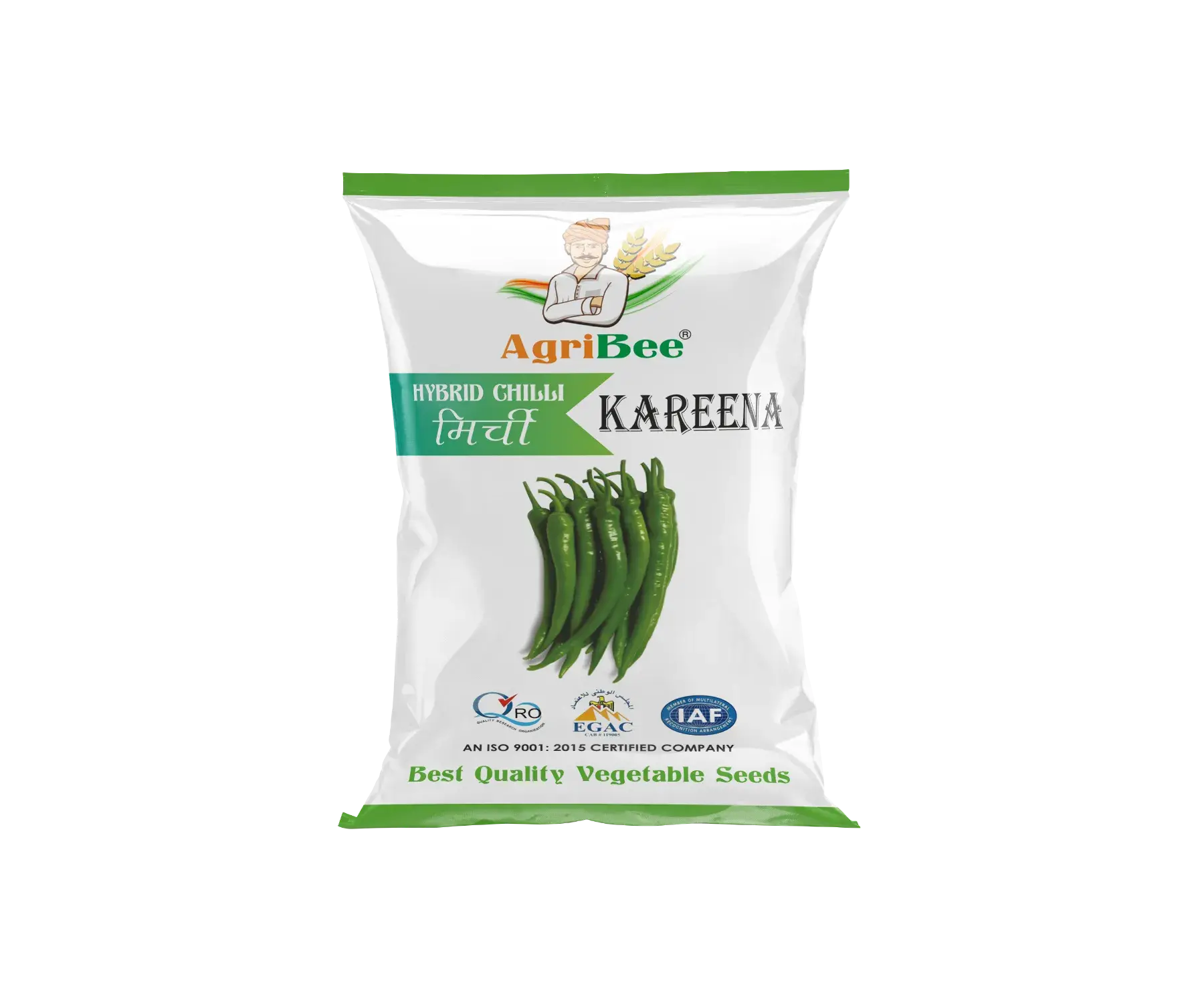
Farming & Cultivation Guide — Chilli Seeds AgriBee Kareena F1 HY
Complete step-by-step agronomic guide for optimal crop management, disease resistance, and premium produce quality.
🌾 Soil Preparation & Field Prep
Proper land preparation ensures uniform seedling emergence and robust root anchorage.
🌱 Ideal Soil Type & pH
Well-drained loamy to sandy-loam soils with good organic matter content. Optimal pH range: 6.0–7.5. Heavy clay or waterlogged soils must be avoided as they predispose plants to root rot and wilt diseases.
✨ Core Advantage
Deep, friable, well-aerated seedbed promotes rapid seed germination, strong taproot development, and excellent anchorage for upright branching habit under high pungency fruit load.
- 1
Deep summer ploughing (25–30 cm) followed by 2–3 cross-harrowings to achieve fine tilth and destroy weed seeds.
- 2
Field leveling with laser leveling where possible; prepare drainage channels to prevent water stagnation during heavy rains.
- 3
Incorporate 8–10 tonnes per acre of well-decomposed Farm Yard Manure (FYM) or compost during final harrowing for improved soil structure and microbial activity.
- 4
Conduct soil health test and adjust pH using agricultural lime (if acidic, pH < 6.0) or gypsum (if alkaline, pH > 7.5) before final bed preparation.
🌱 Sowing Time & Method
Precise seed rate and spacing maximize light interception and canopy development.
| Parameter | Recommendation | Agronomic Importance |
|---|---|---|
| Sowing Window | June–July (Kharif); Oct–Nov (Rabi); Feb–Mar (Summer) | Aligns temperature and moisture for optimal nursery establishment and avoids peak pest pressure during sensitive stages |
| Seed Rate | 300–400 g per Acre (for transplanting) | Ensures adequate healthy seedlings for uniform field population without overcrowding in nursery |
| Spacing | 60 cm (Row-to-Row) × 45 cm (Plant-to-Plant) | Provides adequate canopy spread, airflow, and sunlight penetration for dark green fruit development and disease reduction |
| Sowing / Transplanting Depth | Nursery sowing: 0.5–1.0 cm depth; Transplanting: same depth as in nursery polybag | Shallow sowing ensures rapid and uniform germination; correct transplant depth prevents stem rot and promotes adventitious root formation |
💧 Irrigation & Water Management
Adequate moisture regulation supports strong vegetative and reproductive growth.
☀️ Water Requirement Profile
Chilli is moderately drought-tolerant but requires consistent soil moisture for optimum vegetative growth and fruit development. Drip irrigation is highly recommended — it delivers 30–40% water savings compared to flood irrigation while maintaining uniform soil moisture. The crop needs approximately 4–6 irrigations during the first month after transplanting, followed by intervals of 5–7 days depending on soil texture and weather conditions.
🌦️ Soil Moisture Management
In rainfed situations, adopt conservative irrigation scheduling using soil moisture probes or finger-test method. Avoid moisture stress during flowering and fruit-setting stages (30–60 DAT) as it causes flower drop and malformed fruits. Raised beds with good surface drainage are essential to protect roots from waterlogging during intense rainfall events.
- ✓
First irrigation: Apply immediately after transplanting (within 24 hours) to reduce transplant shock and promote quick root establishment.
- ✓
Vegetative phase (15–45 DAT): Light and frequent irrigation at 4–5 day intervals to support vigorous foliage development and branching.
- ✓
Critical stage — Flowering and Fruit Set (45–75 DAT): Maintain consistent soil moisture; water stress during this window significantly reduces fruit set and causes blossom-end drop. Ensure adequate moisture for 8–10 cm fruit elongation.
- ✓
Pre-harvest: Reduce irrigation frequency 10–12 days before the first picking to improve fruit firmness, shelf life, and pungency concentration.
🧪 Fertilizer & Nutrition Management
Balanced crop nutrition supports robust plant structure and premium produce quality.
| Nutrient | Recommended Dose (per Acre) | Application Method & Timing |
|---|---|---|
| Nitrogen (N) | 80–100 kg/acre | 40% basal at transplanting; 30% at 30 DAT; 30% at 50 DAT as split top-dressing |
| Phosphorus (P2O5) | 50–60 kg/acre | 100% basal application mixed with FYM and incorporated into soil during final land preparation |
| Potash (K2O) | 40–50 kg/acre | 50% basal at transplanting; 50% at 45 DAT to support fruit development, colour, and pungency |
🌿 Interculture & Weed Management
Timely weed control ensures optimal nutrient and moisture availability for crop seedlings.
-
1
First Weeding & Hoeing: Carry out light hoeing and weeding at 15–20 days after transplanting (DAT) to eliminate early weed competition during the critical establishment phase. Shallow hoeing (5 cm depth) is recommended to avoid damaging the shallow feeder root system.
-
2
Second Weeding & Earthing-Up: Perform second weeding and earthing-up at 30–35 DAT to provide stem support as the plant branches heavily under fruit load. Earthing-up also improves root aeration and reduces incidence of soil-borne diseases near the stem base.
-
3
Straw Mulching: Apply 2–3 cm layer of straw mulch between rows immediately after second weeding. Mulching conserves soil moisture, suppresses weed emergence, moderates soil temperature, and reduces splash-borne pathogen inoculum from soil to foliage and lower fruits.
🛡️ Pest & Disease Management
Proactive crop monitoring and integrated management ensure healthy crop development.
🐛 Insect Pest Management
- Thrips (Heliothrips haemorrhoidalis): Tiny slender insects causing silvery scarring on leaves and distorted fruit surface. Spray Spinosad 45% SC at 0.3 ml/L or Imidacloprid 17.8% SL at 0.2 ml/L (alternating modes of action). Apply at 5–7 day intervals during early infestation. Use yellow sticky traps at 10 traps/acre for monitoring and mass trapping.
- Aphids (Aphis gossypii): Colonize tender shoots and buds, secreting honeydew that promotes sooty mould. Spray Thiamethoxam 25% WG at 0.1 g/L or Actara followed by releasing Aphidius colemani (biological control) at 5,000/acre every 10 days in protected cultivation.
- Fruit Borer / Bud Caterpillar (Helicoverpa armigera): Larvae bore into flowers, buds, and young fruits causing direct performance loss and secondary infections. Install pheromone traps at 10 traps/acre for monitoring. Spray Bacillus thuringiensis (Bt)@g 1000@ at 2–3 g/L or Chlorantraniliprole 18.5% SC at 0.5 ml/L at 7-day intervals during peak flowering.
🔬 Disease Control
- Bacterial Wilt (Ralstonia solanacearum): Sudden wilting of entire plant with green leaves; vascular browning on stem cross-section. Preventive drench with Copper oxychloride 50 WP at 2.5 g/L at 15 DAT and again at 45 DAT. Remove and destroy infected plants immediately; apply Trichoderma viride@10 g/plant at transplanting as soil drench for biocontrol.
- Powdery Mildew (Oidium capsici): White powdery fungal growth on leaves, stems, and fruits reducing photosynthetic area and fruit quality. Spray Sulphur 80% WP at 2 g/L or Micronised Sulphur 80% WP at 3 g/L at 7-day intervals during humid conditions. Avoid overhead irrigation to minimize leaf wetness duration.
- Anthracnose / Fruit Rot (Colletotrichum spp.): Water-soaked lesions on mature fruits turning dark brown to black with concentric spore masses in humid weather. Spray Mancozeb 75 WP at 2.5 g/L or Carbendazim 50 WP at 1 g/L at 10–12 day intervals starting from fruit set stage. Maintain proper spacing and mulching to reduce fruit-soil contact and humidity near canopy.
✂️ Harvesting & Produce Quality Guide
Harvesting at peak maturity ensures maximum commercial grade and long keeping quality.
⏱️ Harvesting Schedule & Timing
First harvest begins 65–70 days after transplanting. Subsequent pickings are carried out at 7–10 day intervals, resulting in 5–7 total harvests over the cropping cycle. Harvest in the early morning (6:00–9:00 AM) when temperatures are low to preserve fruit firmness and colour.
⭐ Produce Quality Characteristics
Fruits exhibit long, slender morphology (8–10 cm) with glossy dark green at mature-green stage, firm texture, and high pungency level — a trait highly valued in regional markets and processing units. Uniform fruit caliber and high percent of marketable grade produce are hallmarks of this F1 hybrid.
| Quality Parameter | Agronomic Standard | Farmer & Market Benefit |
|---|---|---|
| First Harvest Stage | 65–70 Days after Transplanting (DAT) | Enables early market arrival capturing premium price windows before bulk supply floods the mandis |
| Harvest Maturity Signs | Dark green colour, 8–10 cm length, firm and glossy skin; fruits reach market maturity before colour break | Prevents over-maturity, maintains crisp texture, and extends shelf life for distant market transport |
| Shelf Life & Keeping Quality | 7–10 days under ambient conditions (25–30°C); up to 14 days under cool storage (10–12°C with 85–90% RH) | Superior keeping quality allows wider market reach, reduces post-harvest losses, and supports export-grade packing |
| Market Suitability | Excellent for fresh market (mandi), retail chains, processing (drying/powder), and regional export demand | Long slender shape, high pungency, and dark green colour attract premium buyer preference and repeat orders from traders |
⭐ Varietal Features — Chilli Seeds AgriBee Kareena F1 HY
Distinguishing characteristics that make this variety a top choice for Indian growers.
🌿 Core Variety Highlight
AgriBee Kareena F1 HY is a high-performing chilli hybrid delivering uniformly long, slender dark green fruits with consistently high pungency — a profile preferred by consumers and processors across India.
🌿 Produce Quality & Appearance
Fruits measure 8–10 cm in length with a sleek, glossy dark green skin, firm flesh, and intense heat. The uniform pod caliber ensures high percent grading and visual appeal in fresh-market channels.
🌿 Stress & Disease Tolerance
The F1 hybrid exhibits strong field tolerance against major chilli diseases including bacterial wilt and anthracnose, along with moderate resilience to thrips and aphid pressure — reducing dependency on intensive chemical interventions.
🌿 Growth Habit & Vigor
Vigorous, upright plant architecture with balanced branching that supports heavy fruit load without lodging. Dense foliage provides natural shade to developing fruits, enhancing colour retention and reducing sunscald incidence.
🌿 Crop Duration & Earliness
Early maturity with first harvest at 65–70 DAT enables faster crop turnaround, flexible rotation planning, and participation in multiple cropping cycles per annum under suitable climatic zones.
🌿 Market & Farmer Preference
Farmers favour Kareena F1 for its reliable field performance, high market acceptance due to elongated fruit shape and pronounced pungency, and overall crop vigor that translates into superior produce quality and trader satisfaction.