Description
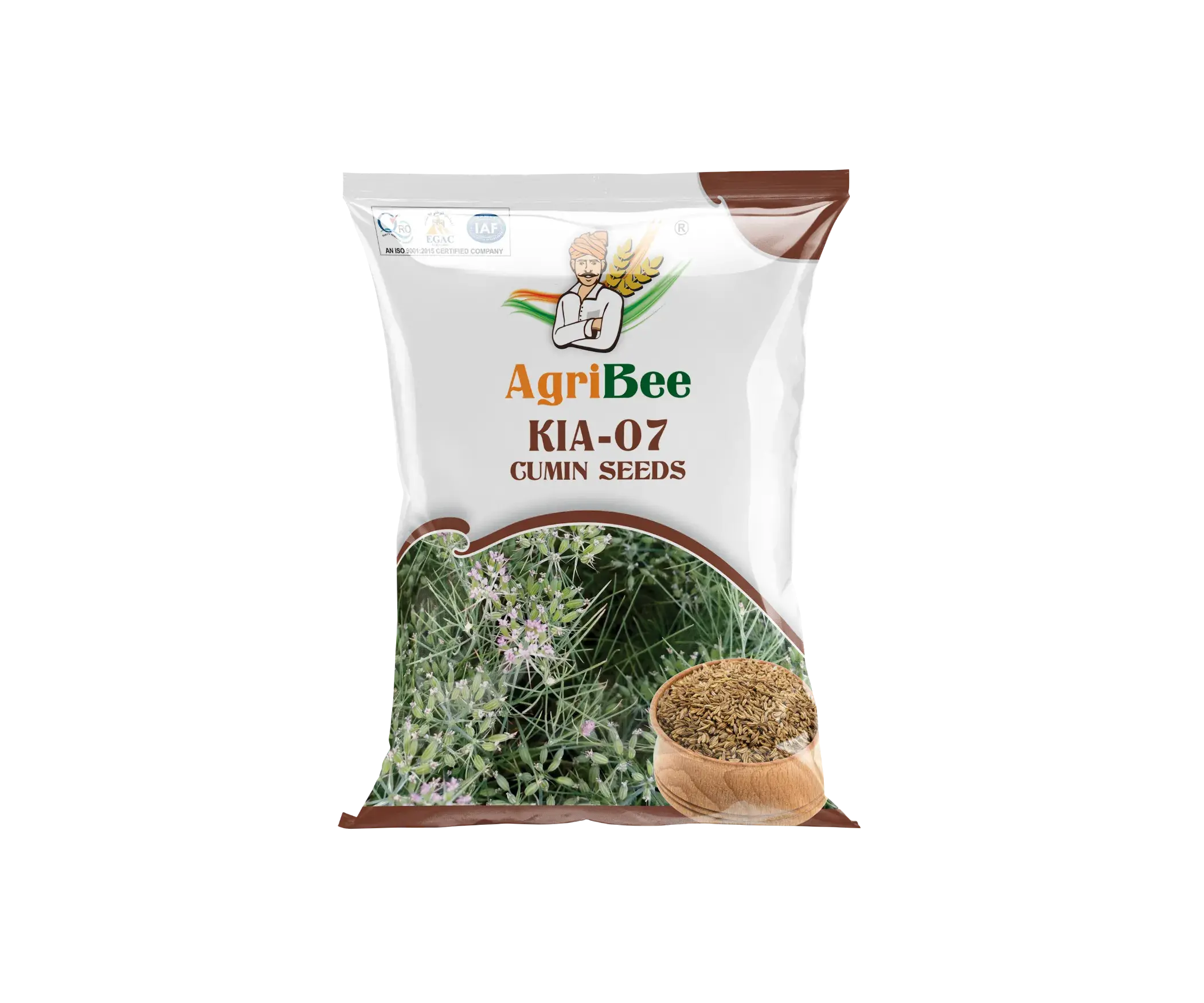
Farming & Cultivation Guide — Cumin Kia 07
Complete step-by-step agronomic guide for optimal crop management, disease resistance, and premium produce quality.
🌾 Soil Preparation & Field Prep
Proper land preparation ensures uniform seedling emergence and robust root anchorage.
🌱 Ideal Soil Type & pH
Well-drained loamy to sandy loam soils with good organic matter content. pH range 6.5–8.2. Deep, fertile soils with moderate water-holding capacity are most suitable. Avoid waterlogged or heavy clay soils prone to root rot.
✨ Core Advantage
Fine, well-tilled seedbed ensures uniform shallow germination, as cumin seeds are small and require close soil contact for optimal moisture uptake and rapid emergence.
- 1
Deep summer ploughing followed by 2–3 cross-harrowings to achieve fine tilth and destroy weed seed banks.
- 2
Field leveling using laser levelling or traditional methods to ensure uniform water distribution and prevent water stagnation.
- 3
Application of 8–10 t/ha well-decomposed FYM or compost incorporated during last ploughing for improved soil structure and organic status.
- 4
Soil health conditioning: test pH and apply gypsum or lime if required to maintain near-neutral to slightly alkaline conditions ideal for cumin.
🌱 Sowing Time & Method
Precise seed rate and spacing maximize light interception and canopy development.
| Parameter | Recommendation | Agronomic Importance |
|---|---|---|
| Sowing Window | October to mid-November | Aligns with cool Rabi season; ensures optimum temperature for germination (15–25°C) and avoids post-monsoon fungal pressures and extreme heat during grain filling. |
| Seed Rate | 8–10 Kg per acre | Ensures adequate plant population for uniform canopy development while preventing overcrowding that could favour fungal diseases. |
| Spacing | 30 cm x 10 cm (row-to-row x plant-to-plant) | Provides sufficient canopy space for air circulation, light penetration, and reduces humidity-related disease incidence around fruit clusters. |
| Sowing Depth | 1–1.5 cm depth | Cumin seeds are small and photoblastic; shallow sowing ensures light exposure required for uniform and rapid germination. |
💧 Irrigation & Water Management
Adequate moisture regulation supports strong vegetative and reproductive growth.
☀️ Water Requirement Profile
Cumin is moderately drought-sensitive despite being grown in semi-arid regions. It requires approximately 350–450 mm of water throughout the crop cycle. Drip irrigation is highly compatible and economical, delivering 2–3 light irrigations at 7–10 day intervals during active growth phases. Waterlogging must be strictly avoided as it causes severe root rot and plant death.
🌦️ Soil Moisture Management
Under rainfed conditions, ensure timely sowing to capture pre-sowing rains (Tarai/barsat). Use mulching with straw or polythene to conserve soil moisture. Monitor soil moisture visually; if the top 15 cm feels dry to touch, irrigate immediately. Supplemental irrigation at flowering and pod-filling stages significantly improves essential oil content and seed plumpness.
- ✓
First irrigation (kanva) within 15–20 days after sowing to support germination and early seedling establishment; keep soil moist but not saturated.
- ✓
Vegetative phase: irrigate at 10–12 day intervals depending on soil type and weather; sandy soils require more frequent light irrigation than loamy soils.
- ✓
Critical stage — flowering to early pod formation (35–60 DAS): maintain consistent soil moisture; water stress during this period causes flower drop, reduced fruit set, and thinner seeds with lower oil content.
- ✓
Withhold irrigation completely 10–15 days before harvest to facilitate even drying, reduce moisture content in seeds, and minimise mould contamination during storage.
🧪 Fertilizer & Nutrition Management
Balanced crop nutrition supports robust plant structure and premium produce quality.
| Nutrient | Recommended Dose (per Acre) | Application Method & Timing |
|---|---|---|
| Nitrogen (N) | 30–40 kg/acre (12–16 kg pure N per hectare) | 50% basal at sowing + 50% top-dressed at 25–30 days after sowing with urea |
| Phosphorus (P2O5) | 20–25 kg/acre (20 kg P2O5 per hectare) | 100% basal application as DAP or SSP incorporated during last ploughing |
| Potash (K2O) | 15–20 kg/acre (12–15 kg K2O per hectare) | 100% basal as MOP; split application enhances seed density and essential oil synthesis |
🌿 Interculture & Weed Management
Timely weed control ensures optimal nutrient and moisture availability for crop seedlings.
-
1
First Weeding & Hoeing: Carried out at 15–20 days after sowing (DAS) using a hand hoe or cultural weeder. Early weeding is critical because cumin seedlings are weak competitors; any weed pressure during the first 30 days significantly reduces plant vigor and essential oil concentration.
-
2
Second Weeding & Shallow Hoeing: Conducted at 30–35 DAS to control later-emerging weeds and loosen soil crust. Avoid deep hoeing near plant bases to prevent root damage. Light earthing-up is not typically done in cumin but shallow inter-row cultivation improves aeration.
-
3
Mulching and Crop Sanitation: Apply straw mulch at 3–4 t/acre after first weeding to conserve soil moisture, suppress weeds, and moderate soil temperature. Remove and destroy any infected or stunted plants promptly to reduce inoculum load of fungal pathogens. Inter-cultivation should cease once canopy closes to avoid fruit damage.
🛡️ Pest & Disease Management
Proactive crop monitoring and integrated management ensure healthy crop development.
🐛 Insect Pest Management
- Aphids (Macrosiphum euphorbiae): Suck sap from leaves and tender shoots, causing curling, yellowing, and stunted growth; also transmit viral diseases. Control: Spray imidacloprid 17.8% SL at 0.3 ml/litre or thiamethoxam 25% WG at 0.1 g/litre. For biological control, introduce ladybird beetles or use neem oil (3 ml/litre) at early infestation.
- Cumin caterpillar / Beet armyworm (Spodoptera exigua): Larvae feed on leaves and fruits, creating irregular holes and skeletonising foliage; severe infestations defoliate plants. Control: Spray chlorantraniliprole 18.5% SC at 0.3 ml/litre or spinosad 45% SC at 0.3 ml/litre. Use pheromone traps at 10 traps/acre for monitoring and mass trapping. Destroy crop after harvest to break pest cycle.
- Jassids / Leafhoppers (Amrasca biguttula): Sucking pests causing leaf yellowing, drying, and 'hopper burn' symptoms on lower leaves first, progressing upward. Control: Spray dinotefuran 20% SP at 0.5 g/litre or acetamiprid 20% SP at 0.2 g/litre. Yellow sticky traps at 15/acre help monitor and reduce adult populations.
🔬 Disease Control
- Alternaria leaf spot / Blight (Alternaria cumini): Irregular brown to black spots with concentric rings on leaves and stems; leads to premature defoliation and reduced fruit set. Control: Spray mancozeb 75% WP at 2.5 g/litre or chlorothalonil 50% WP at 2.0 g/litre at 10-day intervals. Remove and burn infected plant debris. Seed treatment with thiram or carbendazim prevents carry-over inoculum.
- Foot rot / Root rot (Macrophomina phaseolina): Wilting, browning of lower stem near soil level, black microsclerotia on roots and crown; plants uproot easily. Control: drench soil with carbendazim 50% WP at 1.0 g/litre or Trichoderma viride suspension at 10 g/litre around plant base. Practice 3-year crop rotation with non-host crops. Ensure proper field drainage to avoid water stagnation.
- Downy mildew (Peronospora cumini): Olive-green to purplish downy growth on leaf undersides, yellow chlorotic patches on upper surface, stunted growth, and premature drying. Control: Spray metalaxyl 35% WS at 1.5 g/litre or dimethomorph 50% WP at 1.0 g/litre at early onset. Space plants adequately for airflow. Avoid overhead irrigation that wets foliage.
✂️ Harvesting & Produce Quality Guide
Harvesting at peak maturity ensures maximum commercial grade and long keeping quality.
⏱️ Harvesting Schedule & Timing
Harvest begins at 105–115 days after sowing when 70–80% of fruits turn brown and seeds harden. Plants are cut at the base with a sickle during early morning when dew has dried. Harvest is typically done in 1–2 rounds across the field as maturity is not perfectly uniform; selective pulling of mature plants can extend the harvest window.
⭐ Produce Quality Characteristics
Premium-grade cumin fruits with bold, extra-thick seed morphology. Uniform greyish-green colour indicating proper maturation without over-drying. High essential oil content (3.0–4.0%) delivering strong, characteristic cumin aroma and pungent flavour. Low moisture content at harvest ensures excellent milling and processing quality with minimal breakage.
| Quality Parameter | Agronomic Standard | Farmer & Market Benefit |
|---|---|---|
| Harvest Stage | 105–115 Days after Sowing | Ensures peak essential oil content, bold seed development, and early market arrival for better price realization. |
| Harvest Maturity Signs | Fruits turn golden brown, seeds become hard and difficult to crush between nails, plant foliage transitions from green to pale yellow-brown | Prevents over-maturity which causes fruit shattering, seed loss, and degradation of essential oil quality. |
| Shelf Life & Keeping Quality | 8–12 months under cool, dry storage conditions with moisture content below 8% | Superior keeping quality maintains colour, aroma, and oil content during long-distance transport and extended marketing windows. |
| Market Suitability | Export-grade whole spice, grinding mills, pharmaceutical and food processing industries, domestic mandis | Bold seed size, uniform colour, and high oil content attract premium prices from exporters and bulk traders who specifically prefer Cumin Kia 07. |
⭐ Varietal Features — Cumin Kia 07
Distinguishing characteristics that make this variety a top choice for Indian growers.
🌿 Core Variety Highlight
Cumin Kia 07 delivers exceptional essential oil content of 3.0–4.0%, making it a top-choice variety for both domestic and export markets seeking high-potency cumin.
🌿 Produce Quality & Appearance
Produces bold, extra-thick seeds with a uniform greyish-green colour, commanding visual appeal and premium grading in spice trading channels.
🌿 Stress & Disease Tolerance
Demonstrates robust field tolerance against common biotic stresses including Alternaria blight and foot rot, ensuring reliable performance under varied Rabi growing conditions.
🌿 Growth Habit & Vigor
Compact plant architecture reaching 1–1.5 feet in height with strong branching pattern, supporting dense fruit production while maintaining good canopy aeration.
🌿 Crop Duration & Earliness
Matures in 105–115 days, enabling flexible crop rotation planning and timely access to early winter spice markets with competitive pricing advantage.
🌿 Market & Farmer Preference
Highly favoured by spice traders and exporters alike due to consistent seed morphology, high oil performance, and superior shelf stability, translating into reliable income for farmers who choose AgriBee Seeds.