Description
Farming & Cultivation Guide — Coriander AgriBee – 2
Complete step-by-step agronomic guide for optimal crop management, disease resistance, and premium produce quality.
🌾 Soil Preparation & Field Prep
Proper land preparation ensures uniform seedling emergence and robust root anchorage.
🌱 Ideal Soil Type & pH
Well-drained loamy to sandy-loam soils with good organic matter; pH range 6.0 – 7.8. Coriander does not tolerate waterlogging or heavy clayey soils.
✨ Core Advantage
Fine seedbed tilth ensures rapid and uniform germination, as coriander seeds are small and delicate, requiring shallow soil contact for consistent emergence.
- 1
Deep summer ploughing followed by 2–3 cross-harrowings to produce a fine, clod-free tilth ideal for small-seeded coriander.
- 2
Field leveling and drainage preparation to prevent standing water, which causes seed rot and poor germination.
- 3
Incorporation of 8–10 tonnes/acre of well-decomposed FYM or compost during last ploughing to improve soil structure and nutrient-holding capacity.
- 4
Soil health conditioning — apply gypsum at 25 kg/acre in alkaline soils; use rock phosphate in acidic zones to balance pH for optimal nutrient uptake.
🌱 Sowing Time & Method
Precise seed rate and spacing maximize light interception and canopy development.
| Parameter | Recommendation | Agronomic Importance |
|---|---|---|
| Sowing Window | Rabi: 15 October – 15 November | Kharif: 15 June – 15 July (rain-fed or protected zones) | Coriander is a cool-season crop; Rabi sowing gives better fruit quality and essential oil content, while early Kharif sowing avoids late-season heat stress. |
| Seed Rate | 20 kg per acre | Ensures adequate plant population for uniform canopy development and maximises fruit-setting without excessive competition. |
| Spacing | 30 cm (row-to-row) × 10 cm (plant-to-plant) | Optimal spacing promotes better air circulation, reduces humidity-related disease pressure, and supports even fruit maturation across the canopy. |
| Sowing Depth | 1.5 – 2.0 cm (surface sowing with light soil covering) | Coriander seeds are small (100-seed weight ~5.7 g); deep sowing severely reduces emergence and germination percentage. |
💧 Irrigation & Water Management
Adequate moisture regulation supports strong vegetative and reproductive growth.
☀️ Water Requirement Profile
Coriander is moderately drought-sensitive during germination and early vegetative growth. Under drip irrigation, apply 25–30 mm per event at 7–10 day intervals. The crop performs best with 4–6 irrigation events from sowing to pre-harvest. Drip systems enhance water-use efficiency and reduce foliar disease incidence.
🌦️ Soil Moisture Management
In rainfed conditions, ensure timely pre-sowing irrigation (1–2 flood irrigations) to build up soil moisture. Apply mulching with straw to conserve moisture. Avoid waterlogging at any stage, especially during monsoon Kharif sowing, as it causes root rot and seedling mortality.
- ✓
First irrigation within 48 hours of sowing to ensure proper seed-soil contact and rapid germination.
- ✓
Vegetative phase: light irrigation every 10–12 days to sustain foliage growth and essential oil accumulation.
- ✓
Critical stage at 40–50 DAS (initiation of flowering and fruit set) — maintain adequate soil moisture; water stress during this period reduces fruit size and oil content.
- ✓
Withhold irrigation completely 10–12 days before harvest to allow fruits to dry on the plant and facilitate easy threshing.
🧪 Fertilizer & Nutrition Management
Balanced crop nutrition supports robust plant structure and premium produce quality.
| Nutrient | Recommended Dose (per Acre) | Application Method & Timing |
|---|---|---|
| Nitrogen (N) | 40–50 kg/acre | 50% basal at sowing + 50% top-dressing at 25–30 DAS as urea |
| Phosphorus (P₂O₅) | 25–30 kg/acre | 100% basal application as DAP or single super phosphate during last harrowing |
| Potash (K₂O) | 20–25 kg/acre | 100% basal as MOP alongside P fertilizer for improved fruit filling and stalk strength |
🌿 Interculture & Weed Management
Timely weed control ensures optimal nutrient and moisture availability for crop seedlings.
-
1
First Weeding & Hoeing: Carry out at 15–20 DAS using a hoe or cono-weeder. Coriander has slow early growth and is highly susceptible to weed competition during the first 3 weeks. Shallow hoeing avoids root damage.
-
2
Second Weeding & Earthing-Up: Perform at 30–35 DAS. Light earthing-up around the base improves root aeration and provides anchorage as plants reach 95–100 cm height, reducing lodging risk.
-
3
Mulching Operation: Apply straw mulch @ 2–3 tonnes/acre after second weeding to conserve soil moisture, suppress weeds, and maintain uniform soil temperature throughout the growing period.
🛡️ Pest & Disease Management
Proactive crop monitoring and integrated management ensure healthy crop development.
🐛 Insect Pest Management
- Aphids (Myzus persicae): Suck sap from young leaves and stems, causing curling and stunting; also vector viral diseases. Control: Spray Imidacloprid 17.8% SL @ 0.3 ml/L or Spirotetramat 15% OD @ 1.0 ml/L at 15–20 DAS. For biocontrol, introduce Aphidius colemani or spray neem-based products (Neem Gold 3000 ppm) @ 3 ml/L.
- Coriander Fruit Borer (Diaphania indica): Larvae bore into developing fruits causing and seed damage. Control: Spray Chlorantraniliprole 18.5% SC @ 0.5 ml/L or Bacillus thuringiensis @ 2.5 g/L at early flower initiation stage. Install pheromone traps @ 10/acre for monitoring.
- Leaf Miners (Liriomyza coriandri): Creates serpentine tunnels in leaves reducing photosynthetic area. Control: Spray Cyantraniliprole 10.26% OR @ 0.6 ml/L or spinosad 45% SC @ 0.3 ml/L. Remove and destroy infected leaves promptly.
🔬 Disease Control
- Leaf Spot / Cercospora Leaf Spot (Cercospora coriandri): Small circular brown spots with grey centres on leaves, leading to premature defoliation. Control: Spray Mancozeb 75% WP @ 2.5 g/L or Chlorothalonil 50% WP @ 2.0 g/L at first appearance. Practice crop rotation and ensure adequate spacing for air flow.
- Powdery Mildew (Erysiphe cichoracearum): White powdery growth on leaves and stems, prevalent under humid conditions. Control: Spray Sulphur 80% WP @ 3.0 g/L or Myclobutanil 6.9% WG @ 0.5 g/L. Avoid overhead irrigation and reduce nitrogen overdose.
- Root Rot / Damping-off (Rhizoctonia solani & Pythium spp.): Seedlings show wilting, blackening at base, and collapse. Control: Treat seeds with Trichoderma viride @ 4 g/kg seed or carbendazim @ 2 g/kg before sowing. Ensure well-drained seedbeds and avoid waterlogging.
✂️ Harvesting & Produce Quality Guide
Harvesting at peak maturity ensures maximum commercial grade and long keeping quality.
⏱️ Harvesting Schedule & Timing
Harvest at 100–110 DAS when 75–80% of fruits turn light yellowish-brown and seeds harden. Cut whole plants at base using sickle, bundle, and spread for sun drying for 2–3 days before threshing.
⭐ Produce Quality Characteristics
Light yellowish mericarps with strong characteristic coriander aroma, high essential oil content (1.5–3.0%), well-filled seeds, minimal broken or shrivelled fruit content, and low foreign matter — meeting spice grading standards.
| Quality Parameter | Agronomic Standard | Farmer & Market Benefit |
|---|---|---|
| Harvest Stage | 100–110 Days after Sowing (full physiological maturity) | Ensures maximum essential oil development, optimal seed weight, and superior flavour potency |
| Harvest Maturity Signs | Fruits turn light yellowish-brown; seeds become hard and fragrant; lower leaves begin senescence | Prevents over-maturity that leads to shattering losses and under-maturity that reduces oil content |
| Shelf Life & Keeping Quality | 3–4 months in gunny bags under cool, dry, well-ventilated conditions; essential oil retained for extended period due to vigorous seed coat | Facilitates storage, long-distance transport, and flexible marketing without rapid quality degradation |
| Market Suitability | Premium quality dry fruits suitable for spice mandis, export markets, oil extraction, and processing units | Uniform size, colour, and aroma attract higher prices from traders and exporters seeking graded coriander |
⭐ Varietal Features — Coriander AgriBee – 2
Distinguishing characteristics that make this variety a top choice for Indian growers.
🌿 Core Variety Highlight
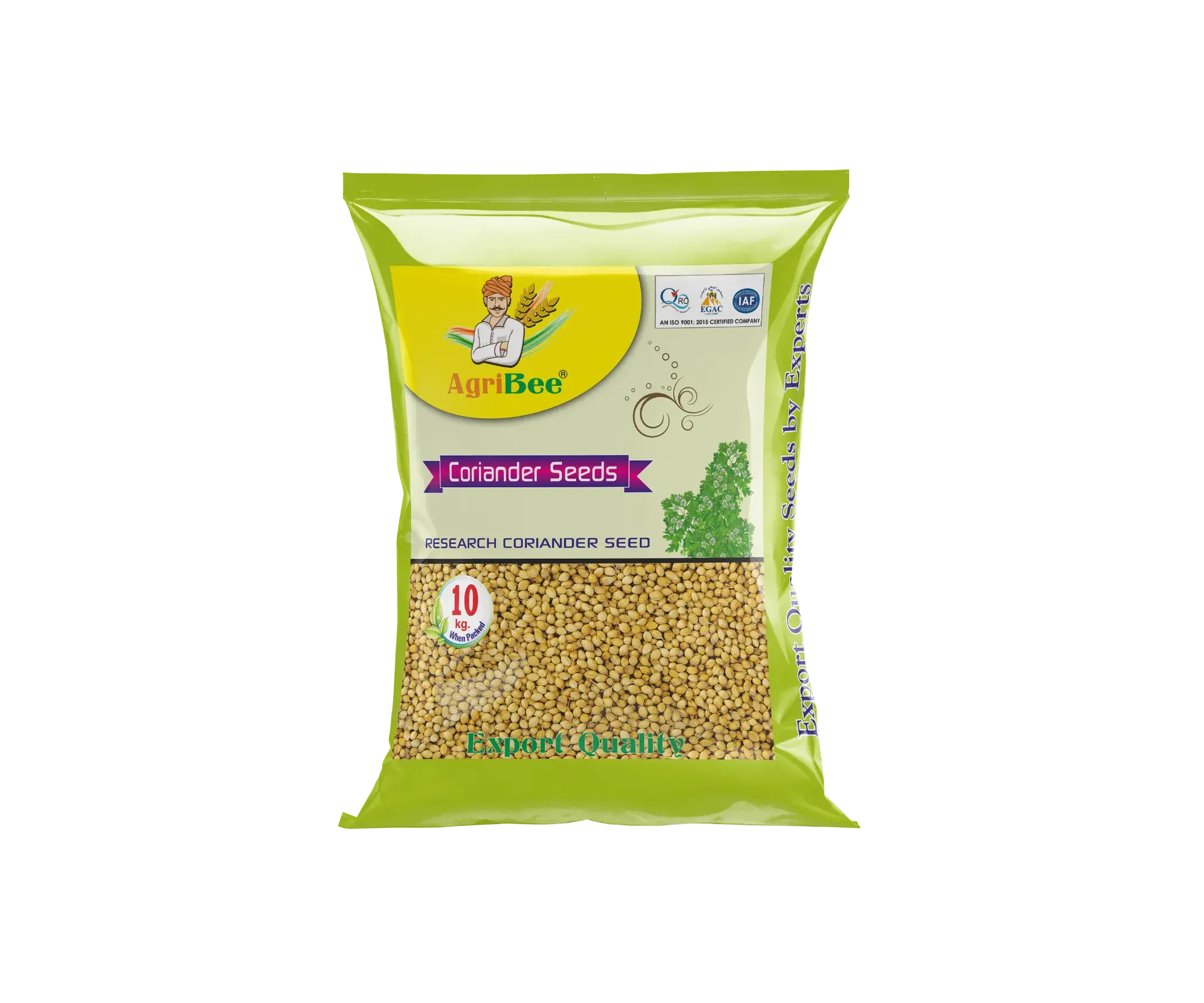
AgriBee Coriander AgriBee-2 delivers a compact yet robust plant architecture (95–100 cm) with uniform fruiting, making it one of the most reliable coriander varieties for Indian Rabi and early Kharif conditions.
🌿 Produce Quality & Appearance
Produces light yellowish, well-shaped mericarps with a high essential oil percentage. Seeds are uniform in size (100-seed weight ~5.7 g), well-filled, and exhibit excellent aroma — a hallmark of premium coriander grade.
🌿 Stress & Disease Tolerance
Demonstrates strong field tolerance to Cercospora leaf spot and moderate resistance to powdery mildew under humid conditions. Vigorous root system confers decent drought resilience during critical fruit-filling stages.
🌿 Growth Habit & Vigor
Bushy, upright growth habit with good branching and canopy spread at 30 × 10 cm spacing. Rapid early growth ensures quick ground cover, suppressing weeds naturally and promoting uniform light interception.
🌿 Crop Duration & Earliness
Reaches 50% flowering in just 50–55 days and attains full maturity in 100–110 days — one of the earlier-maturing coriander varieties, enabling timely land preparation for succeeding crops in intensive rotation systems.
🌿 Market & Farmer Preference
Farmers favour Coriander AgriBee-2 for its uniform maturity (simplifying harvest), high oil content, attractive light yellowish fruit colour, and strong market demand. Traders prefer the consistent grading and long shelf life that translate into better realisation.