Description
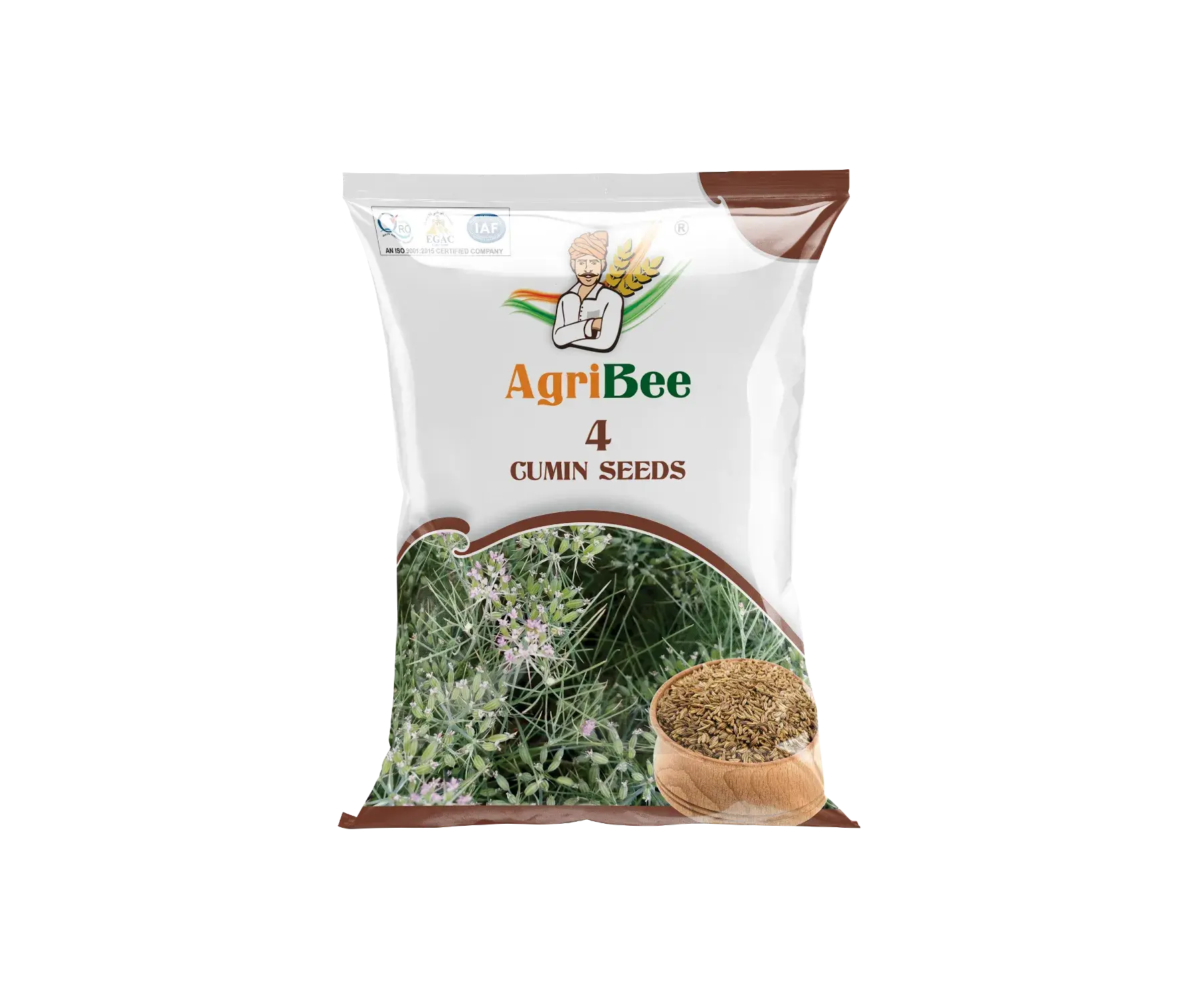
Farming & Cultivation Guide — Cumin AgriBee 4
Complete step-by-step agronomic guide for optimal crop management, disease resistance, and premium produce quality.
🌾 Soil Preparation & Field Prep
Proper land preparation ensures uniform seedling emergence and robust root anchorage.
🌱 Ideal Soil Type & pH
Well-drained loamy, sandy loam, or calcareous soils with good aeration. pH range 6.5–8.0. Waterlogged or heavy clay soils must be avoided as they promote root rot and reduce essential oil development.
✨ Core Advantage
Light, friable soil ensures rapid seed germination, unrestricted taproot penetration, and optimal umbel development for superior seed set and oil concentration.
- 1
Deep summer ploughing followed by 2–3 cross-harrowings to achieve fine tilth and break hard pans.
- 2
Field leveling and drainage channel preparation to prevent any standing water accumulation.
- 3
Incorporation of 10–12 quintals of well-decomposed FYM or farmyard compost per acre during last harrowing for soil structure improvement.
- 4
Application of gypsum at 25 kg/acre in alkaline/sodic soils to improve structure; lime only if pH exceeds 8.0.
🌱 Sowing Time & Method
Precise seed rate and spacing maximize light interception and canopy development.
| Parameter | Recommendation | Agronomic Importance |
|---|---|---|
| Sowing Window | October to mid-November | Aligns with cooler temperatures essential for germination, vegetative growth, and essential oil biosynthesis; avoids late-season heat stress |
| Seed Rate | 8–10 kg per acre | Ensures optimal plant population without overcrowding, supporting healthy canopy spread and adequate air circulation |
| Spacing | 30 cm row-to-row × 10 cm plant-to-plant | Provides sufficient canopy clearance for photosynthetic efficiency and ease of interculture operations |
| Sowing Depth | 2–3 cm below soil surface | Cumin seeds are light-demanding; shallow sowing ensures uniform and rapid emergence without burial stress |
💧 Irrigation & Water Management
Adequate moisture regulation supports strong vegetative and reproductive growth.
☀️ Water Requirement Profile
Cumin has a shallow root system and moderate drought tolerance but is highly sensitive to moisture stress during flowering and fruit development. Drip irrigation is well-suited and improves water-use efficiency by 30–40%. The crop requires approximately 350–450 mm total seasonal water depending on climate and soil type.
🌦️ Soil Moisture Management
In rainfed zones, ensure pre-sowing irrigation to establish germination. Monitor soil moisture during the critical period from 40 to 75 days after sowing; supplementary irrigation every 12–15 days during dry spells prevents flower drop and shriveling of developing cumin fruits.
- ✓
First irrigation within 5–7 days after sowing to ensure uniform germination; avoid waterlogging.
- ✓
During vegetative phase (20–50 DAS), irrigate at 12–15 day intervals depending on soil texture and weather conditions.
- ✓
Critical stage irrigation is essential from boot leaf stage through flowering and fruit set (50–80 DAS); consistent moisture at this stage ensures full fruit development and optimal essential oil synthesis.
- ✓
Withhold irrigation 10–12 days before harvest to allow fruits to dry on the plant, improve threshing ease, and reduce post-harvest spoilage risk.
🧪 Fertilizer & Nutrition Management
Balanced crop nutrition supports robust plant structure and premium produce quality.
| Nutrient | Recommended Dose (per Acre) | Application Method & Timing |
|---|---|---|
| Nitrogen (N) | 40 kg/acre | 40% basal at sowing, 60% as top-dressing in two equal splits at 30 and 60 DAS |
| Phosphorus (P2O5) | 30 kg/acre | 100% basal applied as DAP (18:46:00) during last harrowing or at sowing |
| Potash (K2O) | 20 kg/acre | 100% basal as MOP (0:0:60); second split at 45 DAS for improved fruit filling and oil content |
🌿 Interculture & Weed Management
Timely weed control ensures optimal nutrient and moisture availability for crop seedlings.
-
1
First Weeding & Hoeing: Carry out at 15–20 days after sowing (DAS) using a hand hoe or inter-cultivator. Early weed control is vital as cumin has slow initial growth and is highly competitive against weeds during the first month.
-
2
Second Weeding & Shallow Hoeing: Perform at 35–40 DAS with shallow hoeing to avoid damaging the shallow root system. Remove any perennial weeds manually. Maintain a clean field until pod formation begins.
-
3
Mulching & Drainage Maintenance: Apply straw mulch at 30 DAS to conserve soil moisture and suppress weed growth. Keep inter-row channels clear for drainage. Remove any suckers or excessive lateral branches only if they shade the main umbels.
🛡️ Pest & Disease Management
Proactive crop monitoring and integrated management ensure healthy crop development.
🐛 Insect Pest Management
- Aphids (Macrosiphum cuminum): Small green/black insects cluster on undersides of leaves and tender shoots, causing curling, yellowing, and honeydew sooty mold. Spray imidacloprid 17.8% SL at 0.3 ml/L or thiamethoxam 25% WG at 0.2 g/L at 30 DAS and repeat at 45 DAS if infestation persists.
- Cutworms (Agrotis spp.): Larvae chew seedlings at the base during early stages, causing wilting and plant death. Apply carbendazim seed treatment at 2 g/kg before sowing. For active infestation, spray chlorantraniliprole 18.5% SC at 0.3 ml/L at the base of affected plants in the evening.
- Grasshoppers (Oxya spp.): Chewing pests that defoliate leaves, reducing photosynthetic capacity. Monitor fields regularly. Spray spinosad 45% SC at 0.4 ml/L or chlorpyriphos 20% EC at 2 ml/L upon sighting heavy feeding damage.
🔬 Disease Control
- Downy Mildew (Peronospora cuminum): Yellow chlorotic patches on upper leaf surface with fuzzy grey-purple sporulation on underside in humid conditions. Spray mancozeb 75% WP at 2.5 g/L or metalaxyl 8% + mancozeb 64% WP at 2 g/L at 35 DAS and repeat at 50 DAS.
- Cumin Rust (Puccinia crinata): Orange-brown powdery pustules on leaves and stems, reducing photosynthetic area and weakening plants. Apply propiconazole 25% EC at 0.5 ml/L or trifloxystrobin 50% WG at 0.3 g/L at first sign of rust appearance.
- Cercospora Leaf Spot (Cercospora carvi): Small circular brown spots with grey centers on leaves; severe infection causes premature leaf drop. Preventive spray of copper oxychloride 50% WP at 3 g/L at 30 DAS and 45 DAS controls the disease effectively.
✂️ Harvesting & Produce Quality Guide
Harvesting at peak maturity ensures maximum commercial grade and long keeping quality.
⏱️ Harvesting Schedule & Timing
Begin harvest at 100–110 days after sowing when the majority of fruits on the primary umbels turn from green to greyish-brown. Plants mature unevenly; harvest by cutting entire plants at the base using a sharp sickle. Collect plants in bundles and spread on clean mats for sun drying for 2–3 days before threshing.
⭐ Produce Quality Characteristics
Uniform medium-thick seeds with bright greyish-green color, high essential oil content (2.5–3.5%), and strong characteristic cumin aroma. Seeds are plump, free from shriveling, broken fragments, and extraneous matter, meeting premium trading standards.
| Quality Parameter | Agronomic Standard | Farmer & Market Benefit |
|---|---|---|
| Harvest Stage | 100–110 days after sowing — when 70–80% of fruits show colour change to greyish-brown | Ensures peak essential oil content and aroma development while avoiding seed shattering losses |
| Harvest Maturity Signs | Fruits turn greyish-green to tan; leaves begin yellowing; plants lose turgor; sound rattle when shaken | Accurate visual identification prevents under- or over-maturity, preserving flavor and oil quality |
| Shelf Life & Keeping Quality | Properly dried seeds (moisture <9%) retain quality for 12–18 months in cool, dry, airtight storage | Strong oil stability and low moisture content minimize rancidity and fungal contamination during storage and transport |
| Market Suitability | Suitable for direct mandi sale, spice processing units, export markets, and retail packaging | Uniform seed size, excellent colour, and high oil content command premium prices from traders and processors |
⭐ Varietal Features — Cumin AgriBee 4
Distinguishing characteristics that make this variety a top choice for Indian growers.
🌿 Core Variety Highlight
Developed by AgriBee Seeds for superior essential oil expression and uniform seed morphology, combining genetic vigor with adaptability to the Rabi conditions of Gujarat and Rajasthan.
🌿 Produce Quality & Appearance
Medium-thick, uniformly shaped seeds with attractive greyish-green coloration, strong pungent aroma, and oil content in the 2.5–3.5% range — a premium standard in Indian cumin markets.
🌿 Stress & Disease Tolerance
Moderate tolerance to drought conditions due to efficient water-use physiology; natural resistance to rust and downy mildew reduces reliance on repeated fungicide interventions.
🌿 Growth Habit & Vigor
Compact plant stature of 1 to 1.5 feet with well-branched architecture and strong central umbel development; green foliage remains photosynthetically active throughout the growing period.
🌿 Crop Duration & Earliness
Matures in 100–110 days, enabling timely harvest and flexible cropping sequence — ideal for integration into wheat or legume-based rotation systems in western and central India.
🌿 Market & Farmer Preference
Farmers value this variety for its uniform seed size, reliable field performance, strong trader demand, and favorable oil content that meets export-grade specifications, ensuring better realization at the market.