Description
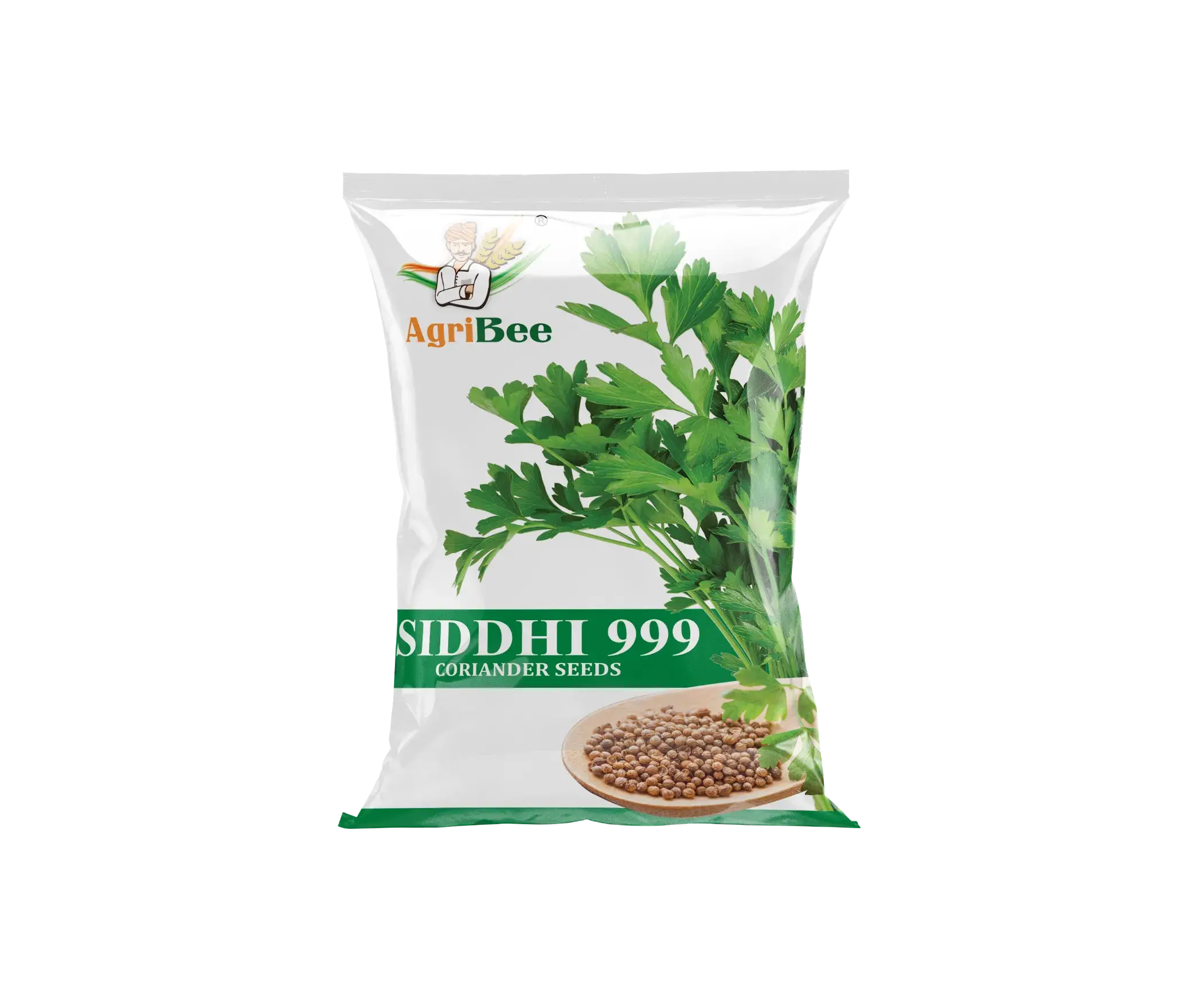
Farming & Cultivation Guide — Coriander Siddhi 999 (IMP)
Complete step-by-step agronomic guide for optimal crop management, disease resistance, and premium produce quality.
🌾 Soil Preparation & Field Prep
Proper land preparation ensures uniform seedling emergence and robust root anchorage.
🌱 Ideal Soil Type & pH
Well-drained loamy to sandy-loam soils with pH 6.0–7.5. Light, deep soils promote rapid germination and healthy root development.
✨ Core Advantage
Fine tilth seedbed ensures uniform emergence, reducing crop gaps and promoting strong initial foliage growth.
- 1
Deep summer ploughing followed by 2–3 cross-harrowings to achieve fine, clod-free tilth for uniform seed-soil contact.
- 2
Field leveling using laser-leveling or board leveling to ensure even moisture distribution and consistent germination.
- 3
Application of well-decomposed FYM at 10–12 tonnes/acre during last harrowing to improve soil structure and water retention.
- 4
Soil health conditioning with gypsum (50 kg/acre) in saline-affected patches and liming (25–30 kg/acre) where pH exceeds 7.8.
🌱 Sowing Time & Method
Precise seed rate and spacing maximize light interception and canopy development.
| Parameter | Recommendation | Agronomic Importance |
|---|---|---|
| Sowing Window | Kharif: June–July | Rabi: October–November | Cool Rabi conditions enhance foliage vigor and delay premature bolting, while Kharif sowing targets early winter demand. |
| Seed Rate | 15–20 kg/acre (direct seeding) | 8–10 kg/acre (transplanting) | Optimal seed rate ensures adequate plant population without excessive competition, supporting the spreading growth habit with 40–50 branches per plant. |
| Spacing | 30 cm × 10 cm (Row-to-row × Plant-to-plant) | Adequate spacing accommodates the spreading canopy and promotes airflow, reducing disease incidence. |
| Sowing Depth | 1.5–2.0 cm | Shallow sowing is critical as coriander seeds have limited energy reserves; proper depth ensures uniform and rapid germination. |
💧 Irrigation & Water Management
Adequate moisture regulation supports strong vegetative and reproductive growth.
☀️ Water Requirement Profile
Coriander requires moderate and well-distributed moisture throughout its short life cycle. The crop is moderately drought-sensitive during the vegetative phase and fruit-setting stage. Drip irrigation with frequent light applications (every 2–3 days) significantly improves foliage quality and uniformity.
🌦️ Soil Moisture Management
Under rainfed conditions, ensure pre-sowing irrigation to germinate seeds reliably. Supplemental irrigation at 10–12 day intervals during the vegetative phase prevents moisture stress that leads to fibrous leaves and poor branch development.
- ✓
First irrigation within 24–48 hours after sowing to trigger uniform germination and seed swell.
- ✓
Light and frequent irrigation (every 5–7 days) during the vegetative phase to support lush foliage and branching up to 40–50 branches per plant.
- ✓
Critical irrigation at 15–20 DAS when flower primordia initiate; water stress at this stage causes poor fruit set and reduced aroma.
- ✓
Reduce irrigation frequency 5–7 days before final harvest to improve shelf life and reduce post-harvest spoilage.
🧪 Fertilizer & Nutrition Management
Balanced crop nutrition supports robust plant structure and premium produce quality.
| Nutrient | Recommended Dose (per Acre) | Application Method & Timing |
|---|---|---|
| Nitrogen (N) | 40–50 kg/acre | 50% basal at sowing; remaining 50% as top-dressing at 15 DAS with irrigation. |
| Phosphorus (P2O5) | 25–30 kg/acre | 100% basal application through DAP (108 kg/acre) or SSP (330 kg/acre) at last harrowing. |
| Potash (K2O) | 20–25 kg/acre | 100% basal through MOP (38 kg/acre) for improved stalk strength and disease resilience. |
🌿 Interculture & Weed Management
Timely weed control ensures optimal nutrient and moisture availability for crop seedlings.
-
1
First Weeding & Hoeing: Perform at 10–12 DAS to eliminate fast-growing weeds during the critical weed-free period. Shallow hoeing avoids root damage while creating loose soil for better aeration.
-
2
Second Weeding & Earthing-Up: Carry out at 20–22 DAS to control late-germinating weeds. Light earthing-up around the base supports the spreading habit and stabilizes plants as they develop 40–50 branches.
-
3
Special Interculture Operation: Apply organic mulch (paddy straw @ 300–400 kg/acre) to conserve soil moisture, suppress weeds, and maintain cooler soil temperature. Thin excess seedlings at 10 DAS to maintain optimal plant population.
🛡️ Pest & Disease Management
Proactive crop monitoring and integrated management ensure healthy crop development.
🐛 Insect Pest Management
- Aphids (Myzus persicae): Sucking sap from leaves causing yellowing and curling. Spray Imidacloprid 17.8% SL at 0.3 ml/liter or Neem-based biopesticide (Azadirachtin 1%) at 2 ml/liter. Repeat after 7–10 days if infestation persists.
- Coriander caterpillar (Autographa separata): Defoliates leaves creating irregular holes. Apply Spinosad 45% SC at 0.4 ml/liter or Bt (Bacillus thuringiensis) at 2 g/liter. Spray in the evening for better contact with larvae.
- Thrips (Sericothrips variabilis): Silvery scarring on leaves and stunted growth. Spray Thiamethoxam 25% WG at 0.2 g/liter or Spinetoram 11.7% WS at 0.3 ml/liter. Use yellow sticky traps at 10 traps/acre for monitoring.
🔬 Disease Control
- Downy Mildew (Peronospora coriandri): Yellow patches on upper leaf surface with grey-purple sporulation underneath. Preventive spray of Mancozeb 75% WP at 2 g/liter or Fidisol at 1 ml/liter. Remove and destroy infected plant debris.
- Leaf Spot / Cercospora Blight (Cercospora coriandri): Small brown to black spots with yellow halos on leaves. Spray Copper oxychloride 50% WP at 3 g/liter or Carbendazim 50% WP at 1 g/liter at 7-day intervals during humid weather.
- Powdery Mildew (Erysiphe spp.): White powdery growth on leaves and stems reducing photosynthesis. Spray Sulphur 80% WP at 3 g/liter or Myclobutanil 70% WP at 0.5 g/liter at first sign of infection.
✂️ Harvesting & Produce Quality Guide
Harvesting at peak maturity ensures maximum commercial grade and long keeping quality.
⏱️ Harvesting Schedule & Timing
First cutting at 25–30 DAS. Subsequent cuttings can be taken at 7–10 day intervals based on foliage recovery and market demand.
⭐ Produce Quality Characteristics
Fresh, vibrant green leaves with strong characteristic aroma. Stems are tender, branching is abundant (40–50 per plant), and foliage density is high — hallmarks of Coriander Siddhi 999 produce.
| Quality Parameter | Agronomic Standard | Farmer & Market Benefit |
|---|---|---|
| First Harvest Stage | 25–30 Days after Sowing | Early market entry commands premium pricing and aligns with off-season demand cycles. |
| Harvest Maturity Signs | Lush green foliage, stems 15–20 cm tall, before bolting initiates | Ensures tender texture, superior aroma, and maximizes subsequent regrowth potential. |
| Shelf Life & Keeping Quality | 4–6 days under ambient conditions; up to 10–12 days under refrigerated storage (8–10°C) | Extended market window enables transport to distant mandis and urban retail outlets. |
| Market Suitability | Fresh market (haat/mandi), wholesale trade, export-grade processing, and institutional supply | High branching capacity and attractive green color make this variety preferred by traders and exporters. |
⭐ Varietal Features — Siddhi 999 (IMP): High Yield & Uniform Stand
A high-yielding, uniform-stand variety developed for consistent production across both Kharif and Rabi seasons. Ideal for progressive farmers who want reliable results and the option of dual harvest (leaf + dry seed).
🌿 Core Variety Highlight
Coriander Siddhi 999 (IMP) delivers early 25–30 day harvest window with exceptional branching vigour (40–50 branches per plant), making it one of the fastest-maturing and most productive fresh coriander varieties.
🌿 Produce Quality & Appearance
Deep green, glossy foliage with strong aromatic essential oil content. Leaves are tender with thick petioles and dense branch clusters — highly valued in both domestic and export markets.
🌿 Stress & Disease Tolerance
Shows field tolerance to common downy mildew and cercospora leaf spot pressures. Vigorous early growth helps the crop outcompete pests and withstand moderate moisture fluctuations.
🌿 Growth Habit & Vigor
Spreading growth habit with extensive lateral branching produces a bushy, full-canopy plant architecture ideal for fresh leaf marketing and repeated harvesting.
🌿 Crop Duration & Earliness
First harvest in just 25–30 days enables farmers to fit multiple cropping cycles within a single season, optimizing land use efficiency and cash flow.
🌿 Market & Farmer Preference
Trusted by traders for its uniform appearance, long shelf life, and reliable branching. AgriBee Seeds guarantees high germination rates and genetic purity for consistent field performance across India.