Product Specifications:

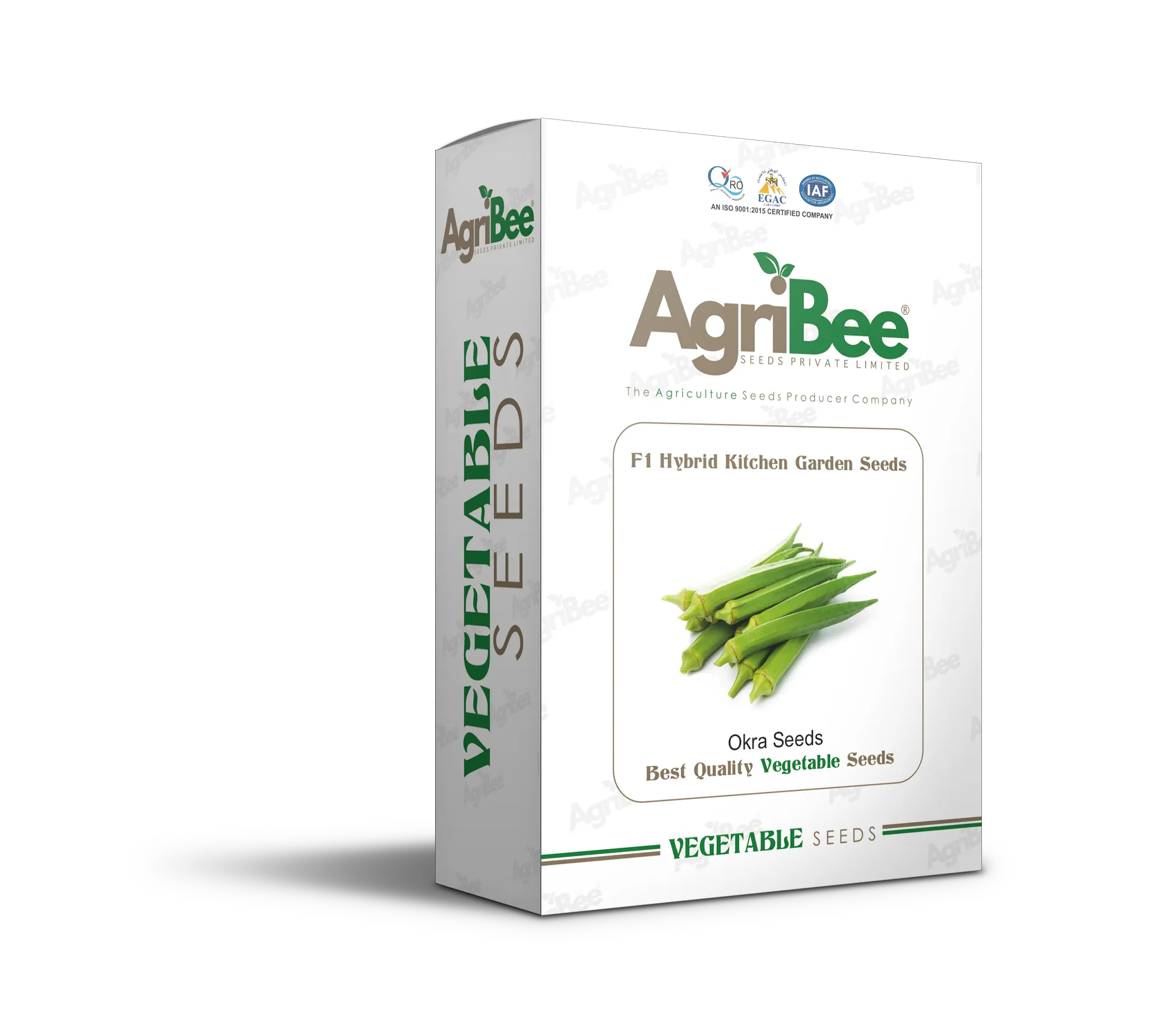
Scientific Name : Abelmoschus esculentus
Days to 1st harvest : 45-50 days after sowing
Fruit shape : Slender, 5-ridged.
Fruit color : Dark green.
Fruit length : 10-12 cm.
Tolerance : YVMV (Yellow Vein Mosaic Virus)
Packing size : 100 g.

Description

🌱 Agronomic Practices

Farming & Cultivation Guide — F1 Hybrid Okra

Complete step-by-step agronomic guide for optimal crop management, disease resistance, and premium produce quality.

📅

Sowing SeasonJune – July (Kharif) / February – March (Summer)
🌾

Seed Rate3–4 kg per hectare (broadcast) / 2–2.5 kg per hectare (line sowing)
⏱️

First Harvest45–50 Days after Sowing
🔄

Harvest TypeMultiple Pickings (7–10 Picks)

🌾 Soil Preparation & Field Prep

Proper land preparation ensures uniform seedling emergence and robust root anchorage.

🌱 Ideal Soil Type & pH

Well-drained loamy to sandy-loam soils with pH range of 6.0–7.5. Okra thrives in warm soils and is sensitive to waterlogging.

Core Advantage

Free-draining seedbed ensures rapid germination, strong root establishment, and minimal risk of root rot under Indian summer conditions.

  • 1
    Deep summer ploughing followed by 2–3 cross-harrowings to obtain a fine, clod-free tilth.
  • 2
    Field leveling and drainage channel preparation to prevent water stagnation during monsoon.
  • 3
    Incorporation of 15–20 tonnes per hectare of well-decomposed FYM or compost during last ploughing.
  • 4
    Soil health conditioning: apply gypsum at 250 kg/ha in alkaline soils; use rock phosphate where P deficiency is observed.

🌱 Sowing Time & Method

Precise seed rate and spacing maximize light interception and canopy development.

Parameter Recommendation Agronomic Importance
Sowing Window June – mid-July (Kharif) and February – March (Summer zones) Soil temperature above 18°C is essential for uniform seed germination and early seedling vigor.
Seed Rate 2–2.5 kg per hectare (line sowing); 3–4 kg per hectare (broadcast) Optimized seed rate ensures ideal plant population without overcrowding, promoting vigorous canopy development.
Spacing 60 cm (row-to-row) x 30–35 cm (plant-to-plant) Balanced spacing ensures adequate sunlight penetration, air circulation, and unrestricted fruit development on dark green pods.
Sowing Depth 2–3 cm below soil surface Proper depth ensures consistent moisture contact for uniform germination while preventing seed rot in heavy soils.
💡 Agronomic Recommendation: Use line sowing at 60×30 cm for better canopy management, easier intercultural operations, and improved spray coverage. Pre-inoculate seeds with Azotobacter (5 kg per 10 kg seed) for enhanced nitrogen fixation and root biomass. Raised beds (15 cm height) are recommended in heavy clay soils during Kharif to ensure excellent drainage.
📍 Regional Timelines: In Gujarat and Rajasthan, sow in early June with protective mulching during peak summer heat. In Maharashtra and MP, timely Kharif sowing by mid-June ensures optimal monsoon moisture utilization. In South India, late Kharif (July–August) and early Rabi (October) sowings both perform well due to favorable temperatures.

💧 Irrigation & Water Management

Adequate moisture regulation supports strong vegetative and reproductive growth.

☀️ Water Requirement Profile

Okra is moderately drought-tolerant but requires consistent soil moisture during flowering and pod development. Drip irrigation is highly compatible and improves fruit quality by maintaining uniform moisture. Avoid over-irrigation which promotes excessive vegetative growth and susceptibility to viral vectors.

🌦️ Soil Moisture Management

In rainfed areas, timely sowing at the onset of monsoon is critical. Apply light irrigation 2–3 days before expected dry spells during flowering to prevent flower drop. Mulching with straw reduces evaporation and conserves soil moisture for extended periods.

  • First irrigation: 3–5 days after sowing to ensure uniform germination; keep seedzone consistently moist.
  • Vegetative phase: Irrigate at 8–10 day intervals depending on soil type and weather conditions.
  • Critical stage — flowering and pod initiation: Maintain regular irrigation at 5–7 day intervals; moisture stress during this phase causes flower abortion and pod deformation.
  • Pre-harvest: Reduce irrigation frequency during late harvest stages to improve pod firmness and shelf life.

🧪 Fertilizer & Nutrition Management

Balanced crop nutrition supports robust plant structure and premium produce quality.

Nutrient Recommended Dose (per Acre) Application Method & Timing
Nitrogen (N) 60–80 kg/ha 50% basal at sowing + 25% at 25 DAS + 25% at 40 DAS as split top-dressing
Phosphorus (P2O5) 40–50 kg/ha 100% basal application at sowing through DAP or single super phosphate
Potash (K2O) 30–40 kg/ha 50% basal + 50% at first picking to support fruit set and pod development
🌿 Nutrition Recommendation: Apply zinc sulfate at 25 kg/ha basal along with FYM to correct widespread Zn deficiency in Indian soils. Foliar spray of boron (0.3% boric acid) at peak flowering enhances fruit set and prevents pod. Use biofertilizers—Azotobacter and PSB—at 10 kg/ha seed + soil treatment for improved nutrient uptake and overall crop vigor.

🌿 Interculture & Weed Management

Timely weed control ensures optimal nutrient and moisture availability for crop seedlings.

  • 1

    First Weeding & Hoeing: Carry out at 15–20 days after sowing (DAS). Early weed control is critical as okra is a slow initial grower and competitive weeds reduce plant vigor and increase pest habitat.
  • 2

    Second Weeding & Earthing-Up: Conduct at 30–35 DAS. Light earthing-up around the base strengthens stem anchorage and improves root zone aeration, particularly important in rainy season crops.
  • 3

    Mulching and Staking Support: Apply straw mulch at 15–20 DAS to conserve moisture, suppress weeds, and maintain soil temperature. In high-density planting, stake the main stem using natural twine to prevent lodging under heavy fruit load.

🛡️ Pest & Disease Management

Proactive crop monitoring and integrated management ensure healthy crop development.

🐛 Insect Pest Management
  • Shoot and Fruit Borer (Helicoverpa armigera): Caterpillars bore into shoots and young pods causing wilting and fruit damage. Control: Spray carbendazim 50 WP at 0.1% or neem-based biopesticide (Neemarin Neo 0.3%) at 2 ml/litre. Apply at first sign of infestation; repeat at 10-day intervals.
  • Jassid / Leafhopper (Amrasca biguttula biguttula): Sucks sap from leaves causing yellowing, curling, and drying of leaf margins; also vector of YVMV. Control: Spray imidacloprid 17.8% SL at 0.3 ml/litre or thiamethoxam 25% WG at 0.5 g/litre. Yellow sticky traps at 10 traps per acre aid monitoring and reduction.
  • Green Halict Aphid (Aphis gossypii): Colonizes tender shoots and underside of leaves, causing curling and honeydew sooty mold. Control: Spray thiometon 30% EC at 1 ml/litre or imidacloprid 17.8% SL at 0.3 ml/litre. Release ladybird beetles (Harmonia axyridis) at 5000/acre as biological control agent.
🔬 Disease Control
  • Yellow Vein Mosaic Virus (YVMV): Symptoms include bright yellow vein clearing on leaves, stunted growth, and reduced fruit size. Vector: Whitefly (Bemisia tabaci). Control: This variety carries YVMV tolerance. Combine cultural practices—remove infected plants immediately, use reflective mulch, deploy yellow sticky traps, and apply regular whitefly management sprays to break the virus transmission cycle.
  • Fusarium Wilt (Fusarium oxysporum f. sp. antisphylli): Progressive yellowing of lower leaves, vascular browning, and plant wilting. Control: Seed treatment with carbendazim 50 WP at 2.5 g/kg seed. Soil drench with carbendazim 50 WP at 2 g/litre at first appearance. Crop rotation with non-host crops for 2–3 seasons.
  • Powdery Mildew (Oidium abelmoschi): White powdery fungal growth on leaves and young pods, reducing photosynthetic capacity. Control: Spray sulfur dust 80% at 15–20 kg/ha or wettable sulfur 80% WP at 2.5 g/litre. Preventive sprays at 25 DAS and again at 40 DAS in humid conditions.

✂️ Harvesting & Produce Quality Guide

Harvesting at peak maturity ensures maximum commercial grade and long keeping quality.

⏱️ Harvesting Schedule & Timing

First harvest begins at 45–50 days after sowing. Subsequent pickings are carried out at 2–3 day intervals throughout the harvest period, with continuous fruit selection for uniform market-quality slender pods.

Produce Quality Characteristics

Dark green, slender fruits with 5 distinct ridges and length of 10–12 cm. Firm texture, tender interior with minimal fiber, mild sweet flavor preferred in kitchen gardens and urban markets.

Quality Parameter Agronomic Standard Farmer & Market Benefit
First Harvest Stage 45–50 Days after Sowing Enables early market entry, fetching better prices and enabling flexible cropping sequences.
Harvest Maturity Signs Pods 10–12 cm long, dark green, firm and crisp; tip end not yet hardened or yellowing Ensures tender, fibber-free produce with superior sensory and culinary quality.
Shelf Life & Keeping Quality 4–5 days under ambient conditions; up to 7–10 days under cool storage (10–12°C) Excellent post-harvest durability supports local mandi supply and short-distance retail distribution.
Market Suitability Kitchen garden consumers, local vegetable mandis, suburban retail, and direct farm-to-consumer sales Dark green color, uniform shape, and YVMV tolerance make this hybrid preferred by household gardeners and commercial growers alike.

Varietal Features — F1 Hybrid Okra

Distinguishing characteristics that make this variety a top choice for Indian growers.

🌿 Core Variety Highlight

F1 Hybrid okra developed by AgriBee Seeds with strong field tolerance to Yellow Vein Mosaic Virus (YVMV), ensuring reliable crop performance even under whitefly pressure during Kharif.

🌿 Produce Quality & Appearance

Dark green, slender 5-ridged pods measuring 10–12 cm with uniform shape, firm texture, and minimal fiber development—ideal for fresh consumption and kitchen gardening.

🌿 Stress & Disease Tolerance

Inherent tolerance to YVMV reduces crop loss from viral infection; vigorous root system provides moderate drought resilience under summer growing conditions.

🌿 Growth Habit & Vigor

Compact plant architecture with strong central stem, good branching pattern, and healthy dark green foliage throughout the crop duration.

🌿 Crop Duration & Earliness

Early maturity at 45–50 days to first harvest allows quick crop turnaround, multiple picking cycles, and compatibility with diverse cropping systems across India.

🌿 Market & Farmer Preference

Favored by kitchen garden enthusiasts and small-scale farmers for its attractive fruit appearance, virus tolerance, easy cultivation, and consistent prolific fruiting across Indian agro-climatic zones.

Need Expert Agronomic Guidance?

Our agricultural specialists provide full technical support on sowing dates, field management, and nutrient planning.