Description
Farming & Cultivation Guide — F1 Hybrid BitterGourd
Complete step-by-step agronomic guide for optimal crop management, disease resistance, and premium produce quality.
🌾 Soil Preparation & Field Prep
Proper land preparation ensures uniform seedling emergence and robust root anchorage.
🌱 Ideal Soil Type & pH
Well-drained loamy or sandy-loam soils with a pH range of 6.0 – 7.5. Soils with moderate organic carbon content and good water-holding capacity are optimal.
✨ Core Advantage
Loose, fertile soil structure encourages rapid radicle emergence, prevents water stagnation around the taproot, and supports strong vine anchorage for trellis training.
- 1
Deep summer ploughing followed by 2–3 cross-harrowings to obtain a fine, clod-free tilth.
- 2
Formation of raised beds or ridges in low-lying areas to ensure adequate surface drainage during heavy rains.
- 3
Incorporation of 8–10 t/ha of well-decomposed FYM or compost during the final harrowing for soil conditioning.
- 4
Application of lime (100–150 kg/acre) in acidic soils to raise pH to the recommended neutral range.
🌱 Sowing Time & Method
Precise seed rate and spacing maximize light interception and canopy development.
| Parameter | Recommendation | Agronomic Importance |
|---|---|---|
| Sowing Window | Feb–Apr, May–Jul, Aug–Sep | Aligns crop cycle with warm temperatures (25–30°C) essential for rapid growth and fruit development. |
| Seed Rate | 2.0–2.5 kg / Acre | Ensures adequate plant population while maintaining genetic vigor of the F1 hybrid. |
| Spacing | 60–90 cm (row) × 45–60 cm (plant) | Provides canopy spread for maximum sunlight interception and improves air circulation for disease reduction. |
| Sowing Depth | 2–3 cm | Optimal depth ensures consistent soil moisture contact for uniform germination without causing seed rot. |
💧 Irrigation & Water Management
Adequate moisture regulation supports strong vegetative and reproductive growth.
☀️ Water Requirement Profile
Bitter gourd has moderate water demands but is sensitive to both water deficit and waterlogging. Under drip irrigation, apply 2–3 mm/day during active vegetative and fruit‑setting stages. Flood irrigation, if used, should be light and frequent to maintain soil moisture without creating anaerobic conditions.
🌦️ Soil Moisture Management
In rainfed areas, practice moisture‑conserving techniques such as organic mulching (straw/paddy husk) immediately after sowing. Avoid prolonged dry spells during flowering and young fruit development, as they cause flower drop and malformed fruits.
- ✓
First irrigation at 5–7 DAS (days after sowing) to ensure uniform germination and seedling establishment.
- ✓
During the vegetative phase, irrigate every 5–7 days in summer and weekly in monsoon depending on rainfall.
- ✓
Critical stage: Maintain consistent soil moisture from 30 DAS onward (flowering and initial fruit set); water stress at this stage directly reduces fruit quality and set.
- ✓
Withhold heavy irrigation 5–7 days before the first harvest to enhance fruit firmness and extend field shelf life.
🧪 Fertilizer & Nutrition Management
Balanced crop nutrition supports robust plant structure and premium produce quality.
| Nutrient | Recommended Dose (per Acre) | Application Method & Timing |
|---|---|---|
| Nitrogen (N) | 80–100 kg/acre | 50% basal at sowing; remaining 50% top‑dressed at 30 DAS. |
| Phosphorus (P₂O₅) | 40–50 kg/acre | 100% basal application mixed with soil during final land preparation. |
| Potash (K₂O) | 30–40 kg/acre | 50% basal; remaining 50% at first flowering to improve fruit set and overall vigor. |
🌿 Interculture & Weed Management
Timely weed control ensures optimal nutrient and moisture availability for crop seedlings.
-
1
First Weeding & Hoeing: Carry out at 15 DAS to remove early‑emerging weeds and loosen the soil surface, improving aeration and root penetration.
-
2
Second Weeding & Mulching: Perform at 30 DAS; simultaneously apply a thick layer of organic mulch around the base to suppress weeds, conserve soil moisture, and regulate soil temperature.
-
3
Trellis Training & Pruning: Guide primary vines onto the trellis at 20–25 DAS. Remove lateral shoots below the first node to direct energy toward fruit production and improve canopy airflow.
🛡️ Pest & Disease Management
Proactive crop monitoring and integrated management ensure healthy crop development.
🐛 Insect Pest Management
- Fruit Borer (Helicoverpa armigera): Larvae bore into young fruits, causing wilting and rotting. Monitor with pheromone traps (10/acre). Spray chlorantraniliprole 0.3 ml/L or spinosad 0.2 ml/L at 30 DAS and repeat after 10 days if needed.
- Aphids (Aphis gossypii): Colonize undersides of leaves and tender shoots, causing curling and sooty mold. Apply imidacloprid 0.3 ml/L or neem oil (3 ml/L) at first sign of infestation; maintain weed‑free borders to reduce vector habitat.
- Cucumber Beetle (Aulacophora foveicollis): Adults chew leaves creating shot‑hole damage. Hand‑pick beetles early morning; if populations are high, spray carbaryl 0.1% or spinosad 0.2 ml/L.
🔬 Disease Control
- Powdery Mildew (Erysiphe cichoracearum): White powdery spots on leaves leading to premature drying. Preventive spray of micronized sulfur (3 kg/acre dust) or myclobutanil 0.1% at 25 DAS and repeated every 10–12 days.
- Downy Mildew (Pseudoperonospora cubensis): Yellow angular lesions on upper leaf surface with purplish growth underneath. Apply metalaxyl 2 g/L or copper oxychloride 3 g/L as preventive drench during humid periods.
- Bacterial Wilt (Ralstonia solanacearum): Sudden wilting of vines with brown vascular discoloration. Remove and destroy infected plants; drench soil with streptocycline 0.3 g/L or copper‑based bactericides at planting.
✂️ Harvesting & Produce Quality Guide
Harvesting at peak maturity ensures maximum commercial grade and long keeping quality.
⏱️ Harvesting Schedule & Timing
First harvest begins 55–65 DAS. Subsequent pickings are taken every 2–3 days to prevent over‑maturity and encourage continuous fruit setting.
⭐ Produce Quality Characteristics
Fruits should be harvested at the immature, tender stage with a bright, uniform green color, smooth firm skin, and a crisp texture that delivers the characteristic mild bitterness prized by consumers.
| Quality Parameter | Agronomic Standard | Farmer & Market Benefit |
|---|---|---|
| First Harvest Stage | 55–65 Days after Sowing | Captures peak tenderness and nutrient density while ensuring early market availability. |
| Harvest Maturity Signs | Skin glossy green, fruit firm to touch, 8–12 cm length depending on cultivar | Prevents seed hardening, pithiness, and flavor degradation associated with over‑mature fruit. |
| Shelf Life & Keeping Quality | 5–7 days under ambient conditions; up to 10–12 days in cool (10–12°C) storage | Maintains visual appeal and crispness for extended distribution windows. |
| Market Suitability | Fresh green markets, local mandis, institutional supply, and home‑consumption segments | Consistent appearance and balanced bitterness attract premium prices in urban and regional trade channels. |
⭐ Varietal Features — F1 Hybrid BitterGourd
Distinguishing characteristics that make this variety a top choice for Indian growers.
🌿 Core Variety Highlight
F1 hybrid vigor delivers uniform germination, synchronized plant growth, and robust early‑season development under diverse Indian agro‑climatic zones.
🌿 Produce Quality & Appearance
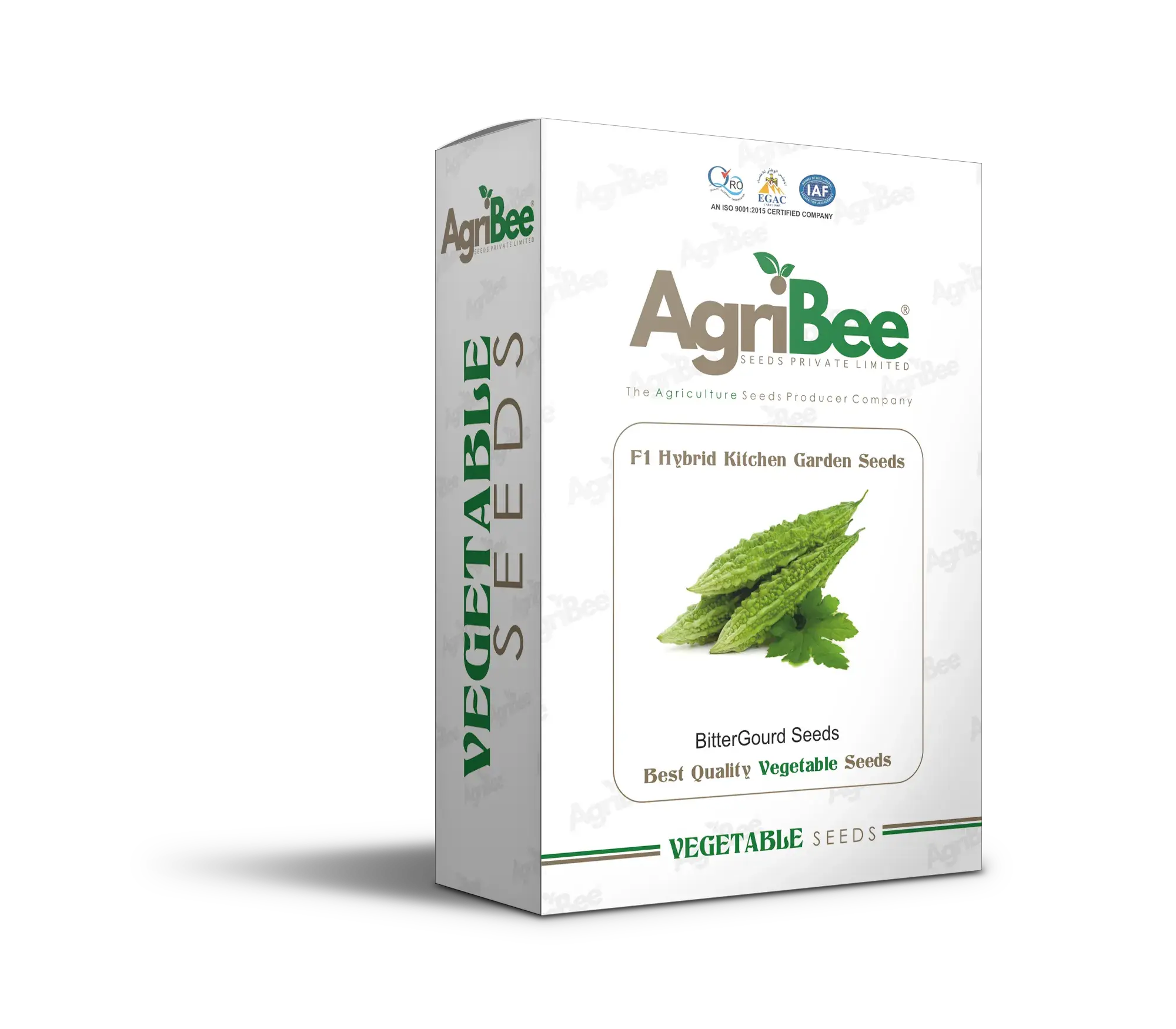
Light‑green, elongated fruits with a smooth, bumpy‑free skin and tender flesh that exhibits the classic bitter‑gourd flavor profile preferred in cooking.
🌿 Stress & Disease Tolerance
Demonstrates strong field tolerance to powdery mildew and downy mildew, and maintains foliage integrity under moderate heat and humidity stress.
🌿 Growth Habit & Vigor
Vigorous vining habit with abundant lateral branching; responds well to trellis training, producing clean, straight fruits with minimal ground contact.
🌿 Crop Duration & Earliness
Early maturity (55–65 days) allows flexible crop rotation, multiple harvest cycles per season, and quick turnover in kitchen‑garden settings.
🌿 Market & Farmer Preference
Traders and consumers favor this variety for its consistent color, shelf stability, and balanced bitterness, making it a reliable choice for both subsistence and commercial growers.