Description
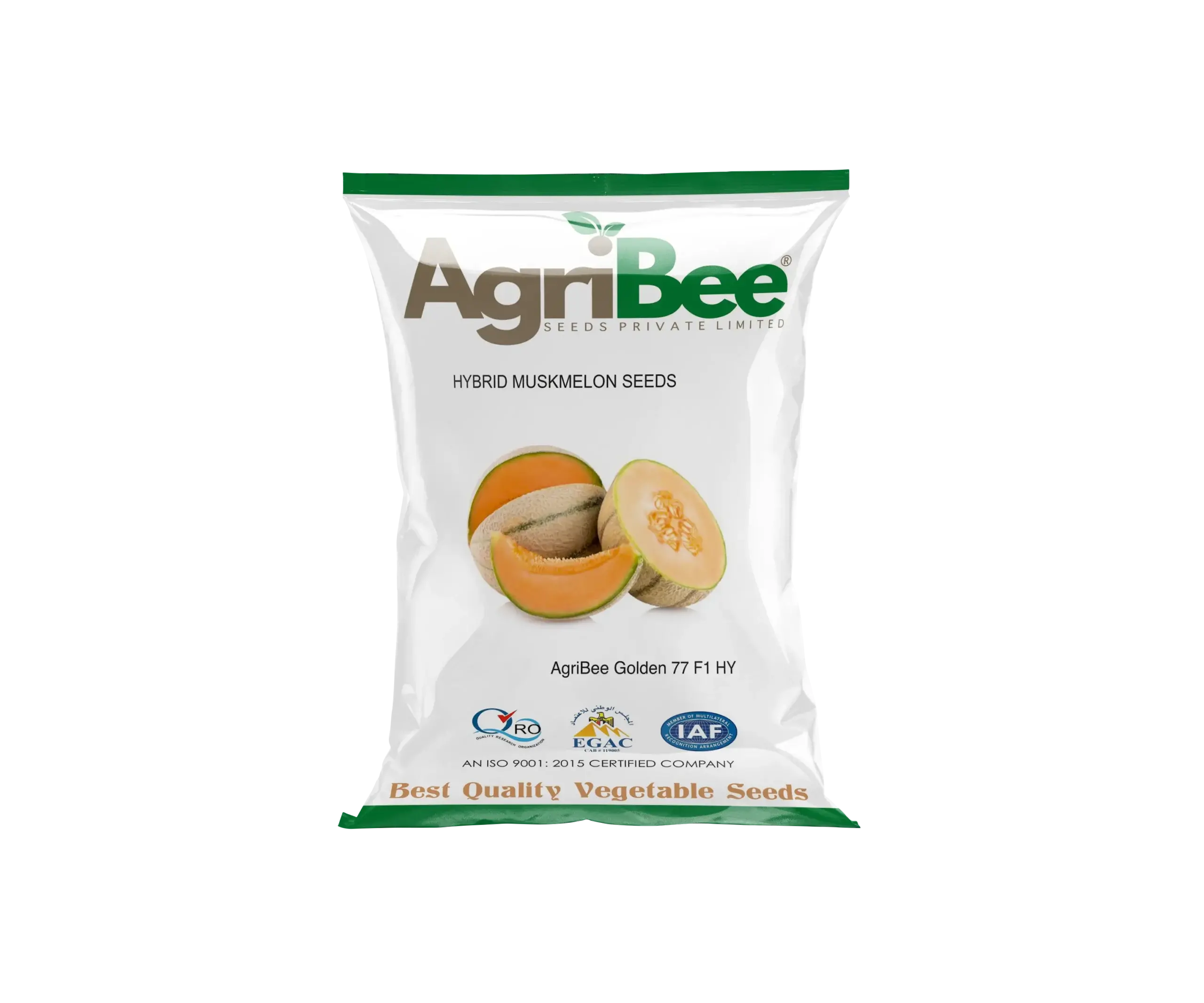
Farming & Cultivation Guide — Muskmelon Seeds AgriBee 07 F1 HY
Complete step-by-step agronomic guide for optimal crop management, disease resistance, and premium produce quality.
🌾 Soil Preparation & Field Prep
Proper land preparation ensures uniform seedling emergence and robust root anchorage.
🌱 Ideal Soil Type & pH
Well-drained sandy loam to loam soils with pH 6.0–7.5. Muskmelon thrives in light, warm soils that permit rapid germination and prevent waterlogging, which causes root rot.
✨ Core Advantage
Fine, well-aerated seedbed ensures uniform emergence and strong taproot development for better nutrient uptake.
- 1
Deep summer ploughing to 25–30 cm followed by 2–3 cross-harrowings to achieve a fine, clod-free tilth.
- 2
Field leveling with laser leveling where possible and preparation of proper drainage channels to avoid water stagnation.
- 3
Incorporation of 15–20 t/ha well-decomposed FYM or vermicompost during final harrowing for soil structure improvement.
- 4
Soil health conditioning: apply agricultural lime at 200–300 kg/ha if soil pH is below 6.0; perform a baseline soil test before sowing for precise nutrient management.
🌱 Sowing Time & Method
Precise seed rate and spacing maximize light interception and canopy development.
| Parameter | Recommendation | Agronomic Importance |
|---|---|---|
| Sowing Window | Kharif: June–July | Rabi: October–November | Summer: March–April | Avoids peak monsoon drenching in Kharif, aligns with favorable temperature (25–32°C) for fruit set and development |
| Seed Rate | 800–1000 g/ha (Direct) | 250–300 g/ha (Transplant) | Ensures optimal plant population of 8,000–10,000 plants/ha without excessive competition |
| Spacing | 90–100 cm (Row-to-row) × 30–40 cm (Plant-to-plant) | Allows adequate canopy spread, improves air circulation, reduces humidity-related disease pressure |
| Sowing / Transplanting Depth | 2–3 cm for direct sowing; 1 cm for nursery seedlings | Shallow sowing ensures rapid emergence; deeper burial restricts germination due to low energy reserves in melon seeds |
💧 Irrigation & Water Management
Adequate moisture regulation supports strong vegetative and reproductive growth.
☀️ Water Requirement Profile
Muskmelon requires consistent soil moisture but is highly sensitive to waterlogging. Drip irrigation is the recommended method, delivering 25–35 mm water per week during active growth. The crop needs approximately 400–500 mm total water during the growing cycle. Soil moisture should be maintained at 60–70% of field capacity throughout vegetative and fruit development stages.
🌦️ Soil Moisture Management
In rainfed situations, sow on raised beds with mulching (black polythene or straw) to conserve soil moisture. Supplementary irrigation at critical stages—flowering and fruit development—is essential. Avoid wetting foliage; apply water at the root zone only to minimize fungal pressure.
- ✓
First irrigation at 3–5 DAS for direct sow or within 24 hours of transplanting; critical for uniform stand establishment.
- ✓
Light and frequent irrigations every 3–4 days during vegetative phase (20–40 DAS) to support vigorous vine growth without causing waterlogging.
- ✓
Increase frequency to every 2–3 days during flowering and fruit set stage (45–65 DAS); consistent moisture during this period prevents fruit cracking and guarantees uniform fruit development.
- ✓
Withhold irrigation completely 7–10 days before harvest to improve Brix (soluble solids) content, enhance shelf life, and prevent post-harvest decay.
🧪 Fertilizer & Nutrition Management
Balanced crop nutrition supports robust plant structure and premium produce quality.
| Nutrient | Recommended Dose (per Acre) | Application Method & Timing |
|---|---|---|
| Nitrogen (N) | 80–100 kg/ha | 50% basal at last ploughing + 25% at 20 DAS + 25% at 40 DAS as Urea (46% N) |
| Phosphorus (P2O5) | 40–50 kg/ha | 100% basal incorporated during final land preparation as DAP (18:46:0) or SSP |
| Potash (K2O) | 40–50 kg/ha | 50% basal + 50% at fruit initiation stage as MOP (60% K2O) for improved fruit size and sugar accumulation |
🌿 Interculture & Weed Management
Timely weed control ensures optimal nutrient and moisture availability for crop seedlings.
-
1
First Weeding & Hoeing: Perform at 10–12 DAS using a manual hoe or cultipacker. Keep weeding shallow (3–5 cm depth) to avoid damaging the shallow root system. Maintain a weed-free circle around each plant for the first 30 days.
-
2
Second Weeding & Earthing-Up: Carry out at 25–30 DAS. Light earthing-up around the base of the vine helps promote adventitious root formation and provides stability to growing vines. This also buries any emerging weed seedlings.
-
3
Mulching and Vine Training: Apply black polythene mulch (40–50 µm) immediately after sowing/transplanting to suppress weeds, conserve moisture, and maintain soil temperature. Train vines along rows by pinching tips at 5–6 leaf stage to encourage lateral branching. Remove laterals beyond the fruit-bearing zone to direct photoassimilates toward fruit development.
🛡️ Pest & Disease Management
Proactive crop monitoring and integrated management ensure healthy crop development.
🐛 Insect Pest Management
- Aphids (Aphis gossypii): Suck sap from leaves and young shoots causing curling and yellowing; also vectors cucurbit viruses. Spray Imidacloprid 17.8% SL at 0.3 ml/L or Thiamethoxam 25% WG at 0.2 g/L. Release ladybird beetles (Harmonia axyridis) at 5,000/ha as biological control. Yellow sticky traps at 10/acre for monitoring.
- Fruit Fly (Bactrocera cucurbitae): Females lay eggs inside developing fruits causing larval feeding and fruit rot. Sanitation: remove and destroy infested fruits. Spray Spinosad 45% SC at 0.5 ml/L or Chlorantraniliprole 18.5% SG at 0.3 g/L. Deploy protein bait traps (Sugar + hydrolyzed protein + insecticide) at 5 traps/acre.
- Cucurbit Beetle / Cucumber Beetle: Adults chew holes in leaves and flowers; larvae bore into stems and roots. Spray Carbendazim 50% WP at 1 g/L for beetle control combined with fungicidal action. Use neem-based formulations (Neemseed kernel extract 5%) as botanical alternative. Remove weed hosts from field margins.
🔬 Disease Control
- Downy Mildew (Pseudoperonospora cubensis): Yellow angular lesions on upper leaf surface with purple-gray sporulation on the underside. Severe defoliation occurs. Spray Metalaxyl 35% WS at 0.8 g/L or Mancozeb 75% WP at 2 g/L. Apply Copper oxychloride 50% WP at 2.5 g/L prophylactically every 10–12 days during high humidity. Remove and burn infected plant debris.
- Powdery Mildew (Erysiphe cichoracearum): White powdery growth on both leaf surfaces causing premature senescence. Spray Sulphur 80% WP at 2–3 g/L or Myclobutanil 10% WP at 0.5 g/L. Preventive sprays starting at 30 DAS are critical. Ensure proper spacing for canopy aeration to reduce humidity around foliage.
- Fusarium Wilt (Fusarium oxysporum f.sp. cucumerinum): Wilting of vines starting from lower leaves; brown discoloration of vascular tissue on stem cross-section. Drench soil with Trichoderma viride solution at 10 ml/L at the base of affected plants. Apply Carbendazim 50% WP at 1 g/L as soil drench. Practice 3-year rotation with non-cucurbit crops. Use wilt-resistant rootstocks such as pumpkin (Cucurbita maxima) scions where available.
✂️ Harvesting & Produce Quality Guide
Harvesting at peak maturity ensures maximum commercial grade and long keeping quality.
⏱️ Harvesting Schedule & Timing
First harvest begins at 70–75 days after sowing. Subsequent pickings can be done at 7–10 day intervals over a 2–3 week period, depending on fruit maturation rate and weather conditions.
⭐ Produce Quality Characteristics
Round to oval fruits with attractive netting pattern, salmon-orange sweet flesh, crisp texture, and high Brix content. The netting should be well-developed and uniform. Fruits exhibit a clean apex scent indicating full ripeness. Consistent fruit size within the 1.5–2.5 kg range ensures premium market grades.
| Quality Parameter | Agronomic Standard | Farmer & Market Benefit |
|---|---|---|
| First Harvest Stage | 70–75 Days after Sowing (complete physiological maturity) | Ensures peak sugar content, optimal netting development, and early market advantage for price realization |
| Harvest Maturity Signs | Full netting coverage, slight softening at blossom end, characteristic sweet aroma, easy abscission layer formation | Prevents under-ripe harvest with poor flavor or over-ripe harvest prone to field decay |
| Shelf Life & Keeping Quality | 7–10 days under ambient conditions (25–30°C); up to 14–18 days under cool storage (8–10°C) | Excellent post-harvest longevity enables transportation to distant markets and reduces post-harvest losses |
| Market Suitability | Fresh market, premium mandis, retail chains, and export-grade packing; suitable for direct consumer sale due to attractive appearance | Premium netting and sweet salmon flesh attract higher price realization in organized and unorganized market segments |
⭐ Varietal Features — Muskmelon Seeds AgriBee 07 F1 HY
Distinguishing characteristics that make this variety a top choice for Indian growers.
🌿 Core Variety Highlight
AgriBee 07 F1 HY is an F1 hybrid muskmelon developed for superior field performance under Indian conditions, combining early maturity, uniform fruit type, and strong vine vigor.
🌿 Produce Quality & Appearance
Delivers round to oval shaped fruits with very good netting, vibrant salmon-orange flesh, and very high sweetness (Brix 14–16°). Uniform fruit weight of 1.5–2.5 kg ensures consistent grading and commercial appeal.
🌿 Stress & Disease Tolerance
Exhibits good tolerance to downy mildew, powdery mildew, and fusarium wilt under moderate field pressure. Tolerant to heat stress during summer growing conditions, making it suitable for wider adaptation across Indian agro-climatic zones.
🌿 Growth Habit & Vigor
Vigorous vine growth with well-branched architecture. Strong primary and secondary shoot development ensures good fruit load per plant and efficient canopy light interception for photosynthesis.
🌿 Crop Duration & Earliness
Early maturing hybrid with first harvest at just 70–75 days after sowing, enabling timely crop completion and flexibility for successive cropping or rotation with other vegetable crops.
🌿 Market & Farmer Preference
Farmers prefer AgriBee 07 F1 HY for its reliable fruit set, attractive netting, exceptional sweetness, and sturdy fruits that withstand handling and transport. Traders value the uniform size and color consistency, ensuring better grade recovery and market acceptance.