Description
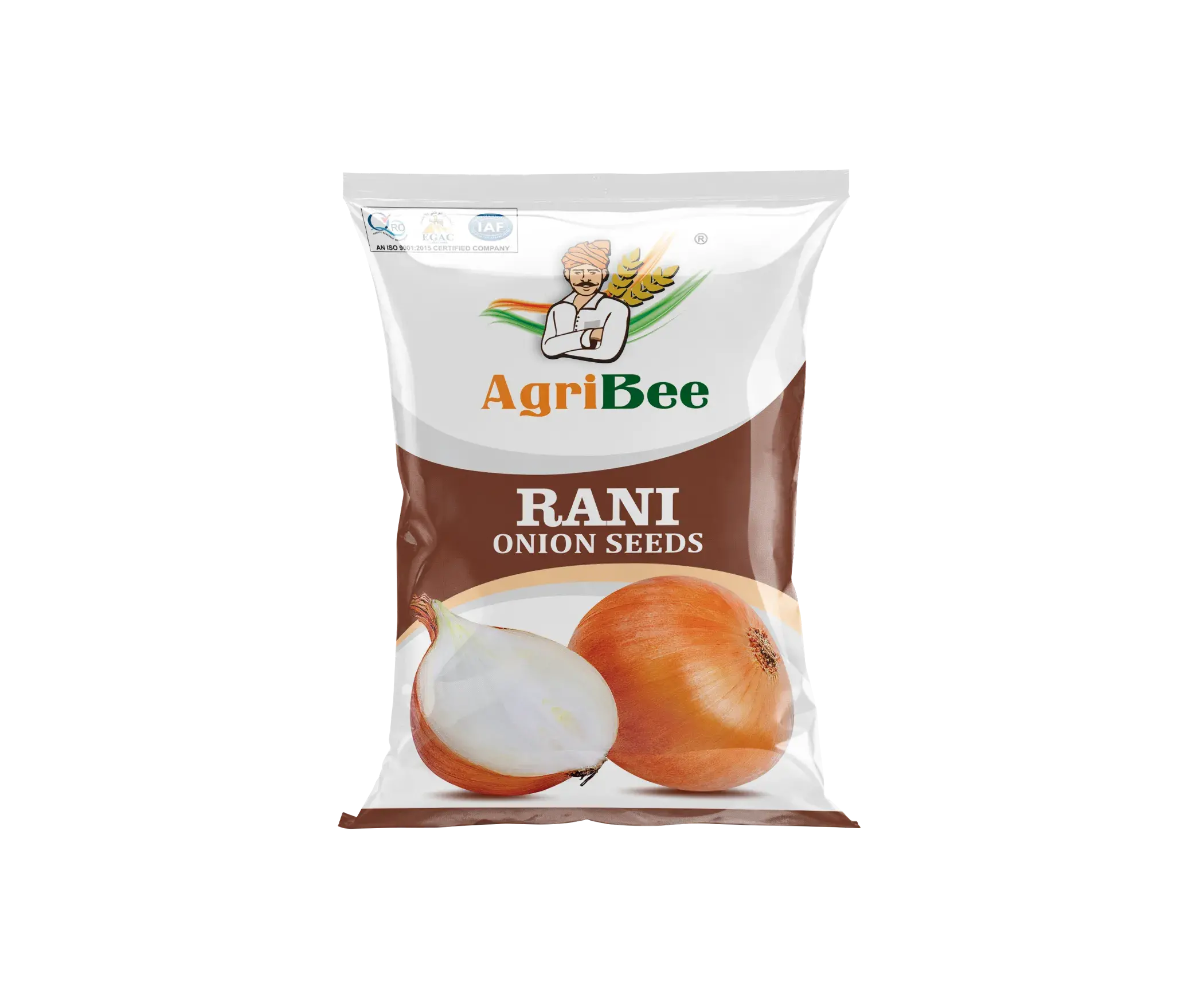
Farming & Cultivation Guide — Onion Rani
Complete step-by-step agronomic guide for optimal crop management, disease resistance, and premium produce quality.
🌾 Soil Preparation & Field Prep
Proper land preparation ensures uniform seedling emergence and robust root anchorage.
🌱 Ideal Soil Type & pH
Well-drained loamy or sandy-loam soils with pH 6.0 – 7.5. Deep, fertile soils free from waterlogging are ideal for uniform bulb development and light-red color expression.
✨ Core Advantage
Loose, well-aerated seedbed promotes rapid seed germination, strong root establishment, and prevents bulb rot during bulbing phase.
- 1
Deep summer ploughing followed by 2–3 cross-harrowings to achieve fine tilth and break hardpan layers.
- 2
Field leveling using laser leveling or traditional methods with proper drainage channels to avoid water stagnation.
- 3
Incorporate 15–20 tons/acre of well-decomposed FYM or compost during last ploughing for soil structure improvement.
- 4
Conduct soil health test and amend pH with agricultural lime if below 6.0; ensure adequate organic carbon for bulb quality.
🌱 Sowing Time & Method
Precise seed rate and spacing maximize light interception and canopy development.
| Parameter | Recommendation | Agronomic Importance |
|---|---|---|
| Sowing Window | October – mid-November (Rabi season across India) | Cool initial growth phase followed by warm dry weather at bulb formation ensures optimal bulb development and light-red color fixation. |
| Seed Rate | 8–10 kg/acre direct sowing; 500–600 g/acre for nursery raising (transplanting 25–30 DAS) | Correct seed rate maintains uniform plant population and prevents overcrowding that reduces bulb size and vigor. |
| Spacing | 30 cm (row-to-row) x 10 cm (plant-to-plant) | Adequate spacing ensures canopy air circulation, reduces disease pressure, and allows unrestricted bulb expansion. |
| Sowing / Transplanting Depth | 1.5–2.0 cm depth for direct sowing; transplant seedlings at 2–3 leaf stage, planted 2.5–3.0 cm deep | Optimal depth ensures uniform emergence; transplants set at correct depth promote strong adventitious root development. |
💧 Irrigation & Water Management
Adequate moisture regulation supports strong vegetative and reproductive growth.
☀️ Water Requirement Profile
Onion has a shallow root system and requires regular but moderate irrigation. The crop is moderately sensitive to water stress, particularly during active bulb formation. Drip irrigation is highly recommended with 3–4 cm water application per irrigation, applied every 5–7 days depending on soil texture and climate conditions.
🌦️ Soil Moisture Management
In rainfed Rabi zones, ensure the field is well-moistured at sowing through pre-sowing irrigation. Mulching with straw paddy mulch conserves soil moisture and suppresses weeds. Avoid late-season waterlogging which causes bulb rot and reduces storage quality.
- ✓
First irrigation 3–4 days after sowing (transplanting) to ensure uniform establishment and germination.
- ✓
Vegetative phase (20–60 DAS): irrigate at 8–10 day intervals; maintain consistent soil moisture for vigorous foliage development.
- ✓
Critical bulbing stage (60–90 DAS): ensure regular irrigation every 5–7 days; water stress during this phase reduces bulb weight and quality.
- ✓
Pre-harvest withholding: stop irrigation 15–20 days before harvest to allow crop maturity, neck senescence, and improved bulb curing for extended storage life.
🧪 Fertilizer & Nutrition Management
Balanced crop nutrition supports robust plant structure and premium produce quality.
| Nutrient | Recommended Dose (per Acre) | Application Method & Timing |
|---|---|---|
| Nitrogen (N) | 80–100 kg/acre (as Urea 46-0-0) | 50% basal at sowing/transplanting; remaining 50% split into two equal doses at 30 DAS and 60 DAS |
| Phosphorus (P2O5) | 50–60 kg/acre (as DAP 18-46-0 or SSP) | 100% basal application at final land preparation or at transplanting |
| Potash (K2O) | 40–50 kg/acre (as MOP 60-0-0) | 50% basal at sowing; remaining 50% at 60 DAS to support bulb development and storage quality |
🌿 Interculture & Weed Management
Timely weed control ensures optimal nutrient and moisture availability for crop seedlings.
-
1
First Weeding & Hoeing: Carry out at 15–20 DAS using a conformable hoe or hand weeding. Early weed control is critical as weeds compete aggressively for nutrients and moisture during the vulnerable seedling stage.
-
2
Second Weeding & Earthing-Up: Perform at 30–35 DAS along with second dose of nitrogen. Light earthing-up around the base of plants supports root anchorage and improves aeration during the onset of bulbing.
-
3
Mulching and Inter-row Cultivation: Apply straw mulch (3–4 cm layer) immediately after second weeding to conserve soil moisture, suppress weeds, and regulate soil temperature. Perform inter-row hoeing at 45 DAS to loosen soil crust without damaging superficial roots.
🛡️ Pest & Disease Management
Proactive crop monitoring and integrated management ensure healthy crop development.
🐛 Insect Pest Management
- Thrips (Thrips tabaci): Sucking pests causing silvery-white streaks and curling of leaf tips. Control: Spray Spinosad 45 SC at 0.3 ml/litre or Imidacloprid 17.8 SL at 0.2 ml/litre. Apply at 15 and 30 DAS as preventive measure. Use yellow sticky traps at 10 traps/acre for monitoring.
- Leaf miner (Liriomyza spp.): Miners create whitish serpentine tunnels inside leaves, reducing photosynthetic capacity. Control: Spray Chlorantraniliprole 18.5 SC at 0.3 ml/litre or Abamectin 1.9 EC at 0.5 ml/litre. Remove and destroy infested plant debris promptly.
- Armyworm (Spodoptera litura): Larvae feed on leaf margins creating irregular holes; severe infestation strips foliage completely. Control: Spray Chlorantraniliprole 0.3 ml/litre or Emamectin benzoate 5 SG at 0.5 gm/litre. Deploy pheromone traps at 5 traps/acre for population monitoring and mass attraction.
🔬 Disease Control
- Downy mildew (Peronospora destructor): pale purple to grey fungal growth on leaf surfaces with elongated yellow lesions. Causal agent thrives under cool humid conditions. Preventive spray: Mancozeb 75 WP at 2.0 gm/litre or Metalaxyl + Mancozeb at 1.5 gm/litre. Repeat at 15-day intervals during high humidity periods.
- Purple blotch / Alternaria blight (Alternaria porri): Small dark purple spots with concentric rings on leaves and bulbs; neck rot during storage. Control: Spray Thiophanate methyl 70 WP at 1.0 gm/litre or Cuxyne at 2.0 gm/litre. Crop rotation with non-allium crops for 2–3 years breaks the disease cycle.
- Stem and bulb nematode (Ditylenchus dipsaci): Stunted plants with swollen, distorted bulbs and rough outer scale tissue. Control: Soil solarization during summer fallow; drench with Carbofuran 3G at 10 kg/acre before sowing. Destroy infected plant residues; use certified disease-free seed sets.
✂️ Harvesting & Produce Quality Guide
Harvesting at peak maturity ensures maximum commercial grade and long keeping quality.
⏱️ Harvesting Schedule & Timing
harvest commences at 100–110 days after sowing. Single bulk harvest is recommended for bulb onion; pull plants when 50–60% of tops have naturally fallen over indicating bulb maturity.
⭐ Produce Quality Characteristics
Round-shaped bulbs with attractive light-red color, smooth outer skins, firm flesh texture, pungent aromatic taste, and consistent bulb weight of 90–100 g. Excellent curing ability and residual flavor retention after storage.
| Quality Parameter | Agronomic Standard | Farmer & Market Benefit |
|---|---|---|
| Harvest Stage | 100–110 Days after Sowing | Ensures peak bulb development, optimal color intensity, and early market arrival for better price realization. |
| Harvest Maturity Signs | Natural top lodging (50–60%), papery outer bulb skins, firm bulb texture, and cessation of leaf growth | Prevents over-maturity risks such as split bulbs, premature sprouting, and reduced storage life. |
| Shelf Life & Keeping Quality | 8–10 weeks under ambient conditions; up to 4–5 months under controlled cool and dry storage (10–15°C, 65–70% RH) | Facilitates long-distance transport, extended marketing window, and minimal post-harvest losses for traders. |
| Market Suitability | Table fresh consumption, wholesale mandis, processing units, and export markets requiring light-red round onions | Uniform round shape and attractive light-red color attract premium rates from traders and processors across India. |
⭐ Varietal Features — Onion Rani
Distinguishing characteristics that make this variety a top choice for Indian growers.
🌿 Core Variety Highlight
Onion Rani is a distinguished Rabi variety developed by AgriBee Seeds, exhibiting robust field vigor, uniform bulb development, and exceptional storage characteristics tailored for Indian growing conditions.
🌿 Produce Quality & Appearance
Produces uniformly round bulbs with attractive light-red coloration, smooth tunic coverage, and consistent 90–100 g bulb weight. The pungent flavor profile and crisp texture meet premium market standards.
🌿 Stress & Disease Tolerance
Demonstrates solid field tolerance to downy mildew, purple blotch, and thrips under moderate pressure. Tolerates variable Rabi-season climate conditions with consistent stand establishment and foliage health.
🌿 Growth Habit & Vigor
Upright semi-erect growth habit with vigorous green foliage and strong root system. Dense leaf canopy provides effective ground cover while maintaining adequate inter-canopy airflow to minimize disease incidence.
🌿 Crop Duration & Earliness
Matures in 100–110 days, enabling timely harvest and efficient crop rotation planning. The relatively early maturity window allows farmers to fit subsequent crops within the Rabi sequence.
🌿 Market & Farmer Preference
Preferred by farmers and traders for its reliable round bulb shape, appealing light-red color, excellent curing ability, and superior storage life. Its consistent quality attributes make it a dependable choice for both domestic mandi trade and export-oriented supply chains.