Description
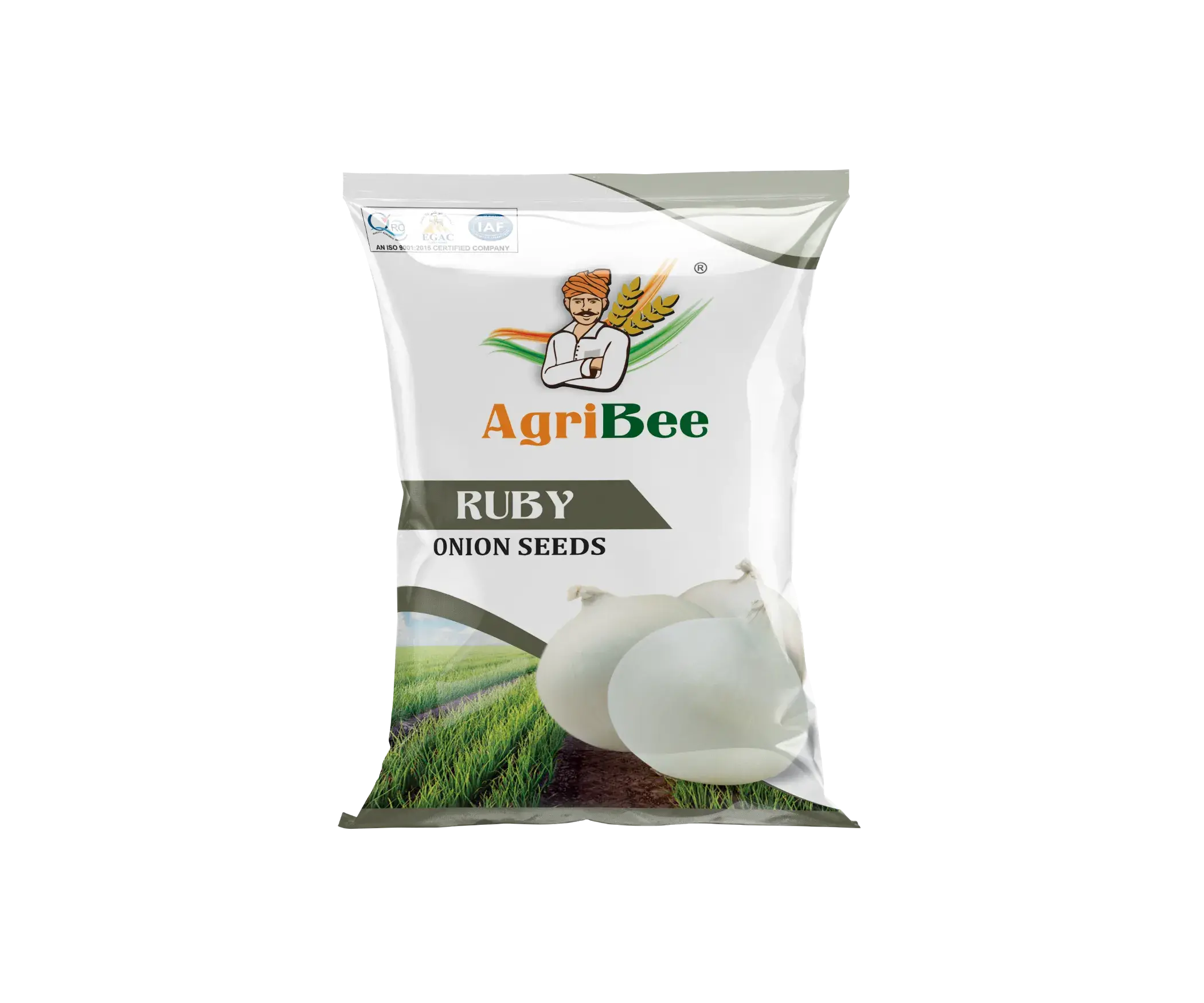
Farming & Cultivation Guide — Onion White Ruby
Complete step-by-step agronomic guide for optimal crop management, disease resistance, and premium produce quality.
🌾 Soil Preparation & Field Prep
Proper land preparation ensures uniform seedling emergence and robust root anchorage.
🌱 Ideal Soil Type & pH
Well-drained loamy to sandy-loam soils with pH 6.0–7.5. Deep, fertile soils with good organic matter content are ideal. Avoid heavy clay or waterlogged soils that promote bulb rot.
✨ Core Advantage
Loose, well-aerated seedbed promotes rapid radicle emergence and uniform early root spread, which is critical for bulb initiation in Allium cepa.
- 1
Deep summer ploughing to a depth of 25–30 cm followed by 2–3 cross-harrowings for fine tilth and weed seed burial.
- 2
Field leveling using laser leveling or board leveling to ensure uniform water distribution and prevent water stagnation.
- 3
Incorporate 8–10 tonnes per acre of well-decomposed FYM or compost during the last harrowing to improve soil structure and water retention.
- 4
Conduct a soil health test and apply lime at 200–300 kg per acre if pH is below 6.0; apply gypsum at 250 kg per acre in sodic soils.
🌱 Sowing Time & Method
Precise seed rate and spacing maximize light interception and canopy development.
| Parameter | Recommendation | Agronomic Importance |
|---|---|---|
| Sowing Window | October – November for Rabi (main season); June – July for Kharif in rain-fed zones; March – April for Summer under protected irrigation | Optimal temperature range of 15–25°C during bulb development ensures proper bulb and prevents premature bolting. |
| Seed Rate | 4–5 kg per acre (Direct) | 50–60 g per acre (Transplanted nursery seed) | Maintains optimum plant population of 80,000–100,000 plants per acre for balanced canopy and uniform bulb sizing. |
| Spacing | 15 cm (Row-to-Row) x 10 cm (Plant-to-Plant) | Ensures adequate air circulation around bulbs, reduces humidity-related disease pressure, and allows full bulb expansion. |
| Sowing / Transplanting Depth | 1–1.5 cm depth for direct sowing; transplant at 4–6 leaf stage at same depth as in nursery | Shallow sowing ensures rapid emergence; correct transplanting depth prevents lodging and supports strong root anchorage. |
💧 Irrigation & Water Management
Adequate moisture regulation supports strong vegetative and reproductive growth.
☀️ Water Requirement Profile
Onion has a shallow root system and moderate drought tolerance. Under drip irrigation, apply 3–4 cm of water per week during active growth. The crop is highly sensitive to both moisture stress and waterlogging. Drip irrigation is strongly recommended for Onion White Ruby to maintain consistent soil moisture, improve nutrient use efficiency, and reduce foliar disease incidence.
🌦️ Soil Moisture Management
In rainfed environments, ensure pre-sowing irrigation to trigger germination. Apply 2–3 light irrigations during the rainy season at 10–12 day intervals. Maintain soil moisture at field capacity during bulb initiation but avoid standing water. Use raised beds (15–20 cm height) in Kharif to facilitate drainage and prevent bulb rot.
- ✓
First irrigation within 3–4 days after sowing (direct) or immediately after transplanting to reduce seedling shock and establish roots.
- ✓
During vegetative phase (20–60 DAS), irrigate at 8–10 day intervals depending on soil type and weather; sandy soils require more frequent light irrigation.
- ✓
Critical stage: Bulb initiation and (60–90 DAS) — maintain uniform soil moisture; stress during this period causes small, misshapen bulbs and reduced storage quality.
- ✓
Cease irrigation 10–15 days before harvest to allow bulb curing, neck drying, and outer scale maturation for improved storage longevity.
🧪 Fertilizer & Nutrition Management
Balanced crop nutrition supports robust plant structure and premium produce quality.
| Nutrient | Recommended Dose (per Acre) | Application Method & Timing |
|---|---|---|
| Nitrogen (N) | 80–100 kg per acre | 50% basal at sowing/transplanting; remaining 50% split into two equal top-dressings at 30 DAS and 60 DAS |
| Phosphorus (P2O5) | 40–50 kg per acre | 100% basal application incorporated during final land preparation with DAP or SSP |
| Potash (K2O) | 40–50 kg per acre | 100% basal along with phosphorus; second split at bulb stage (60 DAS) using MOP for improved bulb firmness and storage quality |
🌿 Interculture & Weed Management
Timely weed control ensures optimal nutrient and moisture availability for crop seedlings.
-
1
First Weeding & Hoeing: Carry out at 15–20 DAS using a hand hoe or cultural picker. Early weeding is critical as onions have weak competitive ability against weeds. Shallow hoeing (3–5 cm depth) avoids damaging the shallow root system.
-
2
Second Weeding & Earthing-Up: Perform at 35–40 DAS with moderate hoeing. Light earthing-up around the base helps support emerging tillers, improves aeration, and encourages secondary root development. Remove any volunteer onion plants to maintain varietal purity.
-
3
Mulching and Inter-row Cultivation: Apply black polyethylene mulch or straw mulch at 3–4 tonnes per acre after first weeding to conserve soil moisture, suppress weeds, and keep bulbs clean. Practice inter-row hoeing at 50 DAS to break crust and improve infiltration. Monitor and remove any bolting plants immediately to prevent seed set and quality loss.
🛡️ Pest & Disease Management
Proactive crop monitoring and integrated management ensure healthy crop development.
🐛 Insect Pest Management
- Thrips (Thrips tabaci): Small, slender insects cause silvery-white elongated streaks on leaves with heavy infestation leading to leaf desiccation and stunted bulbs. Control: Spray Imidacloprid 17.8% SL at 150 ml per acre or Thiamethoxam 25% WG at 80 g per acre in 500 L water per acre. Apply at 20 DAS and repeat at 10-day intervals if infestation persists. Use yellow sticky traps at 10 per acre for monitoring.
- Onion Leaf Miner (Liriomyza trifolii): Miners create irregular white tunnels within leaves, weakening photosynthetic capacity and reducing bulbा. Control: Spray Cartap hydrochloride 50% WP at 600 g per acre or Chlorantraniliprole 18.5% SC at 100 ml per acre. Remove and destroy infested leaves. Practice crop rotation with non-allium crops.
- Onion Aphid (Myzus persicae): Colonies on leaf axils and emerging buds cause curling, yellowing, and honeydew secretion promoting sooty mold. Also vectors viral diseases. Control: Spray Clothianidin 50% WG at 80 g per acre or Acetamiprid 20% SP at 50 g per acre. Encourage natural predators like ladybird beetles and hoverflies. Use silver multicolored mulch to repel aphids.
🔬 Disease Control
- Downy Mildew (Peronospora destructor): Characterized by pale green to yellow lesions on leaves turning purplish, with fuzzy gray-purple sporulation under humid conditions. Severe infection destroys foliage and reduces bulb size. Control: Spray Mancozeb 75% WP at 2.5 g per liter or Propineb 50% WP at 3 g per liter. Alternate with Metalaxyl-based fungicide at 7-day intervals during high humidity. Avoid overhead irrigation and ensure proper spacing for airflow.
- Purple Blotch (Alternaria porri): Small water-soaked spots on leaves developing into characteristic purplish-brown circular lesions with concentric rings. Causes premature leaf collapse and poor bulb development. Control: Spray Chlorothalonil 75% WP at 2 g per liter or Mancozeb at 2.5 g per liter. Apply as preventive spray starting at 30 DAS in areas with high rainfall. Remove and burn infected debris after harvest.
- Neck Rot (Botrytis allii): Appears post-harvest as soft, watery rot beginning at the neck and spreading into the bulb. White mycelium and black sclerotia are visible inside scales. Control: Ensure proper curing and neck closure before storage. Spray Carbendazim 50% WP at 1 g per liter during late vegetative stage. Avoid excessive nitrogen and ensure good field drainage. Store bulbs only after complete drying at 35–40°C for 3–5 days.
✂️ Harvesting & Produce Quality Guide
Harvesting at peak maturity ensures maximum commercial grade and long keeping quality.
⏱️ Harvesting Schedule & Timing
harvest at 100–110 days after sowing when 70–80% of plants show natural lodging (tops falling over). Bulbs are ready for uprooting once necks soften and outer scales turn papery.
⭐ Produce Quality Characteristics
Round-shaped, uniformly white bulbs weighing 80–100 grams with tight, multi-layered dry outer tunics. Crisp texture with mild pungency and sweet undertones when cooked. High dry matter content and excellent slicing quality make it ideal for both fresh consumption and commercial processing into dehydrated onion products.
| Quality Parameter | Agronomic Standard | Farmer & Market Benefit |
|---|---|---|
| Harvest Stage | 100–110 Days after Sowing — when 70–80% tops naturally lodge | Ensures peak bulb maturity, optimal dry matter accumulation, and early market entry for better price realization |
| Harvest Maturity Signs | Yellowing andlodging of foliage, firm bulb development, papery outer scales, and cessation of green leaf growth | Prevents over-maturity that leads to scale separation, neck splitting, and increased post-harvest rot incidence |
| Shelf Life & Keeping Quality | Good for storage — 3–4 months under cool, dry, well-ventilated conditions; curing at 35–40°C for 3–5 days extends shelf life | Facilitates long-distance transport, staggered marketing, and reduced post-harvest losses in wholesale markets |
| Market Suitability | Premium table onion for mandis, export-grade packing, and ideal raw material for drying/dehydration units producing onion powder and flakes | Versatile end-use attracts diverse buyers including processors, exporters, and retail chains, ensuring stable demand throughout the storage window |
⭐ Varietal Features — Onion White Ruby
Distinguishing characteristics that make this variety a top choice for Indian growers.
🌿 Core Variety Highlight
Onion White Ruby is a robust, round white onion variety bred for adaptability across Indian growing seasons, offering reliable field performance and consistent bulb formation under diverse agro-climatic conditions.
🌿 Produce Quality & Appearance
Uniformly round, bright white bulbs with 80–100 gram average weight, tight neck closure, and crisp flesh. The clean white color and attractive shape command premium rates in mandis and retail markets. Well-suited for drying and value-added processing.
🌿 Stress & Disease Tolerance
Demonstrates good field tolerance to common allium diseases including downy mildew and purple blotch under moderate pressure. Strong neck closure reduces neck rot susceptibility. Adapts well to both Rabi and Kharif seasons with proper cultural management.
🌿 Growth Habit & Vigor
Upright, semi-erect foliage with vigorous early establishment. Bushy canopy provides effective ground cover while maintaining adequate air penetration. Strong root system ensures stability and efficient nutrient uptake throughout the growing cycle.
🌿 Crop Duration & Earliness
Matures in 100–110 days, enabling flexible crop sequencing. The medium duration allows inclusion in multiple cropping systems across India — Rabi onion after Kharif rice, summer onion in irrigated belts, and off-season cultivation in subtropical zones.
🌿 Market & Farmer Preference
Farmers and traders favor Onion White Ruby for its uniform bulb size, excellent storage life, and dual suitability for fresh table trade and industrial dehydration. The white color appeals to consumer preferences in northern and central Indian markets, while the dried onion compatibility opens additional revenue channels.