Description
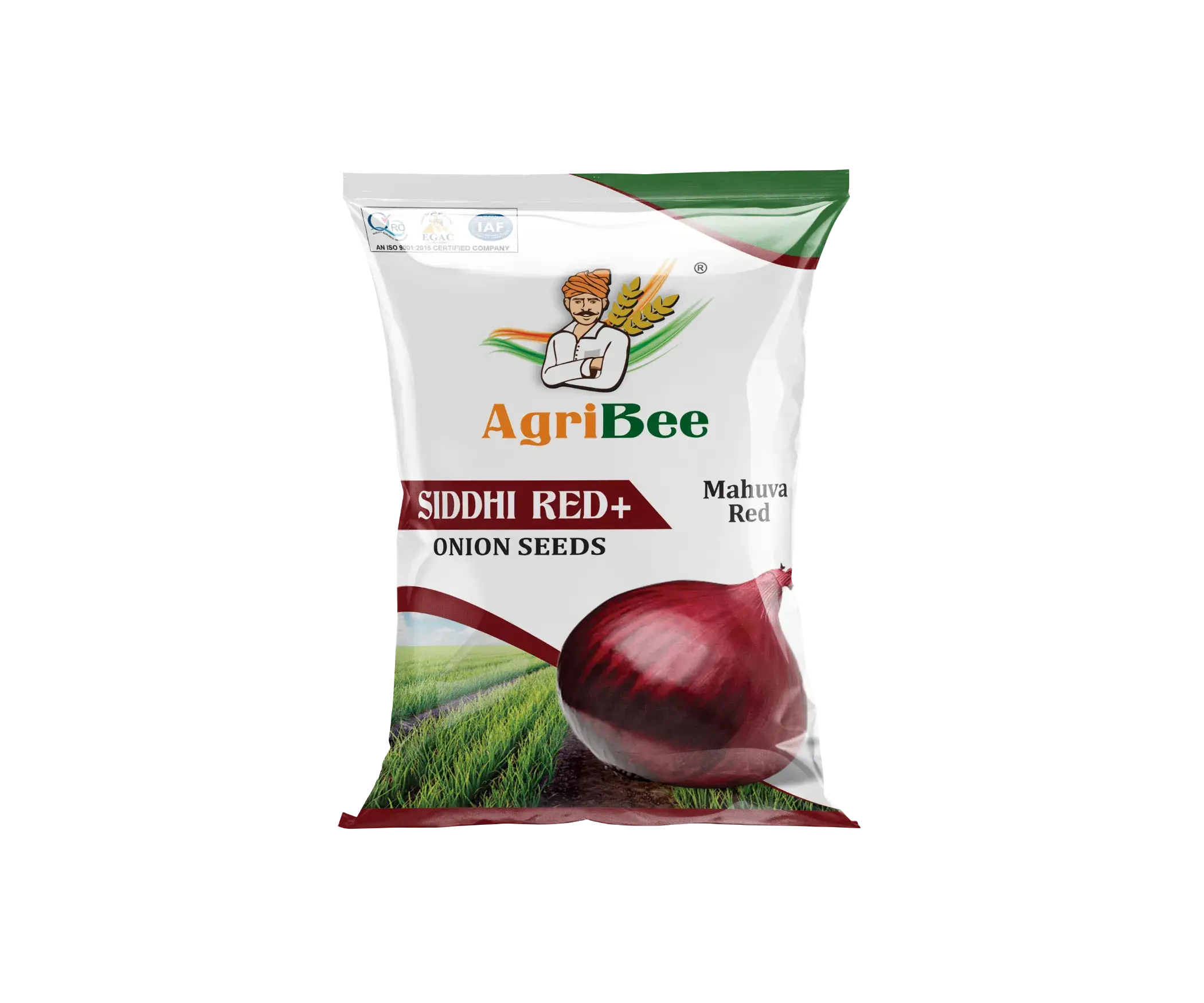
Farming & Cultivation Guide — Onion Siddhi Red+
Complete step-by-step agronomic guide for optimal crop management, disease resistance, and premium produce quality.
🌾 Soil Preparation & Field Prep
Proper land preparation ensures uniform seedling emergence and robust root anchorage.
🌱 Ideal Soil Type & pH
Well-drained loamy to sandy-loam soils with good organic matter content. pH range: 6.0–7.5. Deep, fertile soils free from waterlogging are ideal for optimal bulb development.
✨ Core Advantage
Loose, well-aerated seedbed promotes rapid root establishment, uniform germination, and healthy pseudo-stem development essential for medium-duration varieties like Siddhi Red+.
- 1
Deep summer ploughing to 25–30 cm followed by 2–3 cross-harrowings for fine tilth and weed elimination.
- 2
Field leveling using laser leveler or traditional method; ensure adequate drainage channels to prevent water stagnation.
- 3
Incorporate 8–10 t/acre of well-decomposed FYM or compost during last harrowing for improved soil structure and moisture retention.
- 4
Soil health conditioning with gypsum (50 kg/acre in saline-affected areas) and sulfur (25 kg/acre to correct alkalinity); conduct soil test before sowing.
🌱 Sowing Time & Method
Precise seed rate and spacing maximize light interception and canopy development.
| Parameter | Recommendation | Agronomic Importance |
|---|---|---|
| Sowing Window | Kharif: June–July | Rabi: October–November | Aligns temperature and moisture conditions for optimal germination and vegetative growth of medium-duration variety |
| Seed Rate | 50–60 g per Acre (Transplanted) | Ensures accurate plant population with 10–15 shoots per hill and balanced canopy coverage |
| Spacing | 15 cm x 10 cm (Row-to-row x Plant-to-plant) | Provides adequate space for foliage spread (30–45 cm leaf length) and medium bulb development (4.5–6 cm diameter) |
| Sowing / Transplanting Depth | 1.0–1.5 cm depth for direct sowing; transplant at 3–4 leaf stage at same depth as nursery | Shallow sowing ensures uniform emergence; correct transplanting depth prevents lodging and promotes strong pseudo-stem formation |
💧 Irrigation & Water Management
Adequate moisture regulation supports strong vegetative and reproductive growth.
☀️ Water Requirement Profile
Onion requires moderate and consistent soil moisture throughout the growing cycle. Siddhi Red+, being a medium-duration variety, needs approximately 450–550 mm of water. Drip irrigation is highly compatible and recommended for water-use efficiency. Avoid both drought stress and waterlogging, as either extremes reduce bulb size and quality.
🌦️ Soil Moisture Management
In rainfed conditions, sow at the onset of monsoon with residual soil moisture. Use mulching (straw or polyethylene film) to conserve soil moisture during dry spells. Ensure field drainage is adequate to prevent water accumulation after heavy rains, especially during bulb bulking stage.
- ✓
First irrigation within 24–48 hours after transplanting to ensure zero mortality and rapid root establishment.
- ✓
Irrigate at 8–10 day intervals during vegetative phase depending on soil type and weather conditions; maintain soil moisture at field capacity.
- ✓
Critical stage: Bulb initiation and bulking (60–80 DAS) — maintain consistent moisture; water stress at this stage drastically reduces bulb diameter and pseudo-stem development.
- ✓
Withhold irrigation 10–12 days before harvest to allow curing of outer skin, improve shelf life, and prevent storage rot.
🧪 Fertilizer & Nutrition Management
Balanced crop nutrition supports robust plant structure and premium produce quality.
| Nutrient | Recommended Dose (per Acre) | Application Method & Timing |
|---|---|---|
| Nitrogen (N) | 60–80 kg/acre | 40% basal at transplanting/sowing; remaining 60% in two equal split doses at 30 and 60 DAS |
| Phosphorus (P2O5) | 40–50 kg/acre | 100% basal application as DAP (21:54:0) or SSP incorporated during last ploughing |
| Potash (K2O) | 40–50 kg/acre | 100% basal application as MOP (60:0:0); split not required but second dose at 45 DAS improves bulb firmness and color intensity |
🌿 Interculture & Weed Management
Timely weed control ensures optimal nutrient and moisture availability for crop seedlings.
-
1
First Weeding & Hoeing: Carry out first weeding at 15–20 DAS using hand hoe or culture stack. Keep the field weed-free during the critical early growth period to reduce competition for nutrients and moisture, ensuring vigorous foliage development.
-
2
Second Weeding & Earthing-Up: Second weeding at 30–35 DAS combined with light earthing-up around the base of plants. This supports the pseudo-stem (medium height 3–5 cm), improves root aeration, and prevents lodging as the plant attains full foliage length of 30–45 cm.
-
3
Mulching and Inter-row Cultivation: Apply black polyethylene mulch or organic straw mulch immediately after transplanting to suppress weeds, conserve moisture, and maintain soil temperature. Perform inter-row hoeing at 45 DAS to loosen soil and promote deeper root penetration without damaging shallow fibrous roots.
🛡️ Pest & Disease Management
Proactive crop monitoring and integrated management ensure healthy crop development.
🐛 Insect Pest Management
- Onion Thrips (Thrips tabaci): Suck sap from leaves causing silvery patches, curling, and drying of leaf tips. Control: Spray Imidacloprid 17.8% SL at 0.3 ml/liter or Thiamethoxam 25% WG at 0.2 g/liter. Alternate with Spinosad 45% SC at 0.5 ml/liter for resistance management. Apply at 10-day intervals starting from 25 DAS.
- Allium Leaf Miners (Liriomyza sativae): Larvae create winding mines inside leaves causing wilting and reduced photosynthetic area. Control: Install yellow sticky traps at 15 traps/acre. Spray Chlorantraniliprole 18.5% SC at 0.4 ml/liter or CFMU 0.05%. Destroy Infested plant debris after harvest. Release parasitic wasp Diglyphus isaea at 500/acre/week for biological control.
- Onion Bulb Mite (Rhizoglyphus Roborovii): Adults and larvae feed on bulb scales causing hollow cavities and secondary fungal/bacterial infection. Control: Soil drench with Cartap hydrochloride 4% GP at 20 kg/acre at 30 DAT. Apply Carbofuran 3% G at 10 kg/acre during sowing as soil application. Practice crop rotation with non-allium crops for 2–3 years.
🔬 Disease Control
- Downy Mildew (Peronospora destructor): Appears as pale green to yellow lesions on leaves turning gray-purple downy growth under humid conditions. Lesions girdle leaves causing die-back. Control: Spray Mancozeb 75% WP at 2.5 g/liter or Metalaxyl + Mancozeb 8% + 64% WP at 2.0 g/liter. First spray at 30 DAS and repeat at 15-day intervals. Avoid overhead irrigation to reduce leaf wetness.
- Purple Blotch (Alternaria alternata f.sp. cepae): Small water-soaked spots on leaves turning purplish-brown with concentric rings. Severe infection causes premature drying of foliage and poor bulb development. Control: Spray Maneb 64% + Ziram 12% WP at 2.5 g/liter or Difenoconazole 25% EC at 0.5 ml/liter. Start prophylactic sprays at 35 DAS in high humidity zones. Remove and destroy infected plant residues.
- Bacterial Soft Rot (Erwinia carotovora): Water-soaked, mushy decay of bulb scales with foul odor. Secondary invasion by other microbes accelerates rotting in storage. Control: Treat seeds with Streptocycline 0.1% or Copper oxychloride 0.3% before sowing. Avoid waterlogging and physical injury during harvesting. Apply Copper oxychloride 50% WP at 2.5 g/liter as soil drench at transplantation. Ensure proper curing before storage.
✂️ Harvesting & Produce Quality Guide
Harvesting at peak maturity ensures maximum commercial grade and long keeping quality.
⏱️ Harvesting Schedule & Timing
harvest at 90–100 days after sowing. Harvest entire crop as a bulk operation once 70–80% of plants show natural senescence symptoms. Cut foliage at the base using sharp knives or sickles.
⭐ Produce Quality Characteristics
Siddhi Red+ produces medium-sized bulbs (4.5–6 cm diameter) with medium pseudo-stem height (3–5 cm) and abundant foliage (more than 50 leaves per hill). Bulbs exhibit deep red color with firm texture, pungent taste preferred for table consumption and market sale. Good tunic adherence and uniform bulb shape enhance commercial appeal.
| Quality Parameter | Agronomic Standard | Farmer & Market Benefit |
|---|---|---|
| Harvest Stage | 90–100 Days after Sowing (DAS) | Ensures bulbs reach market-ready medium size with optimal color development and sugar content |
| Harvest Maturity Signs | Yellowing and toppling of 70–80% foliage; bulbs attain medium size (4.5–6 cm diameter) with tight scales and developed outer skin | Prevents over-maturity which leads to scale splitting, neck rot, and poor keeping quality |
| Shelf Life & Keeping Quality | 4–6 weeks under ambient conditions; up to 8–10 weeks in cool dry storage at 2–5°C with 65–70% relative humidity | Good storage potential enables farmers to time market sales for better price realization throughout the season |
| Market Suitability | Suitable for fresh market, mandis, processing units, and export. Red color attracts premium rates in urban markets and food processing industries | Medium maturity allows flexible scheduling for off-season supply when prices are favorable in domestic markets |
⭐ Varietal Features — Onion Siddhi Red+
Distinguishing characteristics that make this variety a top choice for Indian growers.
🌿 Core Variety Highlight
AgriBee Seeds' Siddhi Red+ is a medium-duration red onion variety specifically bred for Indian conditions, offering reliable performance across Kharif and Rabi seasons with balanced vegetation and bulb development.
🌿 Produce Quality & Appearance
Produces attractive medium-sized red bulbs (4.5–6 cm diameter) with medium pseudo-stem height (3–5 cm). Deep red external and internal color, firm texture, and pungent flavor make it highly marketable.
🌿 Stress & Disease Tolerance
Demonstrates good field tolerance to downy mildew and purple blotch under moderate pressure. Adapts well to varied soil conditions and exhibits reasonable resilience to moisture fluctuations typical of Indian agro-climatic zones.
🌿 Growth Habit & Vigor
Vigorous plant architecture with medium foliage length (30–45 cm) and abundant leaf production (more than 50 leaves per hill). 10–15 shoots per plant ensure strong stand without excessive crowding, promoting healthy air circulation.
🌿 Crop Duration & Earliness
Medium maturity period of 90–100 days allows flexibility in crop scheduling and rotation planning. Timely harvest enables farmers to fit subsequent crops effectively in the farming system.
🌿 Market & Farmer Preference
Preferred by traders and retailers for its consistent bulb size, vivid red color, and good post-harvest keeping quality. Farmers appreciate its adaptability to both Kharif and Rabi seasons with dependable field performance across major onion-growing regions of India.