Description
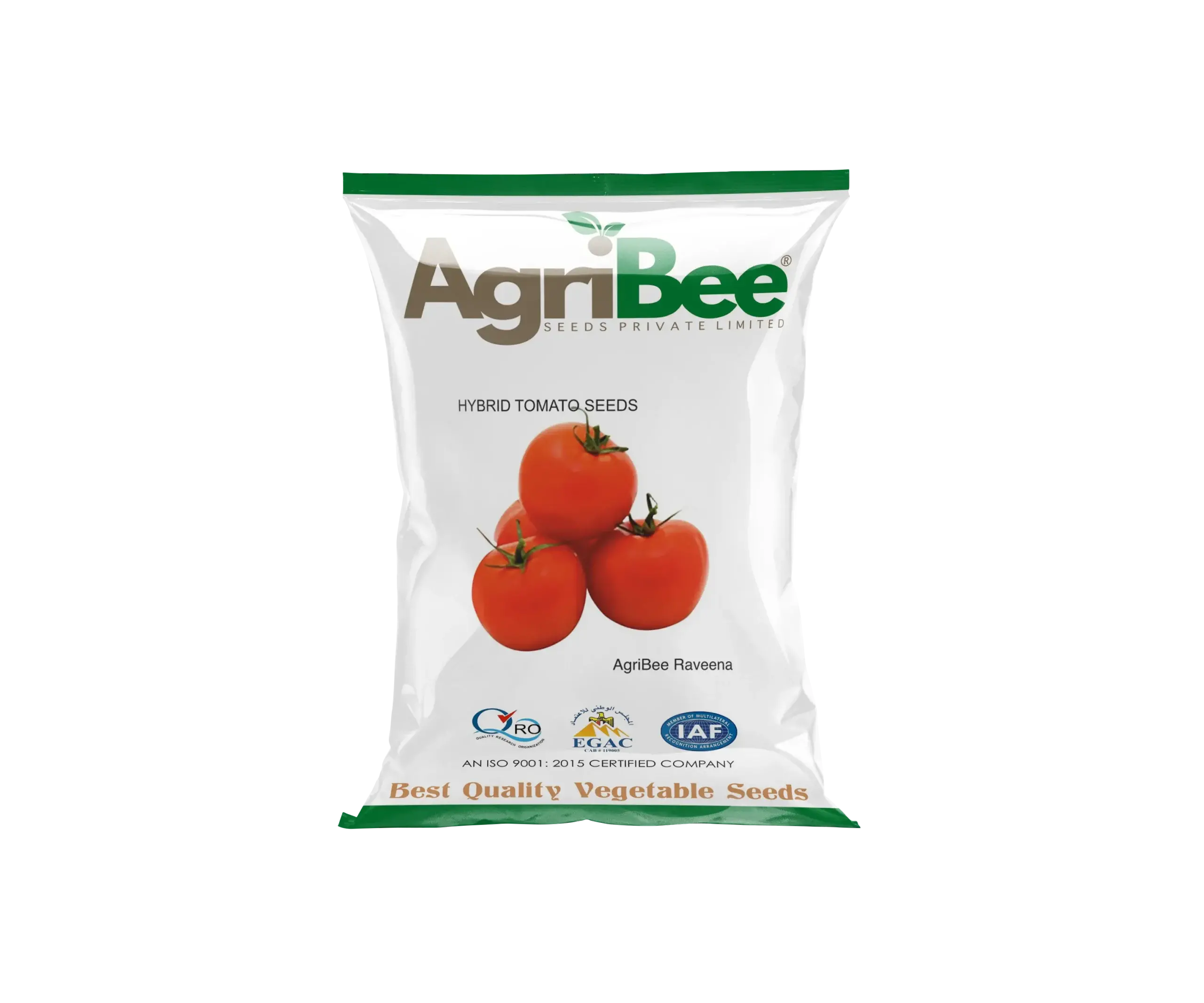
Farming & Cultivation Guide — Tomato Seeds AgriBee Raveena
Complete step-by-step agronomic guide for optimal crop management, disease resistance, and premium produce quality.
🌾 Soil Preparation & Field Prep
Proper land preparation ensures uniform seedling emergence and robust root anchorage.
🌱 Ideal Soil Type & pH
Well-drained loamy to sandy-loam soils with good organic matter content. pH range: 6.0–6.8. Avoid waterlogged or heavy clay soils.
✨ Core Advantage
Light, well-aerated seedbed promotes rapid germination and strong primary root anchorage, essential for supporting vigorous vine growth under Indian field conditions.
- 1
Deep summer ploughing followed by 2–3 cross-harrowings to obtain fine tilth and eliminate soil-borne pathogens.
- 2
Field leveling and formation of raised beds or furrows to ensure efficient drainage, especially during monsoon or erratic rainfall.
- 3
Incorporation of 8–10 tonnes/acre of well-decomposed Farm Yard Manure (FYM) or compost prior to final ploughing to enhance soil structure and microbial activity.
- 4
Soil health conditioning with gypsum (sodic soils) or elemental sulfur (high pH) to maintain optimal nutrient availability.
🌱 Sowing Time & Method
Precise seed rate and spacing maximize light interception and canopy development.
| Parameter | Recommendation | Agronomic Importance |
|---|---|---|
| Sowing Window | Oct–Nov (Rabi) and Feb–Mar (Summer) for open field; protected cultivation possible year-round | Avoids peak monsoon humidity, reducing fungal and viral disease pressure while maximizing fruit set and color development. |
| Seed Rate | 45–50 g per acre for transplanting method | Ensures uniform plant population without overcrowding, supporting healthy canopy architecture and airflow. |
| Spacing | 60 cm (row-to-row) × 45 cm (plant-to-plant) | Provides adequate space for vegetative spread, mechanized operations, and worker access during picking. |
| Sowing / Transplanting Depth | 0.5–1.0 cm depth in nursery trays; transplant seedlings at 25–30 DAS with 3–4 true leaves | Optimal depth ensures uniform emergence; robust seedlings establish faster in the main field. |
💧 Irrigation & Water Management
Adequate moisture regulation supports strong vegetative and reproductive growth.
☀️ Water Requirement Profile
Tomato is moderately sensitive to drought, particularly during flowering and fruit development. Drip irrigation is highly recommended for uniform moisture supply and nutrient efficiency. Maintain soil moisture at 70–80% field capacity throughout the crop cycle.
🌦️ Soil Moisture Management
In rainfed scenarios, ensure pre-sowing irrigation and provide protective mulching to conserve soil moisture. Avoid water stress during critical stages to prevent blossom-end rot and fruit cracking.
- ✓
First irrigation at 2–3 days after transplanting to promote root establishment.
- ✓
Light but frequent irrigation during vegetative phase; avoid waterlogging.
- ✓
Critical irrigation at first flower initiation, fruit set, and fruit bulking stages to support cell expansion and quality.
- ✓
Withhold irrigation 5–7 days before final harvest to improve fruit firmness and shelf life.
🧪 Fertilizer & Nutrition Management
Balanced crop nutrition supports robust plant structure and premium produce quality.
| Nutrient | Recommended Dose (per Acre) | Application Method & Timing |
|---|---|---|
| Nitrogen (N) | 120 kg/acre | 50% basal + 50% top-dressed in two equal splits at 30 and 45 DAT |
| Phosphorus (P2O5) | 60 kg/acre | 100% basal application as DAP or single super phosphate during final land preparation |
| Potash (K2O) | 40 kg/acre | 50% basal + 50% at flowering stage to enhance fruit size, color, and firmness |
🌿 Interculture & Weed Management
Timely weed control ensures optimal nutrient and moisture availability for crop seedlings.
-
1
First Weeding & Hoeing: At 15 DAT, shallow hoeing removes early weed flush without damaging shallow roots. Maintains weed-free environment during critical crop establishment window.
-
2
Second Weeding & Earthing-Up: At 30 DAT, second weeding combined with earthing-up around stem base provides mechanical support and improves aeration for adventitious root formation.
-
3
Staking and Sucker Removal: Install trellis or stake immediately after transplanting. Remove lateral suckers weekly to direct assimilates toward fruit production and improve canopy airflow.
🛡️ Pest & Disease Management
Proactive crop monitoring and integrated management ensure healthy crop development.
🐛 Insect Pest Management
- Fruit and Shoot Borer: Larvae bore into fruits and tender shoots causing wilting and fruit rot. Control: Install pheromone traps @ 10/acre. Spray Emamectin benzoate 5% SG @ 0.3 g/L or Chlorantraniliprole 18.4% SC @ 0.3 ml/L at 7-day intervals during peak flowering.
- Whitefly: Sucks sap, excretes honeydew, and vectors Tomato Leaf Curl Virus (ToLCV). Control: Yellow sticky traps @ 10/acre. Spray Imidacloprid 17.8% SL @ 0.3 ml/L or Neem oil 3% EC @ 5 ml/L every 10 days. Remove infected plants immediately.
- Thrips: Scrapes leaf surface causing silvery patches and distorted growth. Control: Blue sticky traps. Spray Thiacloprid 21.7% SC @ 0.3 ml/L or Spinosad 45% SC @ 0.2 ml/L at early infestation stages.
🔬 Disease Control
- Early Blight: Concentric ring spots on lower leaves leading to defoliation. Causal organism: Alternaria solani. Preventive spray: Mancozeb 75% WP @ 2.5 g/L or Chlorothalonil 75% WP @ 2.0 g/L at 10-day intervals starting from 30 DAT.
- Late Blight: Water-soaked lesions on leaves and brown rot on fruits, favored by cool, humid weather. Causal organism: Phytophthora infestans. Control: Ridomil Gold MZ 68% WP @ 2.5 g/L or Metalaxyl + Mancozeb @ 2.0 g/L every 12 days during high humidity periods.
- Powdery Mildew: White powdery growth on leaf surfaces reducing photosynthetic efficiency. Causal organism: Oidium lycopersici. Management: Spray Sulphur wettable powder 80% WP @ 3.0 g/L or Myclobutanil 10% WP @ 0.5 g/L at first sighting.
✂️ Harvesting & Produce Quality Guide
Harvesting at peak maturity ensures maximum commercial grade and long keeping quality.
⏱️ Harvesting Schedule & Timing
Begin first picking at 65–70 days after transplanting when fruits attain full size and deep red color. Subsequent pickings at 4–5 day intervals over 4–6 weeks.
⭐ Produce Quality Characteristics
Fruits exhibit uniform flat-round to oval shape, smooth skin, firm texture, deep red coloration, and balanced sugar-acid ratio. Excellent internal cavity structure minimizes green shoulder and hollow heart defects.
| Quality Parameter | Agronomic Standard | Farmer & Market Benefit |
|---|---|---|
| First Harvest Stage | 65–70 Days After Transplanting (DAT) | Early market arrival fetches better price realization and allows flexible cropping sequence. |
| Harvest Maturity Signs | Full color break to deep red, firm but ripe flesh, glossy skin surface | Ensures peak eating quality, reduces post-harvest spoilage, and meets trader specifications. |
| Shelf Life & Keeping Quality | 5–7 days at ambient temperature; up to 10–12 days under cool storage (12–15°C) | Sturdy pericarp and thick fruit walls support long-distance transportation with minimal bruising. |
| Market Suitability | Fresh table trade, wholesale mandis, and processing units | Consistent fruit size (80–100 g) and vibrant color attract premium rates from retailers and exporters. |
⭐ Varietal Features — Tomato Seeds AgriBee Raveena
Distinguishing characteristics that make this variety a top choice for Indian growers.
🌿 Core Variety Highlight
AgriBee Raveena is specifically bred for high tolerance to Tomato Leaf Curl Virus (ToLCV), a dominant constraint in Indian tomato cultivation, ensuring reliable stand establishment and sustained vine performance.
🌿 Produce Quality & Appearance
Produces uniformly flat-round to oval fruits with intense deep red color, smooth skin, and firm flesh. Average fruit weight of 80–100 g meets standard commercial grading criteria.
🌿 Stress & Disease Tolerance
Demonstrates robust field tolerance to ToLCV under high pest pressure, while maintaining foliage health and continued fruit set even under moderate viral challenge.
🌿 Growth Habit & Vigor
Indeterminate, semi-upright vine architecture with strong secondary branching. Efficient canopy distribution optimizes light interception and facilitates easy staking and sucker management.
🌿 Crop Duration & Earliness
Medium duration variety reaching first harvest in 65–70 days after transplanting, allowing flexibility in crop scheduling and integration within diverse rotational systems.
🌿 Market & Farmer Preference
Trusted by growers for consistent fruit set, attractive appearance, and superior field performance under Indian agro-climatic conditions, resulting in steady returns through improved marketability.